Top Digital Transformation Trends Businesses Should Watch
Explore the digital transformation trends reshaping industries, from AI and automation to cloud infrastructure and autonomous operations.

In 2019, a mid-size apparel retailer ran its inventory on spreadsheets and whiteboards. Stockouts were weekly. Reordering was manual. By 2024, that same retailer operated on a unified cloud platform with AI-assisted demand forecasting and real-time inventory visibility across twelve locations. No single project produced that outcome. It was a sustained, compounding shift in how the business was built to run.
Digital transformation is what happens when a business systematically replaces manual and legacy processes with digital systems that operate faster, scale without proportional cost increases, and generate data that is actually usable. Global spending on digital transformation is projected to reach nearly $4 trillion by 2027, at a CAGR of 16.2% (IDC, 2024). Spanning healthcare, retail, automotive, insurance, and aerospace, let's map the digital transformation trends shaping decisions right now, and what they actually require from business leaders in 2026.
How Digital Transformation Has Shifted From 2020 to Today
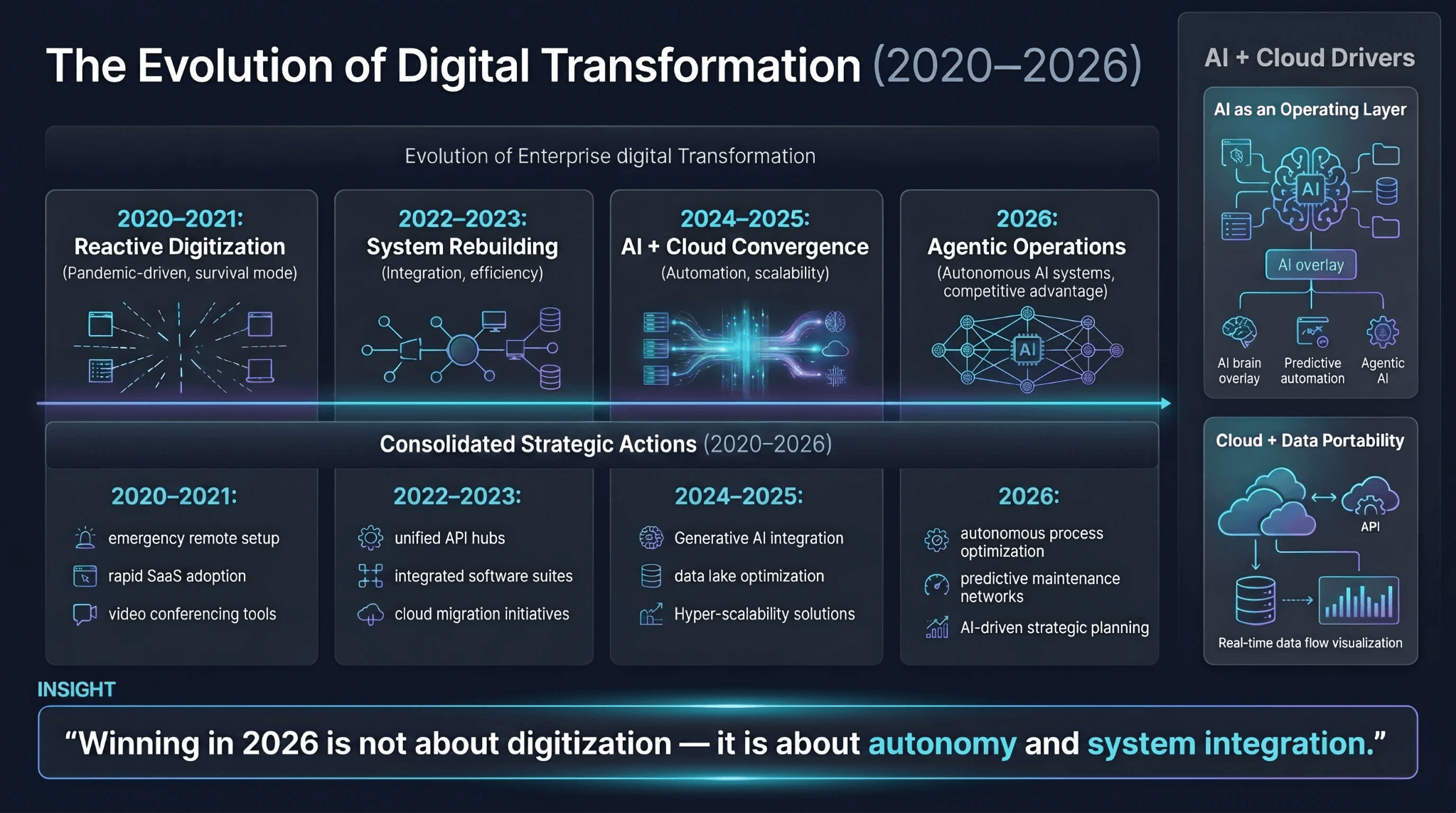
Between 2020 and 2021, digital transformation was almost entirely reactive. The digital transformation trends 2021 organizations focused on were driven by necessity, not strategy. According to McKinsey's 2020 Global Survey, companies accelerated digitization of their customer and supply chain interactions by an average of three to four years during the pandemic. The speed was real. The deliberateness was not.
By 2023 and 2024, long-term architecture planning replaced implementation sprints. The lens through which digital transformation consulting trends 2023-2024 are best understood is this: firms stopped asking whether to go digital and started asking whether their infrastructure was actually built to perform.
|
Era |
Primary Driver |
Focus Area |
Outcome Goal |
|
2020–2021 |
Pandemic response |
Operational continuity |
Survival |
|
2022–2023 |
Strategic rebuild |
Integration and data |
Efficiency |
|
2024–2025 |
AI and data integration |
Intelligent automation |
Scalability |
|
2026 |
Agentic operations |
Autonomous workflows |
Competitive advantage |
The 2026 wave, defined by agentic AI and unified data architecture, requires the technical debt from that reactive period to be resolved before it can be leveraged.
The Core Technology Trends Driving Transformation Right Now
Two foundational forces sit underneath every industry-specific shift on this list: AI moving from a feature into an operational layer, and cloud infrastructure maturing from migration into true data portability.
AI and Automation as the New Operating Layer
Among the trends in digital transformation gaining the most ground in 2026, the shift from AI as a standalone tool to AI as an embedded operational layer stands out above everything else. The defining development is agentic AI, autonomous systems that plan and execute sequences of actions toward a goal. According to Gartner, 40% of enterprise applications will be integrated with task-specific AI agents by the end of 2026, up from less than 5% in 2025. Where AI is actively reshaping operations:
-
Agentic workflows: Autonomous systems executing multi-step processes end-to-end
-
Predictive analytics: Replacing manual demand, revenue, and risk forecasting
-
Automated document processing: In legal, finance, and compliance workflows
-
Intelligent customer routing: Resolving support interactions without agent involvement
-
AI-assisted maintenance scheduling: Driven by real-time sensor and telematics data
IBM's Global AI Adoption Index 2023 found that 42% of enterprise-scale organizations had actively deployed AI, with 59% accelerating their investments. By 2026, Deloitte's State of AI in the Enterprise report notes that AI tools are now available to approximately 60% of surveyed organizations. The gap separating high performers is not access to AI; it is whether those tools have a reliable, unified data environment to operate within.
Cloud Infrastructure and Data Portability
Cloud migration was the entry point. What businesses are working through now is making data portable, consistently structured, and accessible across departments. The failure mode of the first cloud wave was fragmentation, with finance, operations, and sales each on separate systems producing data that could not be aggregated. What mature cloud strategies look like in 2026:
-
Multi-cloud environments: AWS, Azure, and Google Cloud are used in parallel
-
Real-time data pipelines: Replacing batch processing and reporting delays
-
API-first architecture: Enabling new tools without rebuilding the stack
-
Zero-trust security models: Replacing perimeter-based network security
The infrastructure decisions businesses make now will determine how effectively they can act on the next wave of digital transformation trends.
Industry-Specific Transformation: Healthcare and Insurance
Healthcare and insurance share a common structural challenge: both are document-heavy, compliance-constrained industries where the cost of getting transformation wrong is high.
Healthcare Digital Transformation
The healthcare digital transformation trends that matter most in 2026 are structural, EHR interoperability between providers, payers, and pharmacy systems; telehealth becoming a permanent infrastructure; AI-assisted diagnostic imaging; automated prior authorization; and remote patient monitoring via wearable data. The global digital health market is projected to reach USD $946.04 billion by 2030, at a CAGR of 22.2% (Grand View Research, April 2025). The trends shaping digital transformation in PBMs 2025 and into 2026 center on automating claims adjudication, real-time formulary transparency, and live eligibility verification.
Insurance Digital Transformation
The insurance digital transformation trends gaining traction in 2026 are concentrated in underwriting automation, claims speed, and self-service infrastructure. Insurtechs with digital-native stacks process claims faster, underwrite more accurately, and deliver experiences that incumbent carriers struggle to match. The broader digital transformation trends reshaping insurance are not optional; they are the difference between competing at market speed and falling behind it.
Retail and Automotive: Two Industries Rewriting Their Operations
Both industries are navigating the same underlying challenge: integrating physical and digital operations into a single coherent system.
Digital Transformation Trends in Retail
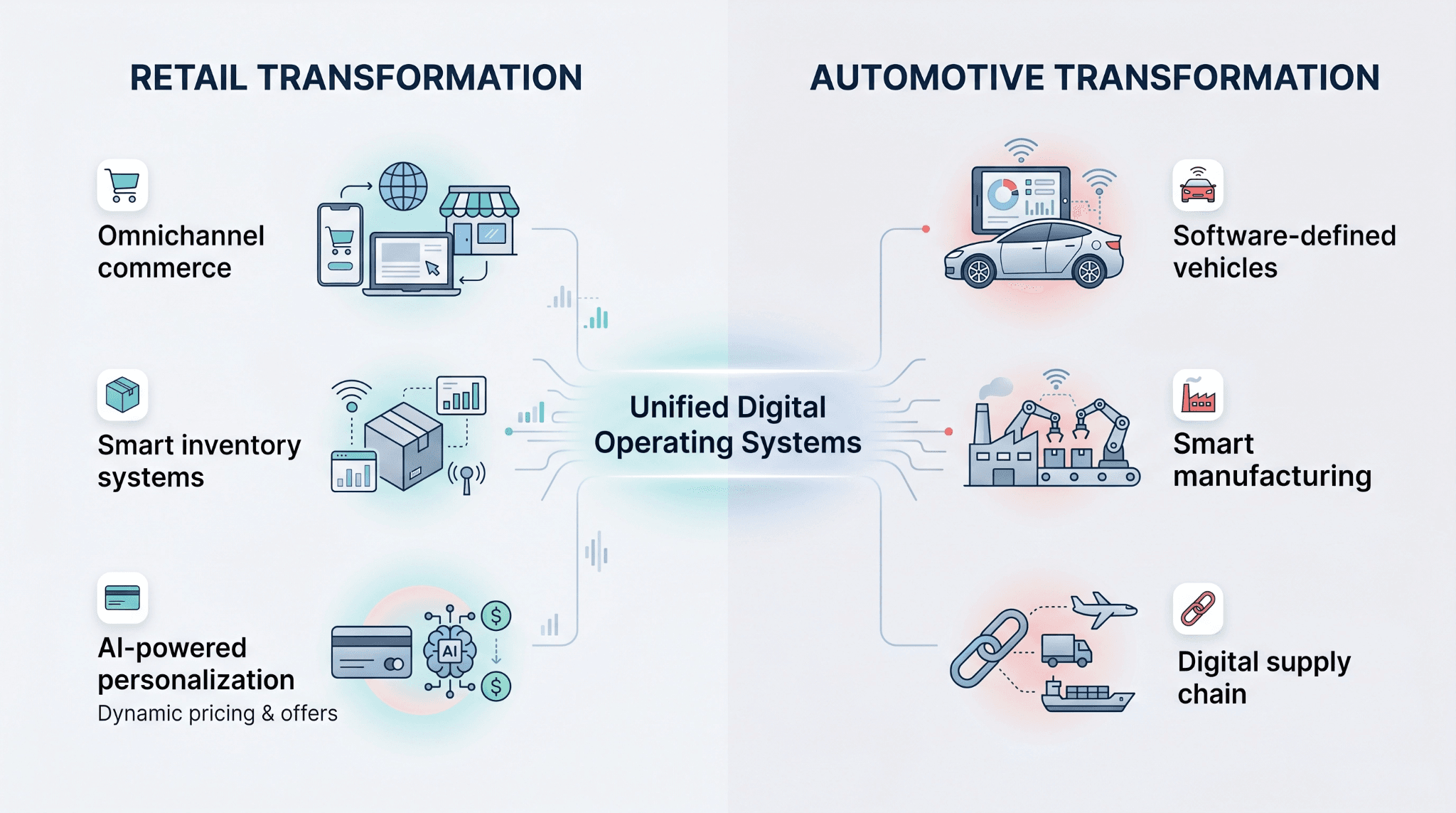
The digital transformation trends in retail are not about adding more channels; they are about connecting existing ones into a system where inventory, pricing, and fulfillment operate from a single source of truth. McKinsey research shows personalization drives a 10 to 15 percent revenue lift on average, and the retailers capturing that lift are doing it with better data infrastructure, not better marketing alone.
Digital Transformation in the Automotive Industry
The digital transformation trends in the automotive industry operate on two tracks: inside the vehicle, and inside the business. Software-defined architecture is replacing hardware-defined design cycles. Inside the business, dealer management systems are being overhauled, digital retail platforms are enabling fully online purchase journeys, and supply chain tools are addressing the fragility exposed by the 2021 to 2022 semiconductor shortage. The automotive sector is also applying digital twin technology borrowed from aerospace to compress development cycles significantly.
Aerospace: The Sector Where Digital Transformation Is Most Precise
No industry operates under tighter constraints than aerospace, which is exactly why the international aerospace digital transformation trends and leading practices from the sector offer lessons for every other industry. Digital twin technology, Model-Based Systems Engineering, predictive maintenance, blockchain-backed parts traceability, and AI-assisted scheduling were all refined here first.
The global digital twin market is projected to grow from $21.14 billion in 2025 to $149.81 billion by 2030, at a CAGR of 47.9% (MarketsandMarkets, 2025). These practices do not stay in aerospace; they migrate.
Digital transformation consulting trends 2023–2024 increasingly pointed to aerospace frameworks as the model for compliance-bound, high-stakes transformation, and that reference point is more relevant in 2026 than ever. As regulatory pressures intensify, aerospace's precision-first approach is fast becoming the benchmark other industries adopt when navigating complex, high-stakes digital change.
-
Digital twins reduce unplanned downtime and accelerate design iteration
-
MBSE aligns teams from requirements through validation on a single source of truth
-
Blockchain traceability eliminates counterfeit risk across multi-tier supply chains
-
Predictive maintenance shifts organizations from reactive repairs to condition-based strategies

What Businesses Get Wrong When Pursuing Digital Transformation
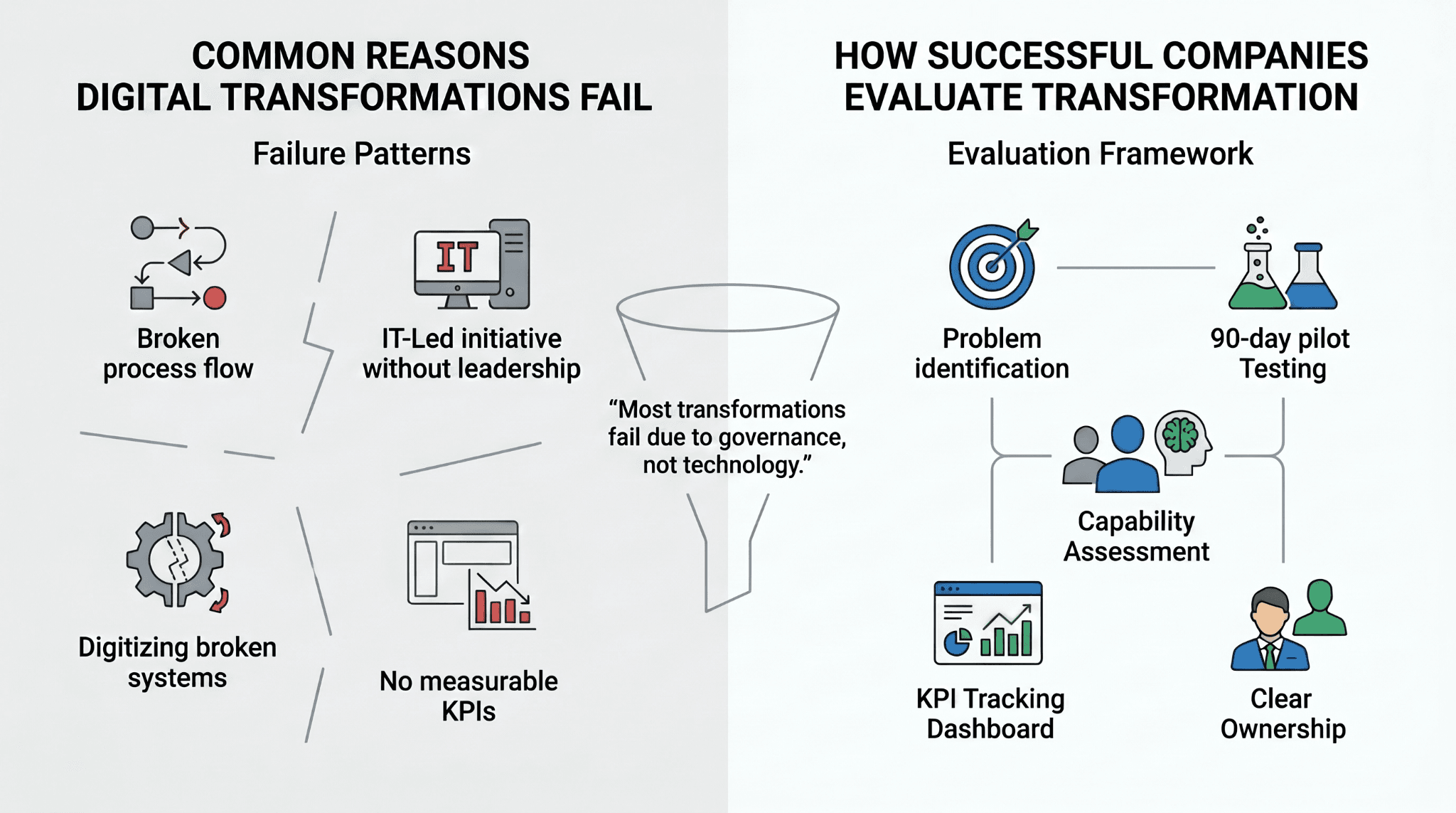
Most failed transformations do not fail because of bad technology. Research from Boston Consulting Group consistently finds that up to 70% of digital transformations fail to meet their stated objectives. It is governance, change management, and process clarity. The most common failure patterns:
-
Purchasing tools before mapping the processes they are meant to fix
-
Running transformation as an IT initiative without executive ownership
-
Digitizing broken processes instead of redesigning them first
-
Setting no measurable outcomes before deployment
By 2026, the most effective operators treat transformation as a permanent discipline, not a project with a completion date.
How to Read and Respond to Transformation Trends as a Business
Knowing what the trends in digital transformation are is only useful with a framework for evaluating which ones apply. A practical evaluation filter:
-
Does this trend address a problem we currently have or can see approaching?
-
Is the technology mature enough to be implemented reliably in production?
-
Do we have internal capability, or do we need an external operator?
-
What does a 90-day pilot look like, and what does it cost?
-
Who owns this internally if we move forward?
McKinsey's research found that only 16% of organizations reported that their transformations successfully improved performance and sustained changes long-term. The gap between launching and sustaining is almost always a governance problem, not a technology one. The sectors that are ahead picked the digital transformation trends that matched their constraints, ran controlled pilots, and scaled what worked.
What Business Leaders Are Asking About Digital Transformation
Digital transformation raises the same core questions across every industry and company size. Here are the ones we hear most often, and what the answers actually look like in practice.
What are the most important digital transformation trends for businesses in 2024 and 2025?
The most consequential shifts were the move from reactive cloud adoption to deliberate data architecture and the emergence of AI as an embedded operational layer. Businesses that used those years to unify their data environments are now positioned to deploy agentic AI at scale in 2026. Those that did not are playing catch-up, and the gap is widening.
How is digital transformation different across healthcare, retail, and automotive industries?
The destination is the same, a connected, data-driven operation, but the constraints differ. Healthcare navigates interoperability mandates. Retail is closing the gap between digital and physical experiences. Automotive is transforming both the product and the business simultaneously. What does not change across any of them is that the businesses moving fastest treated transformation as an architectural problem, not a software procurement decision.
What does digital transformation actually look like for a small or mid-size business?
It looks like replacing one manual process with a system that runs faster and generates usable data. A mid-size logistics company might start with automated dispatch and real-time fleet visibility. A scaling SaaS business might begin with a unified CRM and revenue attribution system. It is not a company-wide overhaul; it is one workflow redesigned, measured, and scaled.
Why do most digital transformation initiatives fail, and how can businesses avoid them?
According to Boston Consulting Group, up to 70% of transformations fail, and the cause is almost never the technology. It is the absence of clear process ownership, measurable outcomes defined before deployment, and organizational readiness to adopt what gets built. The fix: audit the process before selecting the tool, define success before anything goes live, and assign a named owner to every transformed workflow.
What role does AI play in current digital transformation trends?
AI is no longer something businesses add; it is already inside the platforms they use every day. In 2026, its role is operational: agentic systems executing workflows, predictive models replacing manual forecasting, intelligent routing handling customer interactions end to end. But AI only performs at that level when it has clean, unified data to work with, which is the part most businesses underestimate and underinvest in.
What to Do With This Information Now
Transformation does not start at the industry level; it starts with one process in one department, mapped carefully, and redesigned with a specific outcome in mind. Audit your current technology stack before purchasing anything new. Identify where your data breaks down and where a competitor on a more connected system has a structural advantage. Start there.
The businesses that make the most of this moment treat transformation as an operating discipline, not a one-time project. The only variable is where you are willing to begin.