How to Reduce Cost Per Lead in Paid Advertising Campaigns
A high cost per lead isn't a budget problem; it's a system problem. Learn how targeting, landing pages, bidding, and automation work together to lower CPL and improve lead quality.

Last month, a law firm running Google Ads was paying $180 per lead. Their competitor in the same city was paying $62. Same keywords. Same platform. Different strategy.
Cost per lead is not a fixed number; it is the result of decisions made across targeting, creative, landing pages, and bidding. CPL equals total ad spend divided by total leads generated. If you are trying to figure out how to reduce cost per lead without slashing your ad budget, the answer is rarely in the budget itself. It is in the system around it. This article covers the core levers that actually move CPL across platforms, industries, and campaign types.
What Is Actually Driving Your High Cost Per Lead
Before fixing anything, the root cause needs to be identified. Most advertisers treat high CPL as a bidding problem. It is usually a targeting or conversion problem dressed up as a bidding problem.
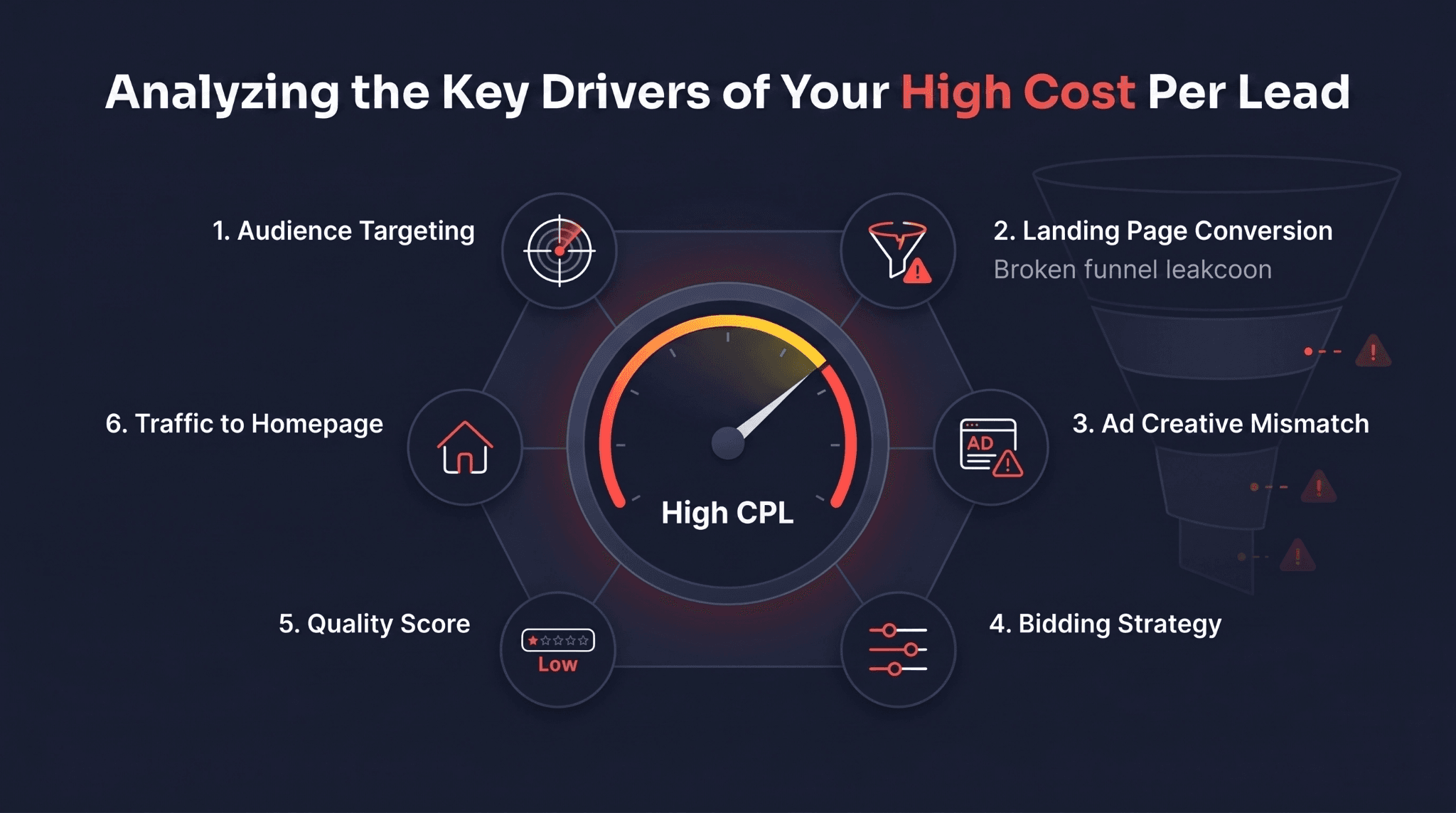
The six core CPL drivers in 2026 are worth diagnosing in order before touching any campaign settings:
-
Poor audience targeting, too broad, too cold, or misaligned with purchase intent
-
Weak landing page conversion rate, traffic arriving but not converting
-
Irrelevant ad copy attracting clicks from users who were never going to convert
-
Bidding strategy misalignment with campaign goals and conversion volume
-
Low Quality Score on Google or low Relevance Score on Meta, both inflate CPL
-
Sending paid traffic to a homepage instead of a dedicated landing page
WordStream's cross-industry analysis found the average landing page conversion rate sits at 2.35%, while the top 25% of advertisers convert at 5.31% or higher. That gap is not a budget gap; it is an optimization gap. Most cost-per-lead strategies focus on the bid, but the real waste sits in the targeting and landing page layer. The goal is not to spend less. It is to waste less.
Audience Targeting Fixes That Cut Waste Immediately
Bad targeting is the fastest way to burn budget. Tightening audience definition across Google, Meta, and LinkedIn directly lowers CPL without touching the bid.
How to Layer Audiences on Google Search
Most advertisers treat Google Search as a keyword-only environment. Keywords control which queries trigger the ad. Audiences control which users, out of all those querying, see the ad and at what bid adjustment. Layering audience signals on top of keyword targeting is one of the highest-leverage CPL moves available in 2026.
The following audience layers produce the most consistent CPL improvement on Google Search:
-
Customer Match: upload existing client lists to exclude them from prospecting and focus the budget on new leads
-
In-Market audiences: increase bids on users whose browsing behavior signals active purchase intent in your category
-
Demographic exclusions: filter out age bands and income brackets that consistently underperform in your account data
This is exactly how universities reduce cost-per-lead in paid search, not by increasing spend on branded keywords, but by layering college planning in-market audiences over those keywords so budget concentrates on users actively in the decision process.
Meta Audience Signals and the CPL Problem
Meta's targeting environment shifted significantly from 2024 into 2026. Narrow interest stacks frequently underperform broad targeting now because Meta's algorithm finds the right audience from creative signals rather than manual interest selection. When brands ask how to reduce cost per lead on Facebook, the answer in 2026 starts with creative, not targeting settings. The ad does the filtering; it repels bad fits and attracts good ones.
The following three adjustments address the most common sources of wasted Meta spend in 2026; each one targets a different layer of the audience problem without restricting overall reach:
-
Use Advantage+ audience settings for top-of-funnel lead gen rather than manually stacked interest layers
-
Exclude past converters and irrelevant demographic bands to prevent wasted impressions
-
Test Lookalike Audiences at 1 to 3% against broad targeting with identical creative to find where efficiency sits
Landing Page Changes That Drop CPL Without More Spend
Clicks are not leads. If a landing page converts at 2% instead of 6%, the CPL is three times higher with zero change to ad spend. The landing page is where most CPL reduction opportunities sit.
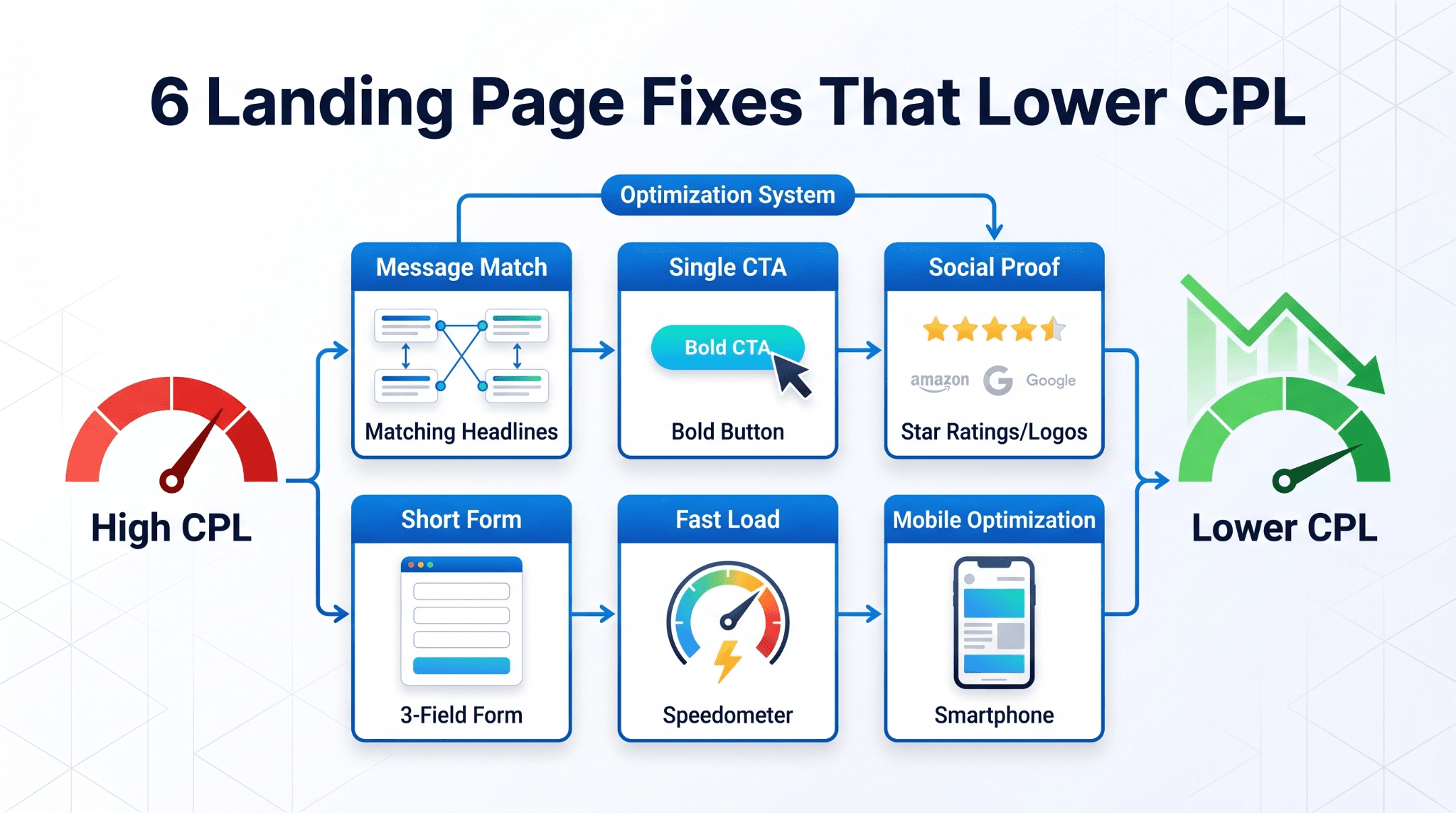
These are not design preferences; they are conversion architecture decisions, each one with a measurable and documented impact on the percentage of visitors who become leads:
-
Message match between ad headline and landing page headline, mismatched messages cause immediate exits
-
Single clear CTA with no competing navigation links or secondary offers
-
Social proof above the fold, case studies, logos, and ratings reduce perceived risk before the user scrolls
-
Form length, every additional field reduces completions measurably; three fields or fewer is the consistent high-performance benchmark
-
Page load speed, according to WIRO's 2026 analysis, a 3-second page load delay can result in up to a 20% reduction in conversions, with 53% of mobile users abandoning a page that takes longer than 3 seconds to load
Use the table below as a structured pre-launch checklist before sending any paid traffic to a page. Each element has a defined benchmark and a priority level so fixes can be sequenced by impact rather than convenience:
|
Element |
Benchmark |
Priority |
|
Message match (ad to page) |
Must match exactly |
Critical |
|
Single CTA |
One action per page |
Critical |
|
Social proof above the fold |
At least one trust signal |
High |
|
Form field count |
3 fields or fewer |
High |
|
Page load speed |
Under 3 seconds |
High |
|
Mobile optimization |
Mobile-first layout |
High |
|
Navigation links |
Remove all |
Medium |
A higher-converting page also feeds back into Quality Score on Google, lowering cost-per-click independently of bid changes, a compounding benefit. Landing page optimization pairs directly with reduce cost per lead marketing automation strategies: once the page converts efficiently, automation handles the follow-up without additional spend.
Bidding Strategies That Work in 2026
Smart bidding has matured; when used with sufficient conversion data, it consistently outperforms manual bidding on CPL. The critical variable is data volume, not strategy preference.
The table below maps each bidding strategy to the account conditions where it actually performs — choosing a strategy without meeting the minimum data requirements is one of the most common reasons smart bidding underdelivers:
|
Strategy |
Best For |
Min Conversions |
CPL Control |
|
Manual CPC |
New accounts, test campaigns |
None required |
Full |
|
Enhanced CPC |
Transitioning from manual |
15 to 20 per month |
Partial |
|
Maximize Conversions |
Volume over cost |
20 per month |
Limited |
|
Target CPA |
Lead gen with defined CPL target |
30 to 50 per month |
High |
|
Target ROAS |
Variable-value conversions |
50 per month |
Revenue-focused |
Before switching to Target CPA, three conditions need to be in place:
-
At least 30 to 50 conversions in the last 30 days at the campaign level
-
Initial Target CPA set 10 to 20% above current average, setting it too low starves the algorithm
-
A minimum two-week evaluation window before drawing conclusions
Google's own experiments, confirmed by LeadsuiteNow's 2026 bidding analysis, show Enhanced CPC outperforms pure manual CPC by 5 to 15% in conversions at equivalent spend. To reduce cost-per-lead B2B PPC campaign strategies, Target CPA works best paired with tight audience layers. The algorithm will not fix weak targeting, but it will efficiently exploit strong targeting once the data foundation exists.

How Marketing Automation Reduces Cost Per Lead Over Time
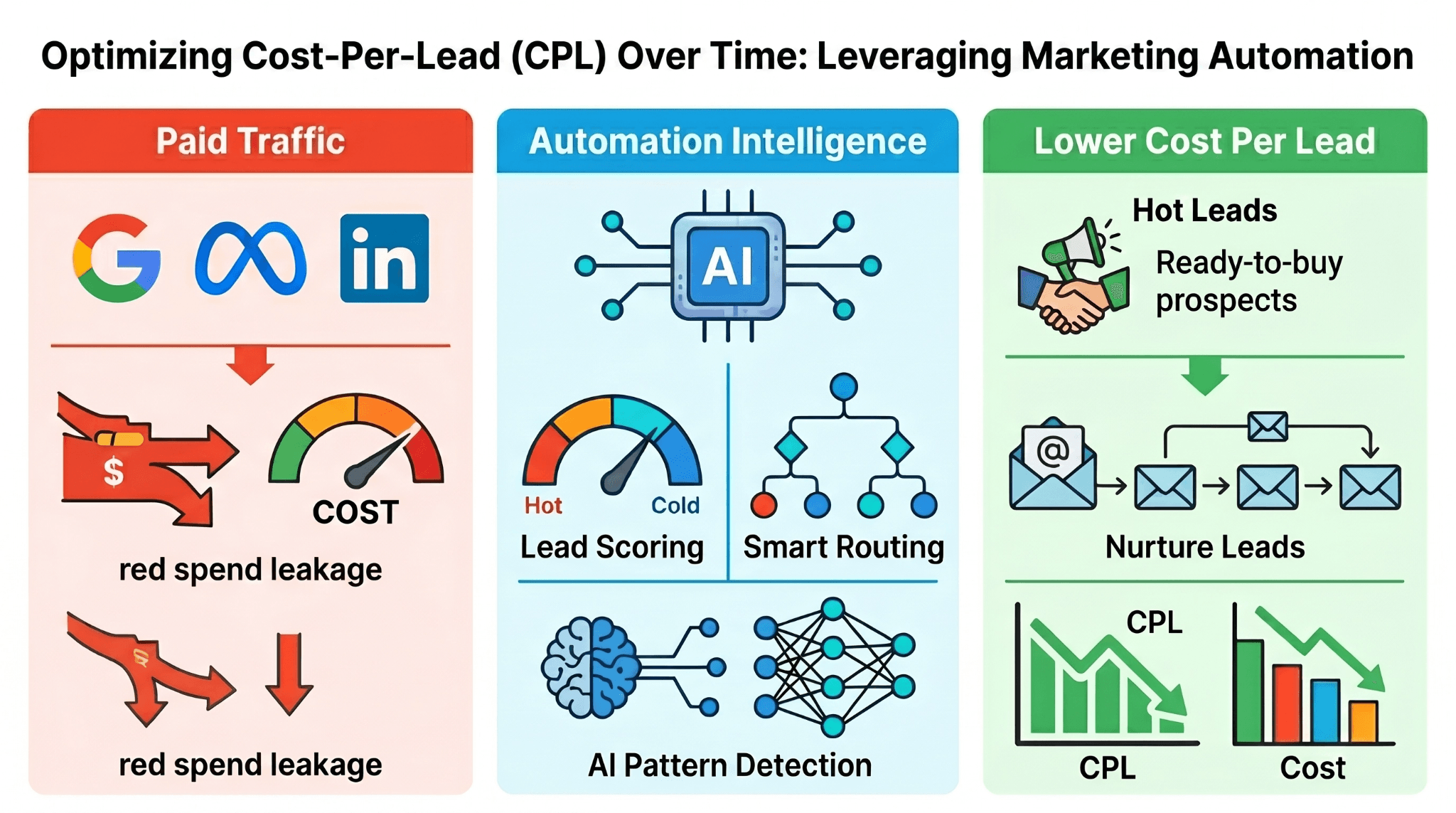
Ad spend gets the click. Automation determines whether that click becomes a lead and whether that lead converts. CPL reduction from automation is structural, not tactical.
Lead Scoring and Routing
When all leads are treated equally, sales teams waste time on cold contacts and miss warm ones. This is the clearest way to understand how to reduce cost per lead with marketing automation: it stops the business from paying to re-market to people who were never going to buy.
Lead scoring only works when the rules reflect actual buying intent signals. The following three actions form the operational backbone of any scoring system worth building:
-
Set rules based on engagement depth, a demo request scores higher than a blog visit; a pricing page view scores higher than an about page
-
Route high-score leads to sales immediately with full engagement context
-
Move low-score leads into email nurture and remove them from paid retargeting to stop spending on unready contacts
Using AI Tools to Find CPL Patterns
Ways to reduce cost per lead using AI are now operationally accessible in 2026 in ways they were not two years ago. Tools like Google's Performance Max, Meta Advantage+, and platforms like Adalysis and Optmyzr surface CPL inefficiencies that would take hours to find manually. Understanding how to reduce cost per lead using software automation starts with identifying where spend leaks; AI surfaces that in minutes.
The following three applications are where AI delivers the most measurable CPL impact in 2026, not by replacing campaign strategy, but by executing faster and catching waste earlier than any manual process can:
-
AI-powered bid adjustments that pause underperforming ad sets before significant waste accumulates
-
Automated reporting identifying which audience segments produce the lowest CPL across campaigns
-
AI creative testing tools running structured A/B tests at scale without manual setup for each variation
Industry-Specific Strategies for Law Firms and Collection Agencies
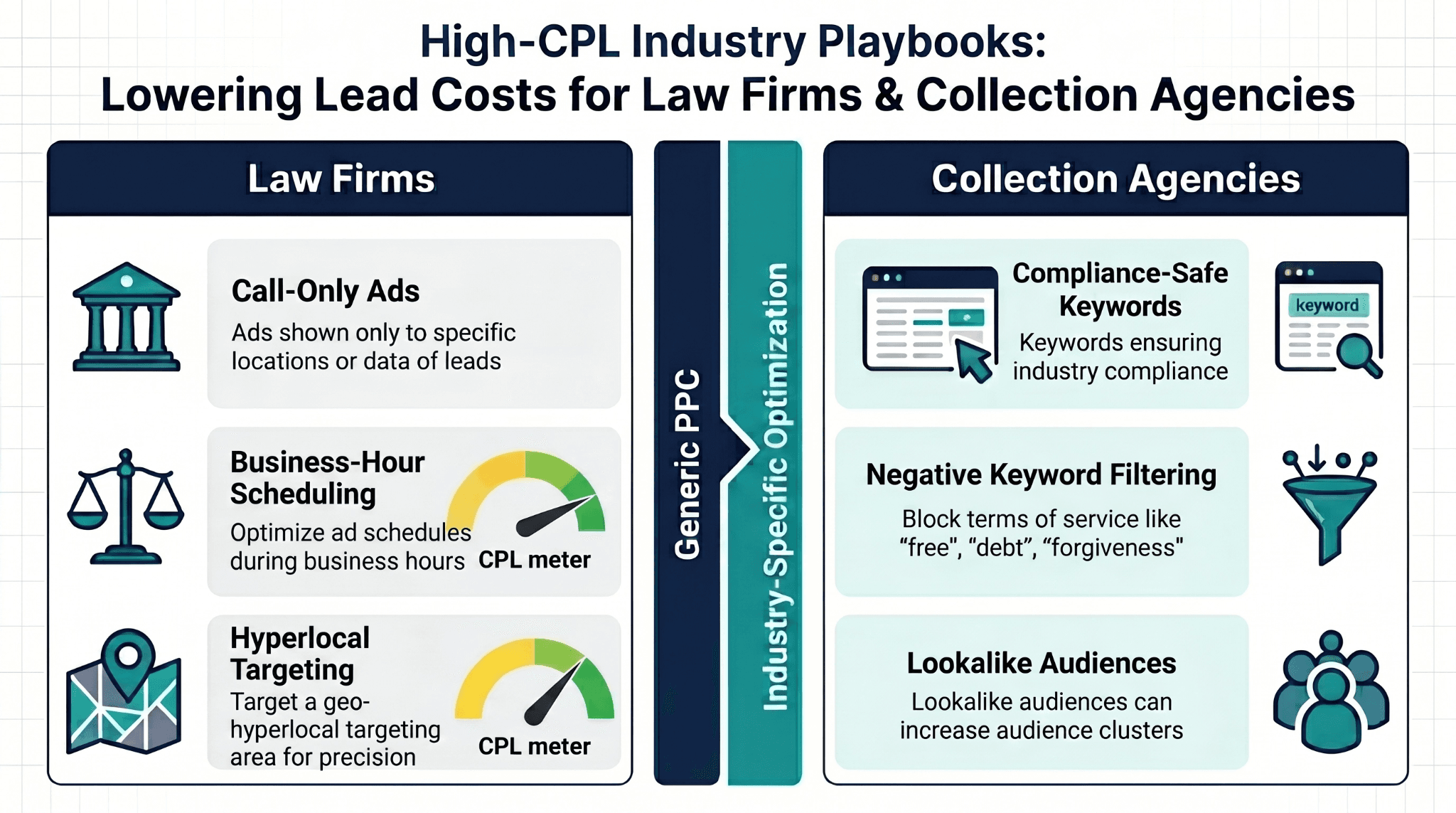
Generic PPC advice does not translate cleanly into high-cost verticals. Reduce cost per lead law firm marketing strategies almost always start with two fixes: tighter geography and call-only ad formats. Legal CPL for personal injury keywords exceeds $200 on average; firms using call-only ads with city-level geo-targeting consistently report CPLs 30 to 40% below that benchmark because phone leads convert at three to five times the rate of form fills.
The following three adjustments address the highest-cost inefficiencies in legal paid search, each one targets a different source of CPL waste that generic PPC guides consistently overlook:
-
Call-only ads for high-intent keywords, phone leads convert at 3 to 5x the rate of form fills
-
Ad scheduling limited to business hours, after-hours clicks in legal rarely convert
-
Geo-targeting at city or zip code level, not statewide, unless the firm genuinely serves that area
To reduce cost per lead for collection agencies, the negative keyword list is where most savings hide. Broad match terms in debt resolution attract significant volume from users seeking free help, none of whom are potential clients.
The three adjustments below address the most consistent sources of unqualified traffic in this vertical, each one filters out a different category of searcher who will never become a paying client:
-
Focus keywords on compliance-safe terms like debt resolution and payment plans
-
Build aggressive negative keyword lists around free, nonprofit, government, and forgiveness
-
Build lookalike audiences from existing client lists on Meta to find users with similar intent signals
The Numbers You Should Actually Be Tracking
CPL does not exist in isolation. Tracking it alongside the wrong metrics leads to cutting campaigns that actually produce the best revenue outcomes.
The table below maps each metric to what it actually measures and why it belongs in the same reporting view as CPL, because optimizing CPL in isolation without these surrounding metrics consistently produces decisions that look right on paper and wrong in revenue:
|
Metric |
What It Measures |
Why It Matters |
|
Cost Per Lead (CPL) |
Spend divided by leads |
Starting point, not the end point |
|
Lead-to-Opportunity Rate |
Leads that become qualified |
High CPL with high lead quality may be correct |
|
Cost Per Opportunity |
CPL divided by lead-to-opportunity rate |
Normalizes CPL for quality differences |
|
Cost Per Acquisition (CPA) |
Spend divided by closed deals |
The only metric that maps to revenue |
|
Quality Score |
Google relevance score 1 to 10 |
Predicts CPC and CPL trajectory |
|
Landing Page Conversion Rate |
Leads divided by visitors |
Isolates whether the problem is pre or post-click |
The businesses achieving the lowest CPL over time are running connected systems where audience targeting feeds landing page relevance, which feeds Quality Score, which feeds bid efficiency, and automation handles the nurture layer that converts paid traffic into closed revenue.
What Paid Advertisers Get Wrong About CPL
These are the highest-volume questions businesses ask when trying to reduce cost per lead, answered directly.
Why is my CPL so high even though my ads are getting clicks?
Clicks and leads are separated by the landing page. If the conversion rate is below 3%, CPL will be high regardless of click efficiency. WellsGroup audits the full paid funnel because the CPL problem is rarely where advertisers are looking.
How quickly can I realistically reduce my CPL?
Landing page and audience fixes typically show results within two to four weeks. Smart bidding needs four to six weeks to stabilize. Automation improvements compound over 60 to 90 days. WellsGroup structures engagements in phases so early wins arrive while longer-term improvements build.
Should I use Target CPA or manual bidding?
Target CPA outperforms manual once a campaign has 30 or more conversions per month. Below that, manual CPC with Enhanced CPC is more reliable. The answer depends on conversion volume, not strategy preference.
Does landing page speed really affect CPL that much?
Yes. Google's research confirms conversion drops approximately 20% per additional second of load time. WellsGroup builds landing pages loading under two seconds on mobile as a baseline requirement.
How do I reduce CPL on Meta without killing reach?
Creative quality is the lever in 2026, not audience restriction. Strong creative that speaks to a specific buyer repels unqualified impressions and attracts qualified ones. WellsGroup tests broad against narrow targeting with identical creative to find where efficiency actually sits.
The Only CPL Question That Actually Matters
Reducing CPL is not a single tactic. It is a stack. Targeting removes waste. Landing pages improve conversion. Bidding automates efficiency. Automation handles follow-through. AI accelerates all of it.
Every business has a different bottleneck, and finding it before spending more is the entire point. For some, it is audience targeting. For others, it is a landing page converting at 2% when it should be at 6%. For others, it is a nurture gap where leads are generated and then abandoned.
Before running another ad, answer three questions: who sees it, what happens when they click, and what happens after they fill the form. Everything else is secondary. The clearest path to reduce cost per lead is not a single fix; it is removing the bottleneck costing you the most first, then working down the list.