How Professional Web Design for Businesses Builds Trust and Drives Real Growth
Learn how professional web design builds trust, improves conversions, strengthens SEO, and turns website visitors into customers.

A potential customer lands on your website. Within three seconds, they've already decided whether you're worth their time, not based on your pricing or your product, but on how your site looks, loads, and feels.
That snap judgment is the trust problem professional web design for businesses solves. According to Northumbria University research, 94% of first impressions are design-related, not content-related. The visitor who bounces isn't rejecting your offer; they're rejecting your presentation before reading a single word.
For small business owners, this isn't a luxury; it's the first handshake. Here's a clear-eyed look at why design signals trust, what professional web design actually includes, and how it translates into measurable business growth.
What "Professional" Actually Means in Web Design (And What It Doesn't)
Most business owners assume professional means expensive or visually complex. Neither is accurate.
Professional web design is intentional, functional, and built around the visitor's experience, not the business owner's preferences. Every decision, layout, typography, load speed, navigation, exists to move a specific visitor toward a specific action.
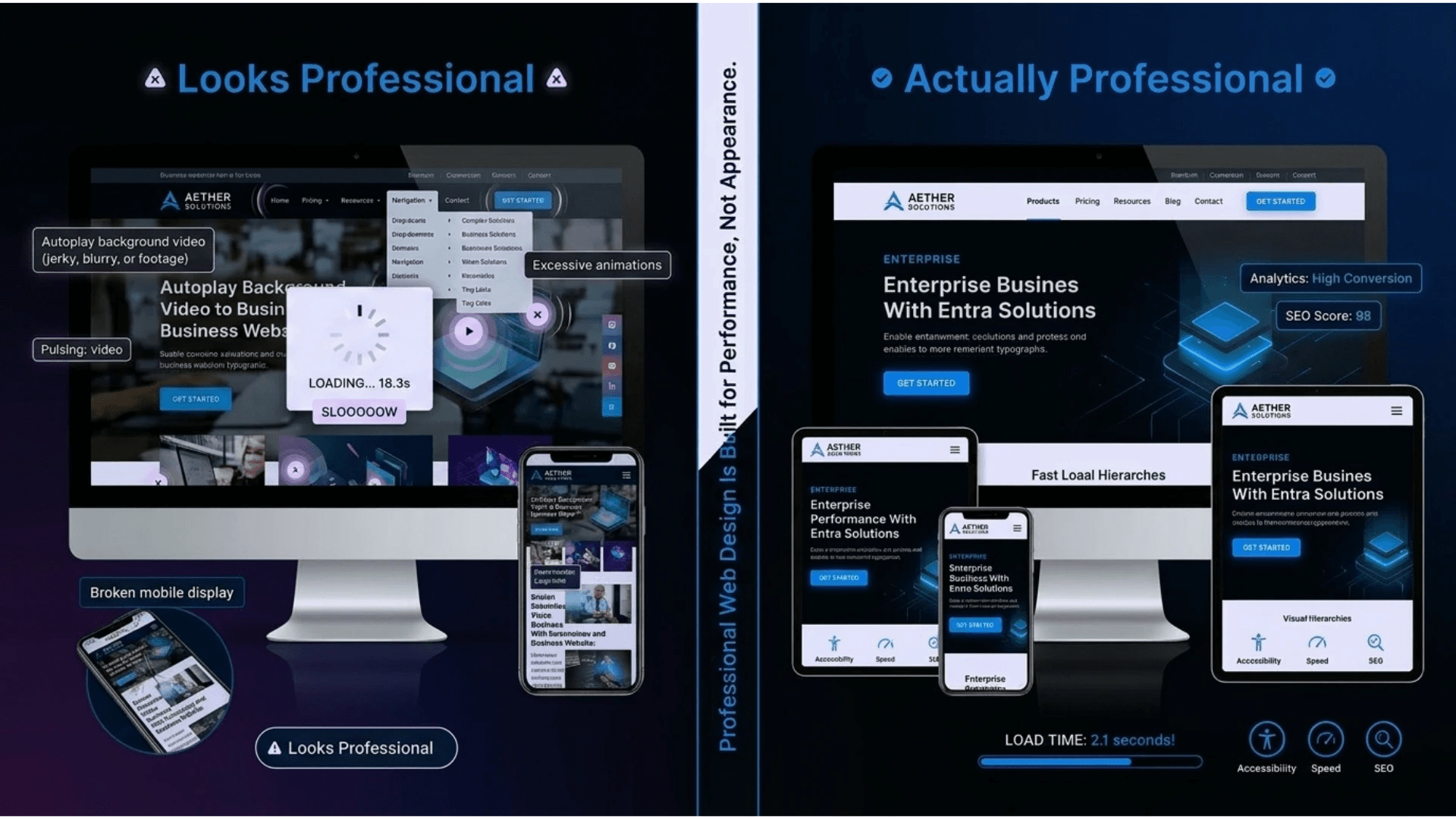
What professional web design is NOT: a polished homepage with autoplay video, a premium template with your logo dropped in, or a site that looks impressive on desktop and collapses on mobile.
Core elements of a truly professional business website:
-
Fast load speed, under 3 seconds; pages taking longer lose 40% of visitors before they load (BrowserStack, 2025)
-
Clear navigation structure that follows patterns visitors already expect
-
Mobile now accounts for over 62% of all global website traffic, according to StatCounter data via DesignRush (2026). Therefore, mobile-first designs are a priority.
-
Accessible typography and contrast meet WCAG standards
-
Consistent visual language across every page, not just the homepage
-
Strategic call-to-action placement tied to the visitor's stage of intent
Professional business web design isn't about looking polished. It's about making the right people feel like they're in the right place, immediately, without effort. A professional custom small business web design is built around specific business goals: who the customer is, what action they need to take, and what friction prevents them from taking it. Generic layouts don't account for any of that.
The Trust Signals Every Business Website Needs
Trust isn't a feeling a visitor decides to have. It's a conclusion they reach based on specific signals, visual, structural, and content-based, that your site either sends or doesn't.
Visual Credibility Markers
Visual design is the first and fastest trust signal. Font choices, color contrast, image quality, and spacing communicate professionalism before the visitor processes a single sentence. According to Google UX Research, users form an opinion about a website's credibility in as little as 50 milliseconds, faster than a conscious thought, and entirely based on what they see.
The visual signals that carry the most weight are the ones visitors process subconsciously, not the ones businesses spend the most time debating internally.
-
Professional logo and consistent brand colors applied across every page
-
High-quality images and blurry stock photos actively damage credibility
-
White space used with intention, not as a placeholder for missing content
-
Consistent header and footer across all pages; inconsistency signals an unfinished site
Content and Social Proof Elements
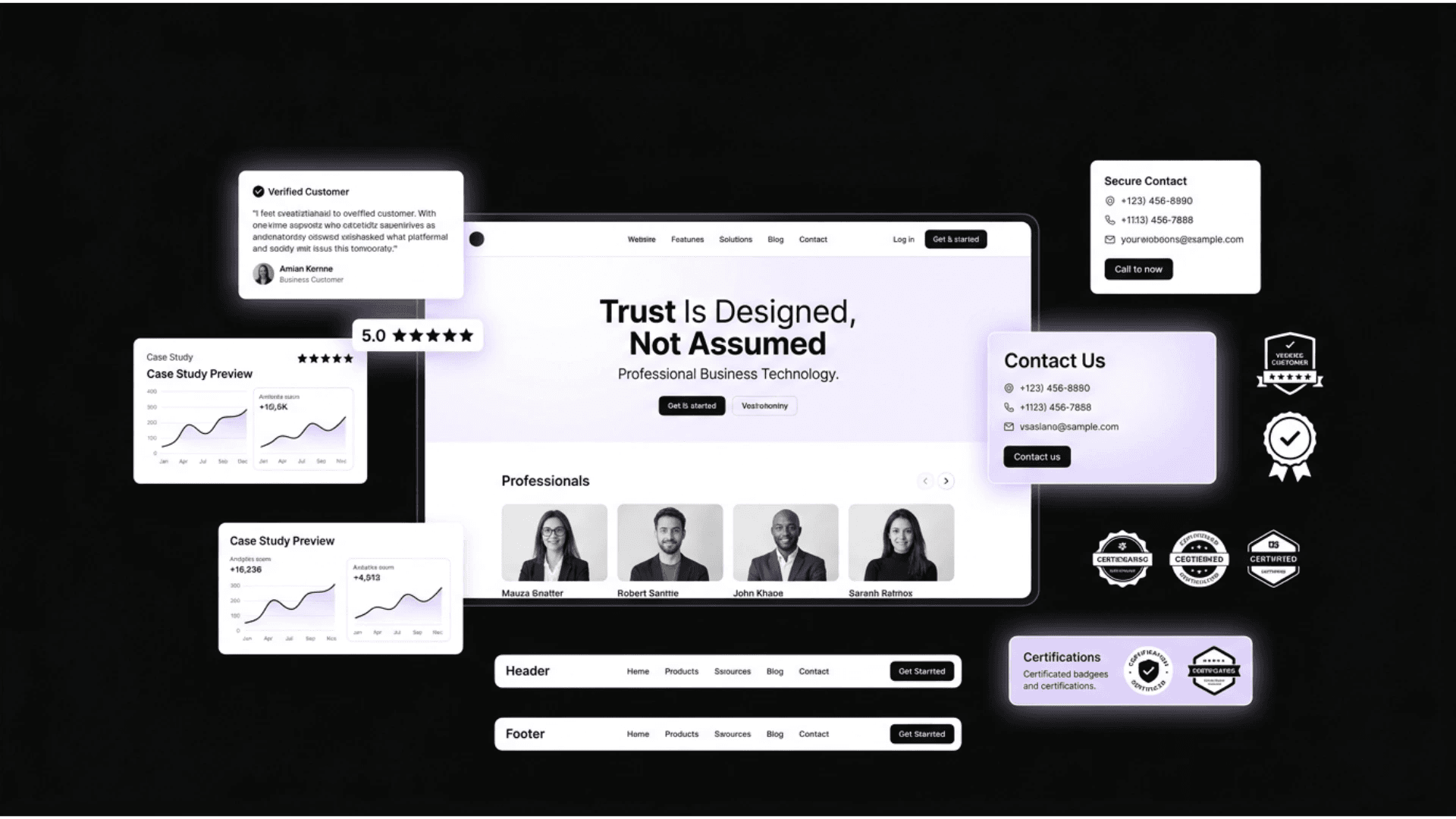
Visual credibility gets visitors to stay. Content credibility gets them to act. Reviews, case studies, certifications, and transparent business information carry the trust argument across the finish line.
For professional web design for local businesses, community-specific trust markers carry particular weight. Google review counts, local awards, and recognizable regional clients all signal that the business is embedded in the community it serves, not an anonymous digital entity.
For professional web design for service businesses, especially, professional branding and web design services for small businesses aren't separate workstreams; the brand IS the trust. A disjointed visual identity between your website, social profiles, and print materials communicates operational disorganization, even if your service is excellent.
-
Verified customer testimonials with full names, not generic quotes attributed to "XYZ."
-
Case studies or before/after examples that demonstrate outcomes, not just claims
-
Industry certifications displayed with context, not just logos
-
A real "About" page with team photos, real faces, reduces perceived risk significantly
-
Clear contact information that doesn't require the visitor to hunt for it
How Professional Web Design for Businesses Directly Affects Growth
The skeptic's question: is web design actually a growth driver, or just overhead? The data answers it clearly.
Forrester Research found that a well-designed user interface can boost conversion rates by up to 200%, and a fully optimized UX design can yield improvements of up to 400%. Remove friction, build trust, clarify the next step, and more visitors will complete it.
The impact of professional web design on business growth breaks down into three operational categories: visibility through clean, crawlable code that supports SEO rankings; conversion through UX flow that reduces drop-off before the CTA; and retention through consistent brand experience that drives repeat visits. A site loading in one second converts at nearly 3x the rate of a five-second site (Portent / Landbase, 2026).
Business outcomes: with vs. without professional web design:
|
Outcome |
Without Professional Design |
With Professional Design |
|
First impression |
High bounce, low trust |
Fast credibility, longer session |
|
SEO performance |
Slow load, poor mobile UX |
Clean code, fast load, better rankings |
|
Conversion rate |
Unclear CTAs, high drop-off |
Strategic placement, guided user flow |
|
Ad spend efficiency |
Traffic lands on weak pages |
Landing pages optimized for intent |
|
Brand retention |
Inconsistent experience |
Cohesive identity, stronger return rate |
Professional web design and development for small businesses that combines technical performance with conversion architecture is where measurable growth impact is most direct and consistent.
Branding, Color, and Visual Identity: The 2026 Standards
The 2025 design landscape was defined by two competing aesthetics: aggressive minimalism on one end, dopamine color palettes on the other. In 2026, neither extreme is winning. What's winning is intention, color systems that are purposeful, accessible, and built to perform across devices and modes.
Several 2025 trends have become obsolete entering 2026. Flat Corporate Memphis illustration, the abstract human figures dominating SaaS sites from 2020 through 2025, is largely dead, replaced by real photography and texture. Generic muted gray palettes are being retired not just for aesthetic reasons but legal ones: the European Accessibility Act now pushes AA/AAA contrast compliance as a baseline requirement. And the safe corporate blues that defined professional portfolios in 2025 now communicate stagnation rather than stability.
2026 color directions for professional business websites:
|
Color Direction |
Business Application |
Why It Works in 2026 |
|
Cloud Dancer (Pantone 2026 COTY) |
Professional services, B2B, consultants |
Signals calm and trust; pairs with any accent |
|
Transformative Teal (WGSN/Coloro 2026) |
Tech, healthcare, sustainability brands |
Conveys resilience without aggression |
|
Navy Blue + single accent |
Finance, logistics, legal |
Timeless trust signal; accent drives CTA visibility |
|
Warm Earth Tones (clay, stone, sage) |
Lifestyle, wellness, local services |
Reduces visual fatigue; feels grounded and human |
|
Monochrome + single bold accent |
SaaS, premium services, enterprise |
Extreme conversion focus, the only color becomes the CTA |
Web design color trends for 2026 are moving from decorative choices toward color as a system, tokenized, accessibility-tested, and consistent across light and dark modes. This applies equally to web design color trends 2025 for professional portfolios, business analyst presentations and service sites: color is now chosen for legibility, trust signaling, and conversion performance simultaneously, not appearance alone.
Branding consistency checklist for 2026:
-
Same hex codes across website, social profiles, and all print materials
-
Typography pairing that matches business personality, an authoritative display font with a clean body font
-
Logo variants prepared for dark and light backgrounds
-
Favicon that remains recognizable at 16px
The 2025 web design color trends for professional business analyst portfolios leaned on safe, passive palettes. In 2026, those read as stagnant. Every color element is now expected to serve a defined purpose in the user journey, not just fill visual space.
Choosing the Right Web Design Service for Your Business
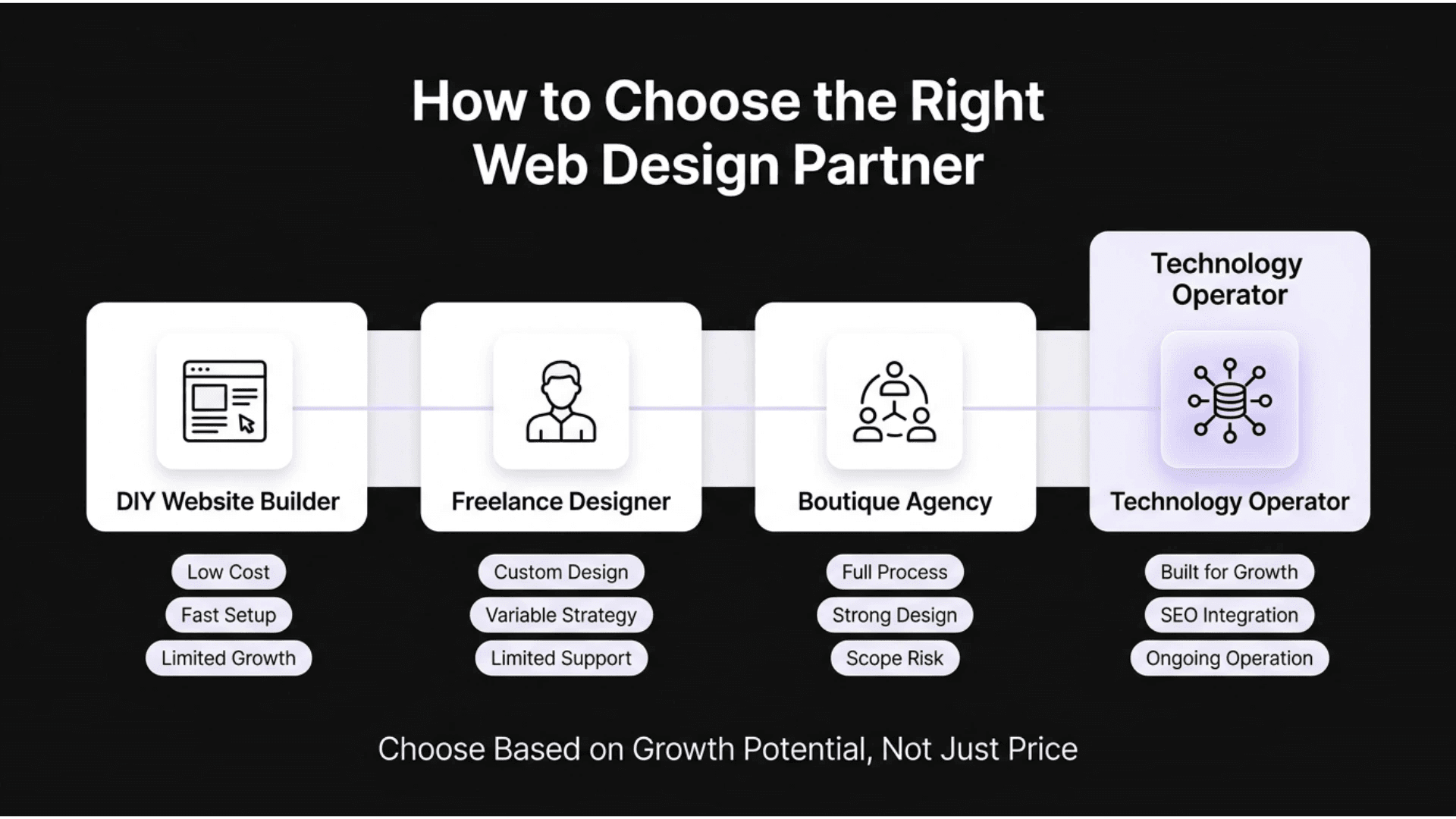
There are thousands of web designers and agencies operating online, and most small business owners have no clear framework for comparing them. The variables that matter most, portfolio specificity, SEO integration, and post-launch accountability, are almost never the ones prominently featured on an agency's own website.
What to look for in a professional web design service:
-
Portfolio with real small business examples, not just enterprise case studies that don't reflect your budget
-
Clear process from discovery to launch, ambiguity at the proposal stage predicts ambiguity at handoff
-
Transparent pricing without vague "starting from" language
-
SEO foundations built into the design, not offered as a post-launch add-on
-
Post-launch support and maintenance options
Comparing web design options for small businesses:
|
Option |
Cost Range |
What You Get |
Key Risk |
|
DIY website builder |
$0–$50/month |
Template, basic functionality |
No SEO architecture, no conversion strategy |
|
Freelance designer |
$1,500–$8,000 |
Custom design, variable quality |
Limited strategic input, no ongoing support |
|
Boutique agency |
$5,000–$25,000 |
Full process, portfolio accountability |
Scope creep if process isn't defined upfront |
|
Technology operator |
Project + retainer |
Build + ongoing operation, monitoring |
Higher initial investment |
Professional small business web design at affordable rates is achievable, but "affordable" should never mean cutting SEO, mobile optimization, or security. It means scoping the project correctly for the business's actual growth stage, not stripping out the components that determine whether the site performs.
A regional specialist often delivers more relevant output than a generic national agency. Professional Indiana web designers for small businesses & startups, for example, bring local market understanding that a standardized template-based approach simply cannot replicate, knowledge of the audience, the competitive landscape, and the regional context that shapes how customers make decisions.
The best engagements happen when the designer understands not just the technical requirements, but the operational reality of the business, who the customer is, how they find you, and what gets them to convert.
Real Examples of Professional Business Websites That Work
Seeing consistent patterns across strong examples is more operationally useful than reading principles in isolation. When evaluating web design examples, professional business website portfolios, ignore the awards section, look at whether the sites they built actually convert, retain visitors, and communicate value without requiring effort from the user.
The commonalities among high-performing small-business websites are consistent regardless of industry or visual style. They answer the visitor's core question, "Am I in the right place?", before the first scroll.
What strong professional business websites have in common:
-
Homepage answers "who this is for" within 5 seconds, without scrolling
-
Services page has a clear scope, pricing context, and an obvious next step
-
Contact page is easy to find and offers multiple contact options
-
About page features real people, not corporate stock photography
-
Blog or resources section demonstrates expertise and supports SEO simultaneously

A strong professional web design business name in search results is a starting signal, not a conclusion. For focalidea SEO professional and web design services industry business description searches and similar regional queries, the portfolio is the only reliable evidence of whether a provider can execute for your category and budget. Integrated providers who treat design and SEO as a single system, not separate services, consistently produce sites that perform rather than just impress.
What Business Owners Ask About Web Design
Most small business owners come to web design decisions with the same set of concerns, budget, timeline, ROI, and whether what they already have is doing more damage than they realize. The following addresses those concerns directly, without the typical agency spin.
How much does professional web design cost for a small business in 2026?
Costs range from $1,500 for a basic freelance engagement to $25,000+ for a full agency process. The more relevant question is what a non-converting site is costing you in lost leads. We scope every project around business outcomes, not arbitrary deliverables.
Can I get professional web design on a tight budget without sacrificing quality?
Yes, with scope discipline. Professional small-business web design works on a constrained budget when built around the essentials: performance, mobile optimization, CTA placement, and SEO foundations. We build on those foundations first; everything else scales from there.
How long does it take to build a professional business website?
A well-scoped small business site takes 6–12 weeks from discovery to launch. WellsGroup includes rigorous testing within that timeline; compressed timelines mean reduced process, and that always shows in the result.
What's the difference between web design and web development, and do I need both?
Design is the user experience architecture. Development is the technical implementation. Professional web design and development for small businesses requires both in coordination. We handle them as a unified system, not two separate handoffs.
How do I know if my current website is hurting my business?
Check three things: bounce rate above 65–70% on key pages, mobile load time above 3 seconds, and whether key landing pages have a visible CTA. If any fail, the site is costing you leads. We audit to identify exactly where drop-off is happening and why.
What should I look for when hiring a professional web designer for my local business?
Portfolio examples from your category, a documented process, SEO-integrated design, and post-launch support. Professional web designers for small businesses who understand conversion architecture are worth the search; that's the standard every WellsGroup engagement is held to.
Your Website Is Either Building Trust or Losing It
Return to that visitor from the opening. They landed on a poorly designed site, formed a judgment in under three seconds, and went straight to a competitor. Your product was never evaluated. The website decided for them.
Professional web design for businesses isn't about aesthetics. It's about communicating, immediately and without friction, that your business is real, reliable, and worth the customer's time. Every visual, structural, and content decision either reinforces that message or undermines it.
Audit your site against the trust signals in this article. If three or more are missing, the site isn't neutral; it's actively working against your growth.