When Custom Software for Business Makes More Sense Than Ready-Made Tools
Learn when custom software becomes a competitive advantage, helping businesses eliminate inefficiencies, connect systems, and scale smarter.

Picture a Monday morning at a mid-sized logistics company. The operations manager opens three separate tabs: one for customer records, one for scheduling, and one for invoicing. None of them shares data. Every week, someone spends two hours copying information between them by hand.
This is the duct-tape problem that custom software for business ultimately solves. Most businesses start with ready-made tools because they are fast and affordable. Then the business grows, and "good enough" starts costing real money. For most growing operations, custom software development for small businesses is not a tech luxury. It is what happens when the workarounds stop working. Let's break down the real signs your business has outgrown generic tools, what custom software actually solves, and how to make the right call for your stage in 2026.
The Real Difference Between Custom Software and Ready-Made Tools
Off-the-shelf software is built for the broadest possible audience. It deploys quickly, runs on a subscription model, and covers the most common use cases. The features are designed around average workflows, not yours.
Custom software for business means a system built around your specific operational logic, customer data structure, and growth constraints. It does not ask your business to conform to its architecture. It reflects the architecture you already operate in.
Custom software vs. off-the-shelf: structural comparison:
|
Factor |
Off-the-Shelf |
Custom Software |
|
Built for |
General market |
Your specific workflows |
|
Cost model |
Ongoing subscription, scales with users |
Higher upfront, lower long-term per-seat cost |
|
Flexibility |
Limited by the vendor roadmap |
Fully owned and modifiable |
|
Data ownership |
Vendor-controlled |
Fully owned by your business |
|
Scalability |
Hits ceilings as complexity grows |
Designed to scale with your operations |
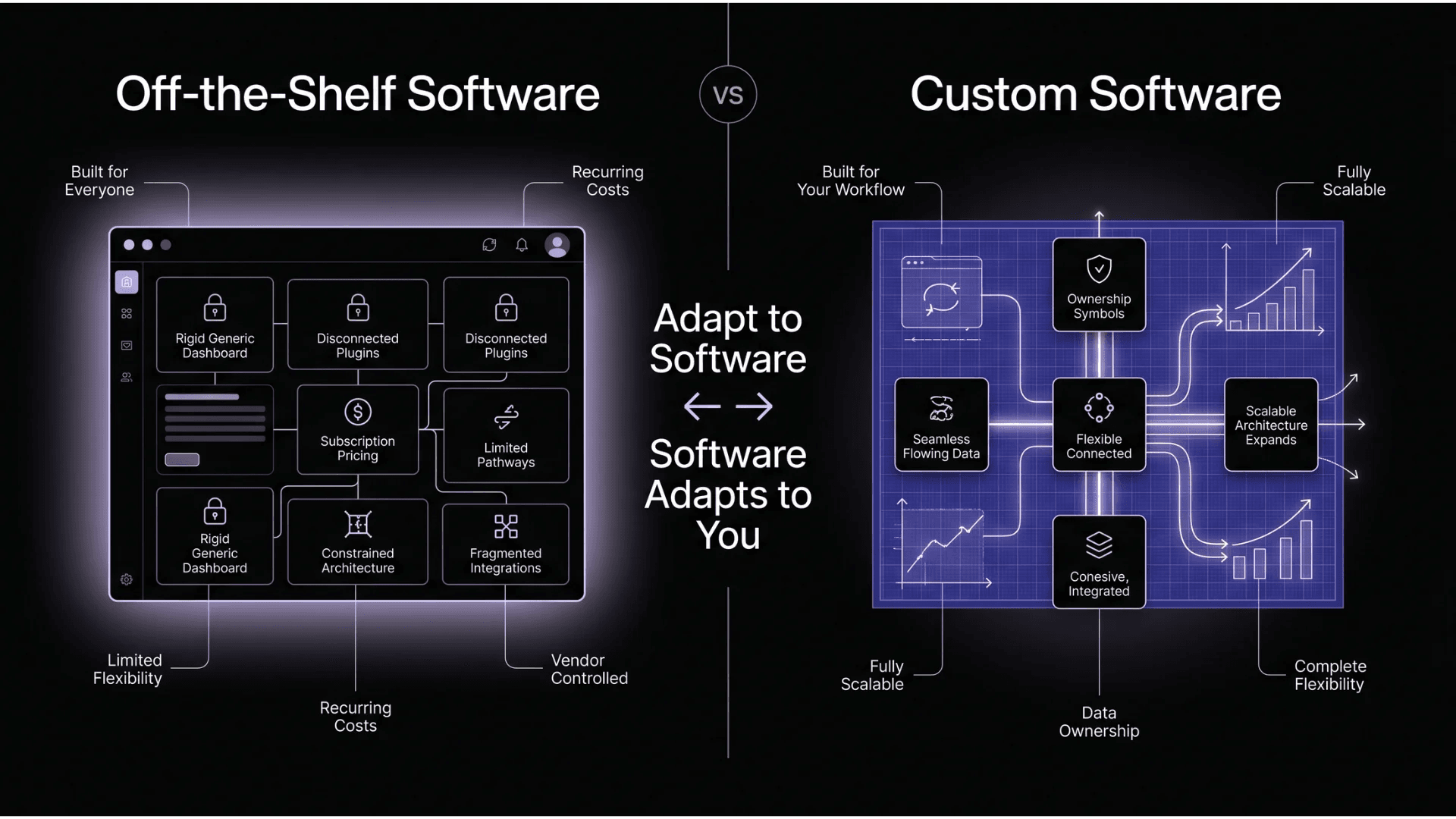
Not every business needs a ground-up custom build. Many need custom software solutions for businesses in the form of deeply integrated platforms where existing tools are made to communicate properly. According to Gartner, up to 30% of enterprise software spend is wasted on underutilized or redundant tools. The problem is rarely which tools a business owns. It is whether those tools are connected in a way that reflects how the business actually operates.
Five Signs Your Business Has Outgrown Off-the-Shelf Software
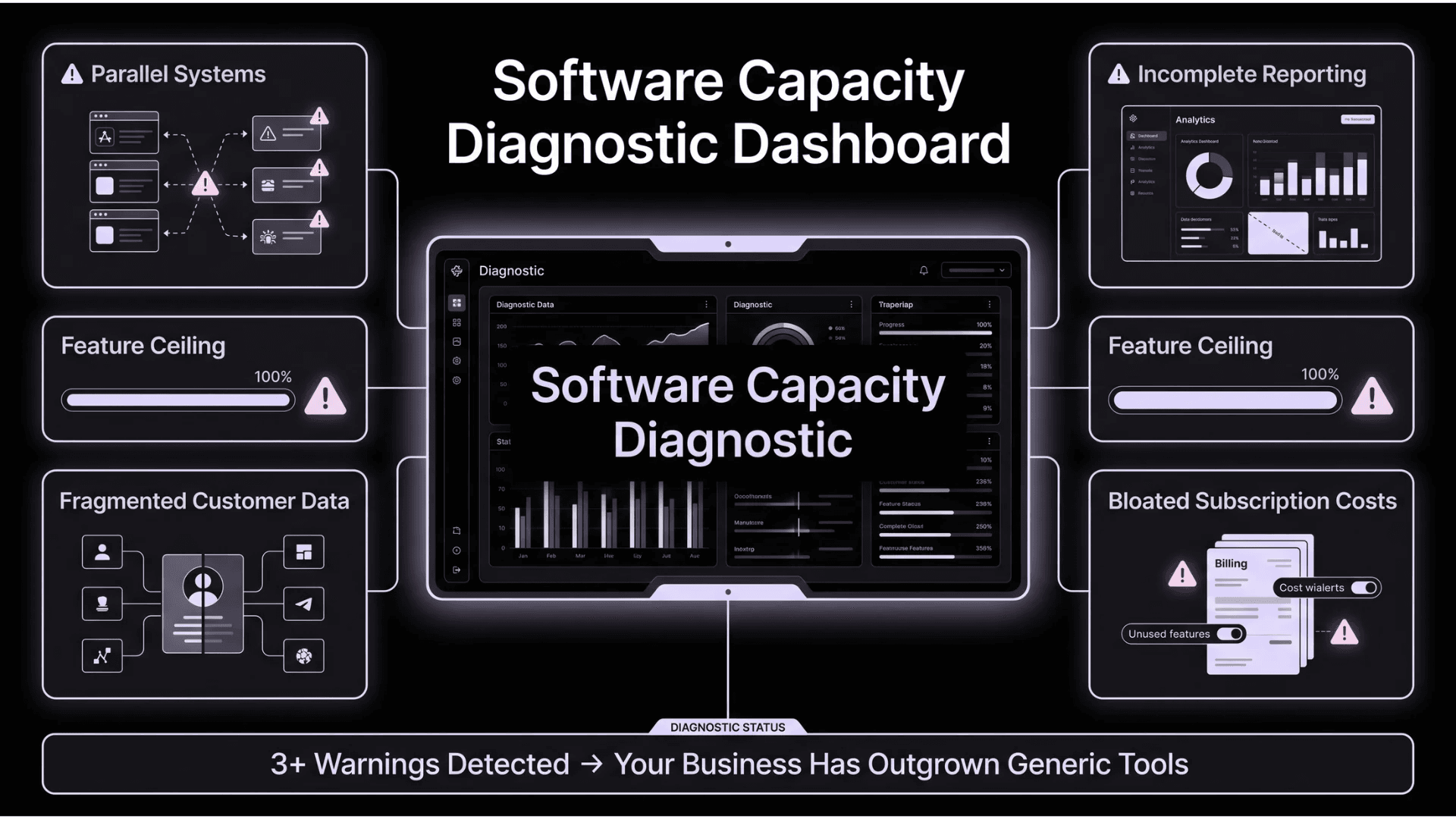
This is a diagnostic, not a sales pitch. These are operational symptoms. If three or more appear familiar, the answer is likely already clear. They rarely show up in the first year; they surface between the 18 and 36 month mark, when real volume and complexity have accumulated.
The five signs your tools have reached their limit:
-
You are running parallel systems: Data lives in two or three tools, and your team manually syncs them. This is a systems architecture issue, not a workflow issue.
-
Your reporting is always incomplete: The dashboards your tools offer do not match how your business actually measures success.
-
You have hit the feature ceiling: You need a capability the tool does not offer, and the workaround is consuming real time.
-
Your customer data is fragmented: Your customer database software for small businesses does not connect with your billing or service platform.
-
You are paying for features you never use: The subscription is bloated, but the vendor will not let you turn off what you do not need.
McKinsey's November 2025 report found that 57% of U.S. work hours are already automatable with currently available technologies. When your customer database software for small businesses cannot talk to your billing platform, that is not a minor inconvenience. It is a structural problem that compounds every week it goes unresolved.
What Custom Software Actually Solves (And What It Doesn't)
Most business owners either over-expect or under-appreciate what custom development delivers. Both positions cost money. Setting honest expectations up front is what separates a successful build from an abandoned one.
What It Genuinely Fixes
Custom software solves workflow-specific problems. It automates the exact process your team runs every day, not a version designed for a hypothetical average business. When the system reflects your actual logic, the benefits are measurable rather than theoretical.
Real problems custom software resolves:
-
Eliminating manual data entry between disconnected tools by building a single source of truth
-
Generating reports that reflect your actual KPIs, not the metrics the vendor decided to track
-
Scaling without per-seat pricing that multiplies with every new hire
-
Owning your data architecture without vendor lock-in or third-party dependency
Where It Won't Save You
Custom software does not fix a broken process. If the underlying workflow is inefficient, building software around it makes the inefficiency faster and harder to reverse. The process needs to be mapped and cleaned up before a single line is written.
Situations where custom development is not the right move:
-
When a ready-made tool covers 90% of your needs for a modest monthly fee
-
When your team does not have the bandwidth to adopt a new system
-
When you need something working within the next two to four weeks
-
When your business model is still changing, and requirements would shift mid-build
The Standish Group CHAOS Report confirmed that 31.1% of software projects are cancelled before completion. The primary cause is not technical failure. It is poorly scoped and has unclear requirements. Custom software development for small businesses fails most often not because of the code, but because the brief was built on assumptions instead of mapped, documented workflows.
Customer Management, Loyalty, and Service: Where Generic Tools Fall Short
Customer-facing systems are the highest-stakes place to have the wrong software. Every friction point a customer encounters is a potential churn event. Generic tools in this category are well-designed for average use cases. The problem is that your customer relationships are not average.
Comparing customer management tool types:
|
Tool Type |
Coverage |
Limitation |
|
Off-the-shelf CRM |
Contact management, basic pipelines |
Does not connect with service or billing |
|
Loyalty platform |
Points, rewards, campaigns |
Siloed from purchase history and service data |
|
Customer service software |
Ticketing, helpdesk, live chat |
Separate from CRM and loyalty data |
|
Custom integrated system |
All of the above in one connected view |
Higher build cost, longer deployment |
The best customer loyalty software for service businesses works well as a standalone product but rarely connects to your appointment system, purchase history, or service log. That disconnect costs upsell opportunities and retention every day.
What an integrated custom customer system delivers that generic tools cannot:
-
Full customer history across purchases, service records, and loyalty points in one view
-
Automated follow-ups triggered by actual service events, not generic timers
-
Proactive outreach flags for customers showing early churn signals
-
Behavioral and purchase data for custom software solutions for in-store analytics retail businesses, tracking in-store and digital patterns simultaneously

Salesforce's State of the Connected Customer research found that 70% of customers say service agents' awareness of previous interactions is very important to keeping their business. The best customer service software for businesses 2025 and top-rated customer service software for businesses 2025 rankings include strong standalone products, but the top-rated reflects average use cases.
The best customer success software for small businesses is the one that fits how your customers actually move through your operation, not the one with the highest review score. Customer service software for small businesses, decisions made purely on ratings without operational fit analysis, consistently produce the same result: a well-reviewed tool that creates new friction instead of resolving the old kind.
Custom Software Development: Costs, Timelines, and What to Expect
Cost is determined by scope. Any figure given before a proper scoping process is an estimate built on assumptions.
Cost and timeline ranges for small business custom builds:
|
Project Type |
Estimated Cost |
Timeline |
|
Workflow automation tool |
$8,000 to $25,000 |
6 to 12 weeks |
|
Custom CRM or client portal |
$20,000 to $60,000 |
12 to 20 weeks |
|
Integrated business platform |
$50,000 to $150,000+ |
20 to 40 weeks |
|
In-store analytics and loyalty system |
$30,000 to $80,000 |
14 to 24 weeks |
What the development process actually looks like:
-
Discovery and scoping (2 to 4 weeks): mapping real workflows, defining requirements, and wireframing system logic
-
Design and architecture (2 to 4 weeks): UX design, database structure, tech stack decisions
-
Development sprints: built in phases with testing at each stage
-
User Acceptance Testing (1 to 2 weeks): your team actively tests before launch
-
Launch and handoff: documentation, training, and a defined support period
As IBM research confirms, every dollar spent resolving a problem during design saves $10 in development and $100 after launch. Skipping the scoping phase does not save time. It moves costs downstream, where it is far more expensive to fix. Custom software development for small business projects that succeed are the ones where the client invested as much in the brief as in reviewing proposals.
How to Choose the Right Software Path for Your Business in 2026
The 2025 trend of layering AI tools on top of disconnected systems to paper over integration gaps has proven in 2026 to add complexity rather than resolve it. The underlying architecture still determines performance.
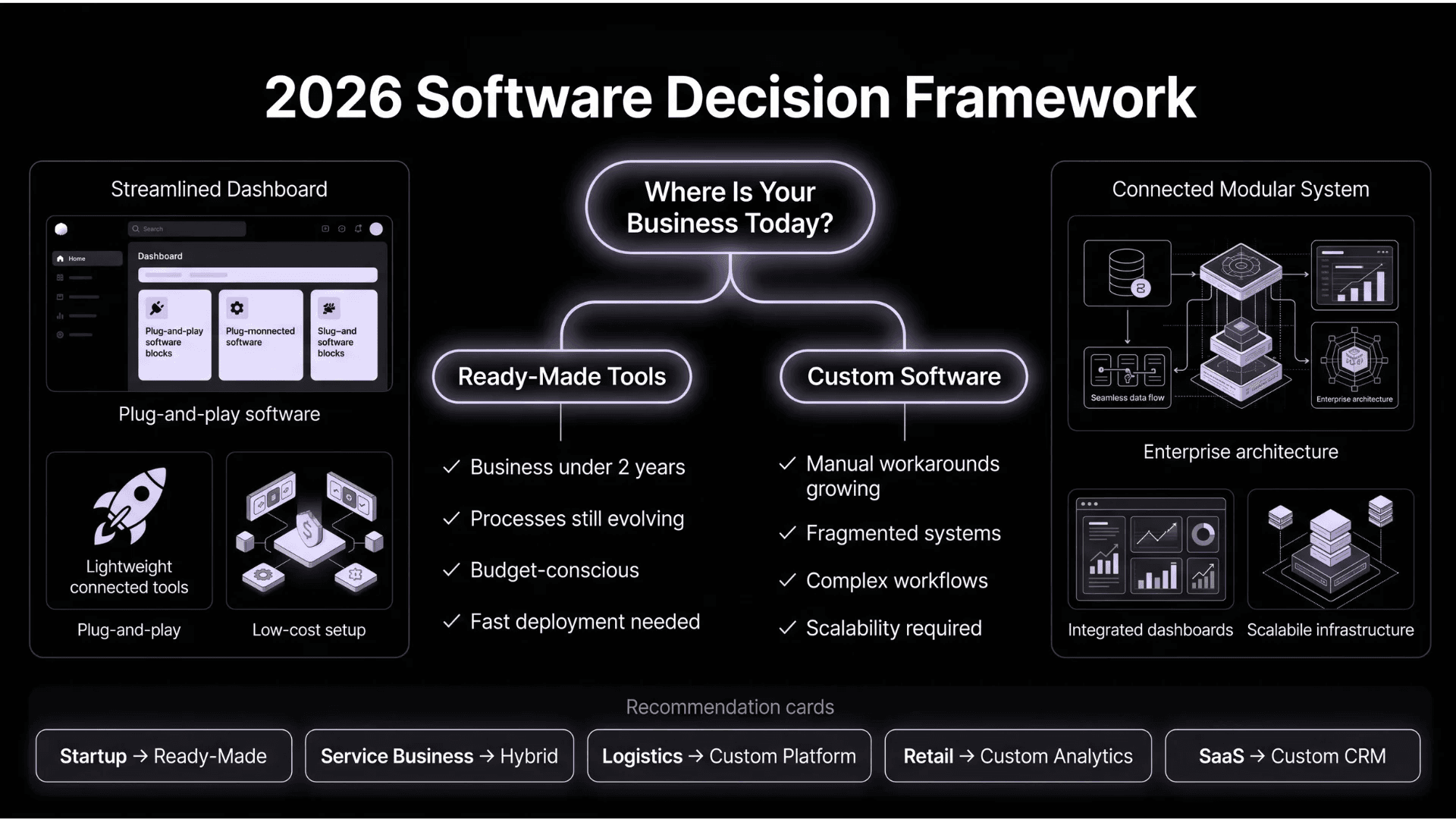
Stick with ready-made tools if:
-
Your business is under two years old, and processes are still forming
-
A single subscription covers 85% or more of your operational needs
-
Your team does not have the bandwidth to onboard a new system
-
Your total software budget for the year is under $5,000
Move toward custom software for business if:
-
You have documented, repeatable workflows that no existing tool maps to cleanly
-
Your team is spending more than 10 hours per week on manual workarounds
-
Customer data is fragmented across three or more systems
-
You have already tried two or three off-the-shelf solutions and hit the same walls
Quick decision guide by business type:
|
Business Type |
Recommended Path |
Primary Reason |
|
Early-stage startup |
Ready-made tools |
Processes still forming |
|
Growing service business |
Custom integration or light custom build |
Customer data fragmentation becomes a retention risk |
|
Logistics operator |
Custom operational platform |
Dispatching and billing logic rarely served by generic tools |
|
Retail business with in-store data needs |
Custom analytics and loyalty system |
Generic tools cannot connect POS, loyalty, and service data |
|
SaaS company |
Custom CRM and client portal |
Off-the-shelf CRMs rarely reflect multi-stage customer lifecycles |
Before calling a developer, spend two hours documenting your most painful weekly workflow. Every tool involved, every manual step, every handoff. That document is worth more than any discovery call. The right customer service software for a small business solution sometimes turns out to be a reconfigured existing tool. That document will make it clear either way.
What Business Owners Ask About Custom Software
The decision to invest in a custom build raises the same set of questions almost every time. The following addresses the most common ones directly, without softening the trade-offs or oversimplifying the variables.
How do I know if my small business actually needs custom software or just a better ready-made tool?
The clearest signal is repeated failure with well-reviewed off-the-shelf tools. If you have tried two or three options in the same category and hit the same walls each time, the problem is not the specific product. WellsGroup starts every systems evaluation by mapping the actual workflow before recommending a build or reconfiguration.
What is the average cost of custom software development for a small business in 2026?
Realistic ranges run from $8,000 for a single workflow automation tool to $150,000 or more for a fully integrated platform. WellsGroup scopes every engagement around documented requirements so estimates reflect real work, not assumptions.
How long does it take to build custom software for a small business?
A focused automation tool typically takes 6 to 12 weeks. A fully integrated platform takes 20 to 40 weeks. Timelines that sound faster usually mean the scoping phase has been compressed, which moves cost and risk downstream.
What is the difference between custom software and a customized off-the-shelf platform?
Custom software is built from the ground up around your specific logic. A customized platform is reconfigured within the limits the vendor allows. Custom software solutions for businesses often begin as reconfiguration projects and evolve into full custom builds as operational complexity increases.
Can custom software integrate with the tools I am already using?
Yes. Integration with existing tools is almost always part of the build. The goal of custom software development for small businesses is rarely to replace every system at once. It is to connect what you have, fill the gaps, and eliminate the manual work currently bridging them.
What are the best customer service software options for small businesses in 2026?
Strong options include Zendesk, Intercom, Freshdesk, and HubSpot Service Hub for standard support needs. For businesses where customer service software for small businesses needs to connect with loyalty, billing, or operational systems, standalone tools consistently fall short. WellsGroup evaluates fit against your specific customer journey before recommending any platform.
The Right Tool Is Not Always the Popular One
Return to that operations manager on Monday morning. The three tabs, the manual transfers, and the spreadsheet bridging systems were never designed to talk to each other. They are not unsophisticated. They are using tools that made sense when the business was simpler and that are now creating structural drag every week.
Custom software for business is not about having an enterprise budget. It is about recognizing when the accumulated cost of the workaround exceeds the cost of fixing the underlying architecture. Document your most painful weekly process from start to finish. If it takes more than 20 minutes to explain to a new hire or involves more than two manual handoffs, it is ready to be rebuilt. That document is where every good custom software solution for businesses' conversation starts.