What Is AI SEO and Why Businesses Should Care
AI SEO is reshaping search visibility. Learn how to optimize for AI Overviews, citations, and zero-click search behavior.

A business owner opens Google Analytics in early 2026. Traffic is down, but rankings look fine. They're still on page one. What changed is that Google's AI Mode now answers the query before the user sees a single link, ChatGPT handles millions of those same searches without sending a click, and Perplexity is becoming the first stop for high-intent research.
The traffic didn't disappear. It got absorbed by AI systems that satisfy user intent before anyone reaches your page. That's the operating reality of AI SEO now, and it's no longer a trend to prepare for. Here's a clear-eyed look at what changed, why rankings are no longer a reliable proxy for visibility, and what a structured response looks like for businesses navigating this shift.
What Is AI SEO, Exactly?
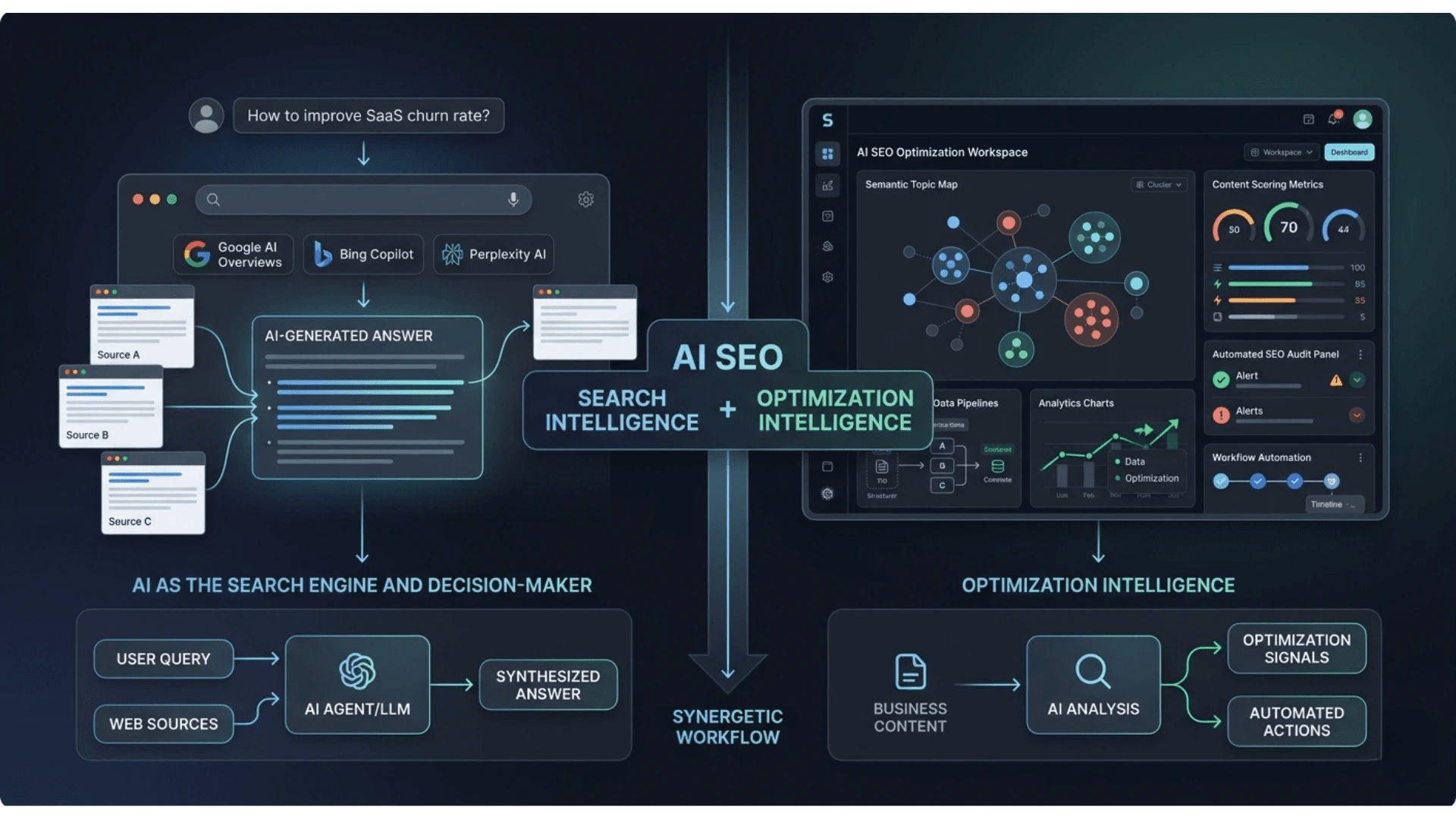
AI SEO refers to two distinct phenomena that businesses need to understand separately before building any AI SEO strategy.
The first: AI systems, not human curators, are now deciding which content gets surfaced at the top of results. Google's AI Overviews, Bing Copilot, and Perplexity don't just rank pages; they synthesize content from multiple sources and generate a direct answer. The page that "wins" isn't necessarily ranked #1; it's the one structured well enough to be extracted, cited, and used.
The second: Businesses are now using AI-powered tools to improve their own performance, automating keyword clustering, content gap analysis, and AI SEO tools visibility optimization at a scale that wasn't operationally possible three years ago. Both meanings matter. Confusing them leads to misallocated resources.
The landscape of AI in search now includes:
-
AI as the search engine itself: Google AI Overviews, Bing Copilot, Perplexity AI, ChatGPT Search, Gemini
-
AI as the optimization layer: rank tracking platforms, content scoring tools, semantic keyword clustering, automated auditing software
According to BrightEdge's 12-month analysis, Google AI Overviews now trigger on approximately 48% of all tracked U.S. search queries as of February 2026, a 58% year-over-year increase. For informational queries in sectors like education and B2B tech, that figure reaches as high as 82–83%.
How AI Search Has Changed the Way Google Works
Traditional SEO was a predictable system. You optimized a page, earned backlinks, monitored rankings, and tracked traffic. That architecture no longer describes how most high-intent queries resolve.
Google's AI Overviews now synthesize content from multiple pages and present a structured answer before organic results appear. Users read the summary, get what they need, and leave without clicking any source that was technically "ranked." Understanding how to show up in AI Overviews, SEO is now a core business problem, not a niche technical concern, and why AI and the future of SEO can't be treated as forward-looking. It's already in the present operating condition.
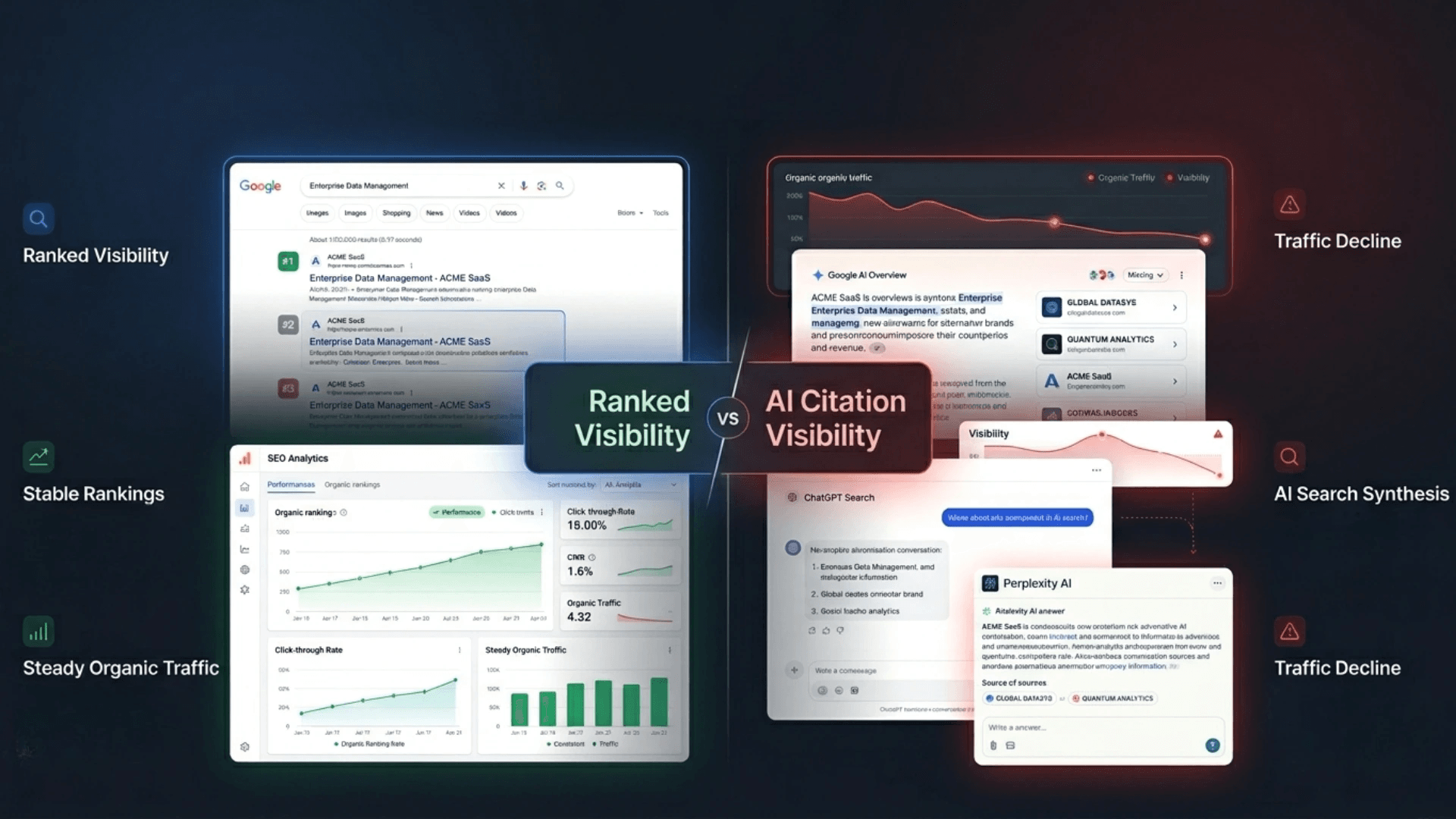
The gap between these two approaches isn't cosmetic; it reflects a fundamental shift in how search engines decide what deserves to be seen. Understanding the structural differences is the first step toward identifying where your current strategy falls short.
|
Ranking Factor |
Traditional SEO |
AI SEO (AI Overviews Era) |
|
Primary goal |
Rank #1 on page one |
Be cited inside the AI-generated answer |
|
What gets rewarded |
Backlinks, on-page keywords, authority |
Structured content, E-E-A-T signals, and semantic clarity |
|
How content is consumed |
User clicks through to your page |
AI extracts your content; the user may not visit |
|
Click-through behavior |
Organic CTR tied to position |
CTR drops even at position #1 if the AI Overview appears |
|
Key optimization focus |
Technical SEO + link acquisition |
Content architecture + entity clarity + trust signals |
Seer Interactive's study analyzing 3,119 informational queries across 42 organizations found that organic CTR dropped 61%, from 1.76% to 0.61%, for queries where AI Overviews appeared. AI overviews of SEO rank tracking are now essential for understanding true traffic impact, not just position data.
Why Businesses Can No Longer Ignore AI SEO
The most dangerous position right now is ranking well on Google while being completely absent from AI-generated answers. It creates a false sense of security, stable rankings on the dashboard, while actual referral traffic erodes month over month.
An AI-driven SEO improvement SERP position study by BrightEdge found that businesses adapting content for AI Overviews saw 2.3x more organic impressions than competitors with comparable domain authority who hadn't adjusted. Traditional ranking signals are necessary but no longer sufficient.
The specific business risks of ignoring AI SEO include:
-
Competitors who've restructured content are capturing AI Overview placements and the authority that comes with being cited by Google's own answer engine
-
Brand invisibility in Perplexity, ChatGPT Search, and Bing Copilot, now used by tens of millions monthly for high-intent queries
-
Declining organic CTR even when rankings are stable, creating an unexplained revenue gap
-
Missing local AI search visibility, service-based businesses are particularly exposed as AI Overviews answer "best [service] near [city]" queries directly
A 2026 survey by Goodfirms found that while 43% of marketers now name AI search optimization as a core strategy, only 14% have implemented any structured AI SEO tools for small business citation tracking. The best AI SEO tools aren't replacing human strategy; they're creating leverage for businesses that know how to deploy them.
How to Optimize Your Content for AI Search
The standard Google uses to select content for AI Overviews is E-E-A-T, which stands for “Experience, Expertise, Authoritativeness, and Trust”. Its operational weight has increased significantly now that an AI system is actively evaluating whether your content deserves to be synthesized and cited.
The businesses appearing in AI Overviews are not necessarily the most authoritative brands; they are the ones whose content is most structurally legible to a machine making rapid source-selection decisions.
Write Content That Answers, Not Just Ranks
AI search systems reward content that resolves a query cleanly, not content that performs on keyword density metrics. This is the core shift in AI SEO strategy at the content level, and it has direct implications for how pages are written and structured, including which best AI mode SEO tool you use to evaluate content performance against AI retrieval criteria.
The structural location of your answer matters as much as the answer itself. An AI Overview selects clean, extractable statements, not paragraphs that bury the point three sentences in.
The following principles apply regardless of industry; whether you're in SaaS, logistics, or professional services, the structural requirements for AI citation eligibility are consistent.
-
Use question-based subheadings that mirror how users phrase queries, not how your marketing team describes your services
-
Write one clean, quotable sentence per key point; AI systems extract discrete statements, not paragraphs
-
Cite data and link to primary sources, not other blog posts, to signal information provenance
-
Define terms the way a knowledgeable practitioner explains them to an intelligent colleague, not the way a glossary defines them for a beginner
Build E-E-A-T Signals Into Every Page
E-E-A-T is not a checklist item; it's an architectural requirement. Every page Google evaluates for AI Overview inclusion is assessed for whether a real, credible, accountable entity produced it. Deploying AI tools for SEO optimization in the USA without these signals in place produces optimized pages that still won't be cited.
The signals that matter are specific and verifiable, not cosmetic additions made at the last stage of publishing. These are not optional enhancements; they are the baseline criteria Google's AI system evaluates before deciding whether your content is trustworthy enough to surface in a generated answer.
-
Author bylines with verifiable credentials, a named professional with a linked bio, not "Staff Writer."
-
First-person experience sections reflecting direct operational knowledge, not synthesized general advice
-
Case studies or documented outcomes, specific, verifiable results that support the claims being made
-
Links to primary research: government data, peer-reviewed studies, verified industry reports, not aggregator blogs
-
Complete business information, About pages, contact channels, and trust signals confirming the business is real and accountable
The AI SEO Tools You Actually Need
The best AI SEO tools 2026 market is crowded and full of products that use "AI" as a label without meaningful differentiation. The operational question isn't "which tool is best", it's "which tool solves which specific visibility problem." Tools that optimize content for AI search are not the same as tools that track visibility inside AI Overviews. Both are needed. Neither replaces the other.
Not every tool in this space solves the same problem, and selecting the wrong category wastes both budget and implementation time. The table below maps each tool type to its specific function so you can evaluate options against your actual visibility gaps.
|
Tool Type |
What It Does |
Best For |
Example Use Case |
|
AI Overview rank trackers |
Monitors whether your pages appear inside Google AI Overviews |
Ongoing visibility measurement |
Tracking citation frequency for high-intent queries |
|
AI-powered content optimization |
Scores content against semantic relevance and E-E-A-T signals |
Content restructuring |
Identifying pages that rank but aren't cited in AI answers |
|
AI SEO auditing software |
Full-site technical and semantic audit using AI pattern recognition |
Site-wide health checks |
Finding structural content gaps across topic clusters |
|
AI keyword clustering tools |
Groups semantically related queries into content architecture maps |
Content planning |
Building pillar-and-cluster systems, AI recognizes as topically authoritative |
|
AI mode SEO analysis platforms |
Analyzes how AI Overviews are constructed and which sources are cited |
Competitive intelligence |
Understanding why a competitor is cited and you aren't |
A true SEO AI agent continuously monitors query behavior, identifies citation gaps, and recommends structural changes based on real-time SERP data. The best implementations combine AI-mode SEO checking software with human editorial judgment. The best AI mode SEO tracking tools and best AI mode SEO analysis software solve for AI-specific visibility gaps that generic rank trackers miss entirely.
What to look for when evaluating any AI SEO tool:
-
Does it track AI Overview appearances specifically, not just traditional rank position?
-
Can it analyze content against E-E-A-T criteria at the page level?
-
Does it show SERP volatility tied specifically to AI updates?
-
Is it updated frequently enough to keep pace with Google's AI rollout cycle?

Selecting the right platform starts with clarity on your specific visibility objective; the tool that fits depends entirely on what gap you're trying to close. For competitive benchmarking, the best AI SEO rank tracking platforms that aggregate citation data across Google, Bing, and Perplexity provide the most complete picture. AI overview: SEO rank tracking accuracy is particularly critical in competitive verticals where citation frequency directly drives inbound volume.
Building an AI SEO Strategy for Your Business
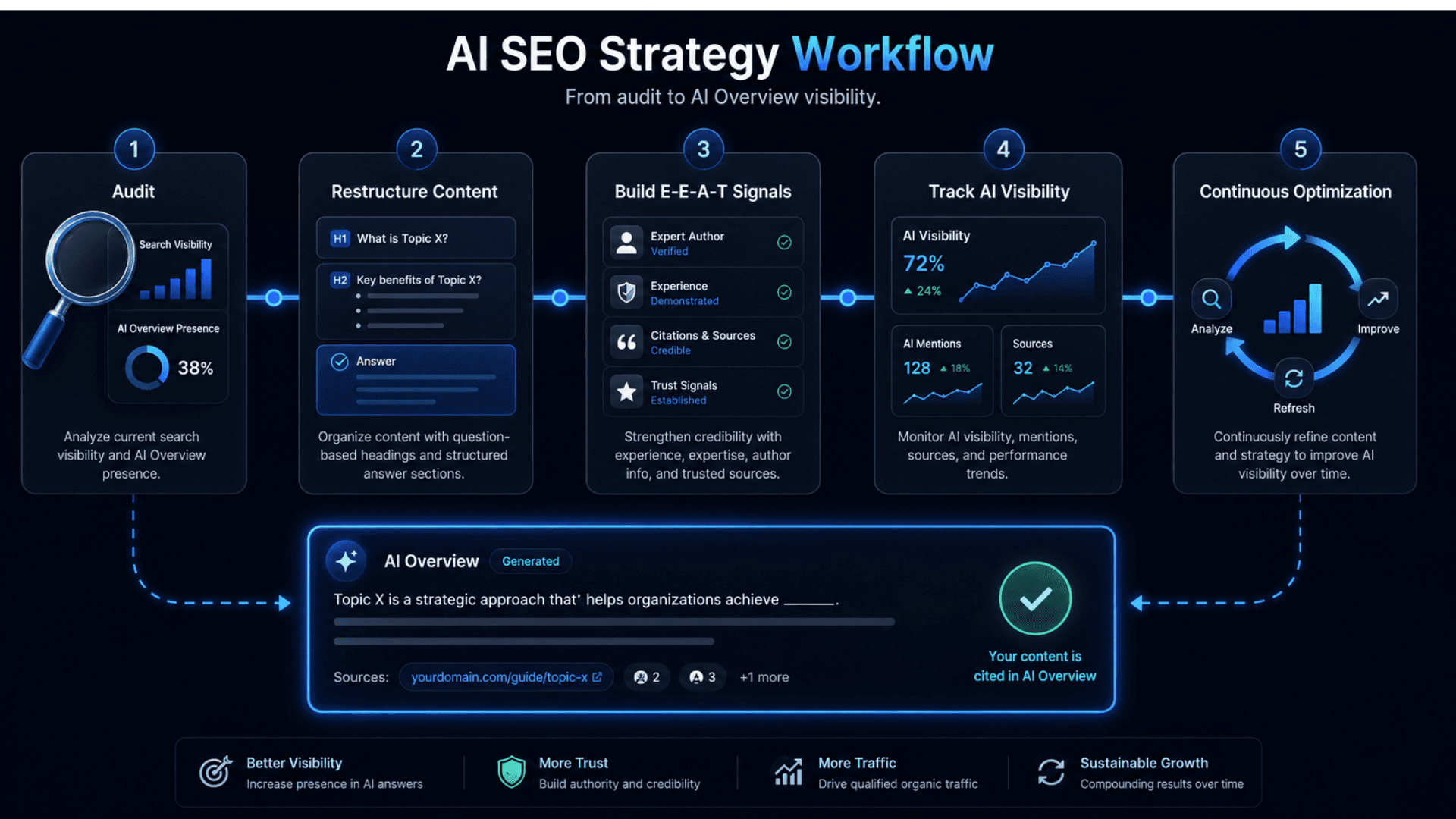
A structured AI SEO strategy is not a content refresh. It's a systematic restructuring of how your business produces, structures, and monitors information, designed to be legible to AI retrieval systems while maintaining genuine value for human readers. Selecting the right AI mode SEO software for your stack comes after the audit, not before; the sequence is audit first, then structure, then tool setup, then ongoing monitoring.
The sequence below is designed to be executed in order. Skipping the audit phase and moving straight to content restructuring is one of the most common reasons AI SEO efforts produce inconsistent results.
-
Audit current AI Overview and zero-click exposure using an AI-capable tracker, not Google Search Console alone, which doesn't report AI Overview appearances
-
Identify pages that rank but don't appear in AI Overviews; authority exists; content architecture is the problem
-
Restructure content with question-based subheadings and direct answers, prioritize informational queries first, then commercial
-
Add E-E-A-T signals at the page level: author credentials, data citations, verifiable business information, first-person experience sections
-
Set up AI-specific rank tracking for ongoing monitoring of citation frequency across Google, Bing Copilot, and Perplexity
-
Review monthly, not quarterly, the best AI SEO tools 2025 flag changes in real time; your review cadence must match
A Profound study analyzing ~80,000 prompts across major AI platforms found that approximately 59% of domains cited in Google AI Overview responses are completely different just one month later for the same query. Monthly monitoring isn't aggressive; it's the minimum viable cadence.
Using AI tools for SEO optimization in the USA without this structured sequence produces fragmented output and optimized pages that don't connect to a coherent visibility architecture.
What Businesses Ask About AI SEO
The shift toward AI-driven search has generated a specific set of questions that business owners and marketing leaders are actively working through right now. The answers below address the most common strategic and operational concerns directly.
How is AI changing the future of SEO and organic search rankings?
AI is shifting the primary optimization target from ranking position to citation frequency inside AI-generated answers. AI and the future of SEO mean backlinks and technical performance are now prerequisites, not differentiators. The differentiator is content architecture that AI systems can parse, extract, and cite.
What are the best AI SEO tools for small businesses to use in 2026?
Small businesses should prioritize tools that track AI Overview appearances and surface E-E-A-T gaps at the page level. AI SEO tools for small business deployments work best when scoped to a defined set of high-intent queries rather than site-wide monitoring from day one.
How can I track my SERP position specifically for Google AI Overviews?
Standard rank tracking tools do not report AI Overview appearances. You need platforms built specifically for AI overviews, SEO rank tracking, and monitoring whether your content is cited inside the generated answer, not just whether your page appears in organic results below it.
What is the most effective AI SEO strategy for visibility optimization?
The most effective AI SEO strategy combines content restructuring, question-based architecture, direct answers, clean extractable sentences, with E-E-A-T integration and dedicated AI Overview monitoring. AI SEO tools and visibility optimization platforms accelerate this process, but the underlying logic is strategic, not technical.
How do I optimize my content to show up in AI Overviews?
Structure content to answer questions directly. Use question-based subheadings, write one clean sentence per key point, cite authoritative data, and build E-E-A-T signals into every page. This is the structural pattern AI systems use to select citation-worthy content, the core of how to show up in AI Overviews SEO.
Are there specific AI agents designed to automate SEO tasks?
Yes. An SEO AI agent continuously monitors search behavior, evaluates content against AI visibility criteria, and recommends structural changes automatically. The most effective deployments combine agent automation with human editorial review, not replace it.
What is the best AI mode SEO tracking software currently available in the USA?
The best AI mode SEO tracking software combines AI Overview citation tracking, traditional rank monitoring, and SERP volatility alerts in a single interface. Evaluating any AI mode SEO checking software should include testing against your actual target queries, not just reviewing feature lists.
How does an AI-driven SEO study help in improving website rankings?
An AI-driven SEO improvement SERP position study benchmarks your content's current performance inside AI-generated answers, identifies structural gaps preventing citation, and maps which competitor content is being cited and why. It's a diagnostic tool for AI search visibility specifically.
AI SEO Is Not Optional Anymore
Return to that business owner from the opening. Traffic down 34%. Rankings unchanged. The problem wasn't their SEO; it was that their SEO was optimized for a search environment that had already changed beneath them.
They now know what happened: Google's AI Overviews absorbed the query before it reached their page. They know the gap: content not structured for extraction. And they know the path forward, a structured AI SEO strategy that audits current visibility, restructures content for machine legibility, and monitors citation frequency on a cadence that matches how fast this environment moves.
The businesses gaining ground right now aren't doing anything exotic. They're applying systematic thinking to a system that has changed. Start there.