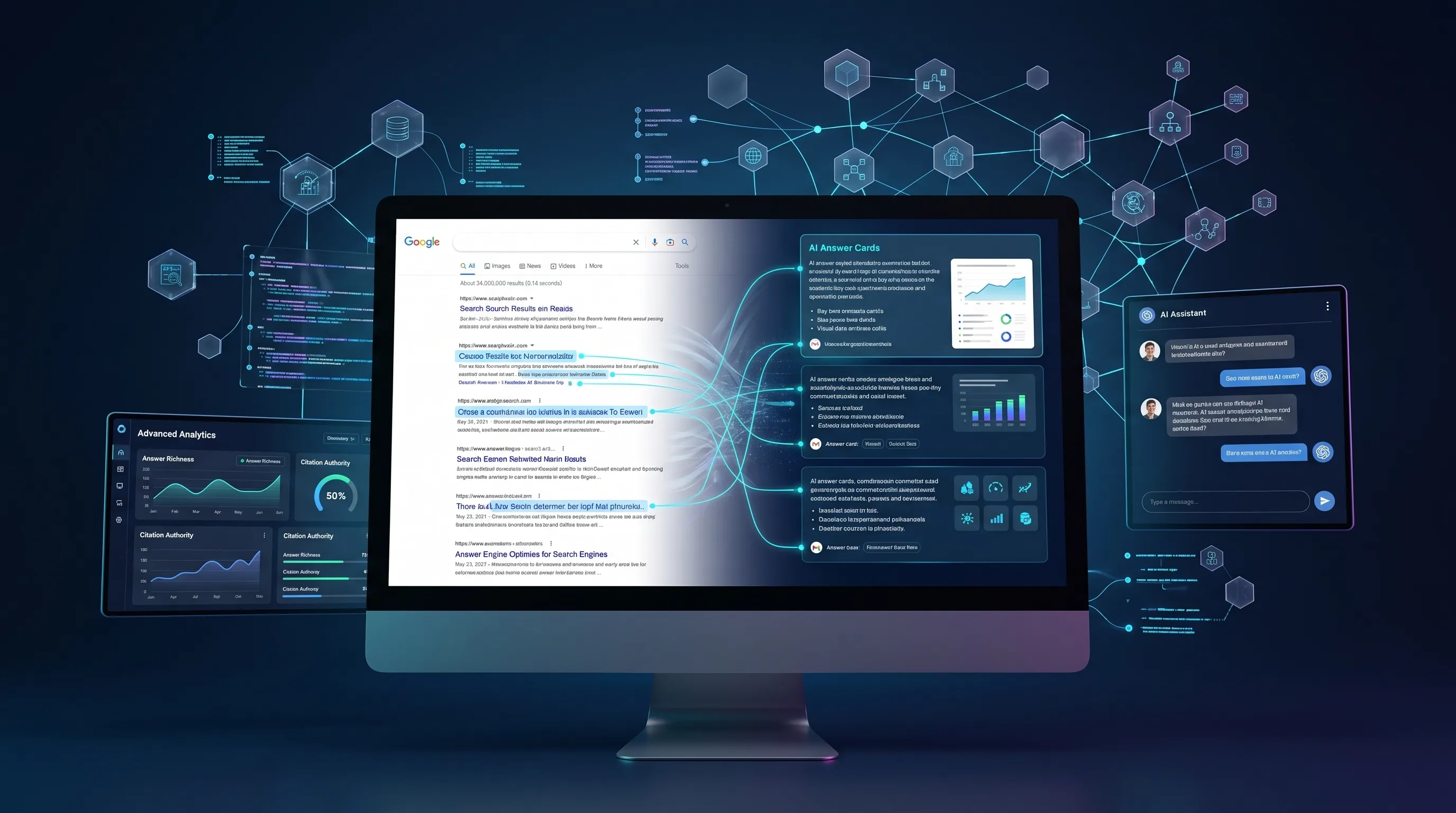
SEO vs GEO vs AIO: What Businesses Need to Know
SEO, GEO, and AI Overviews are reshaping search. Learn how to stay visible, cited, and competitive in 2026.

A business owner opens Google Search Console on a Tuesday morning in early 2026. Their site still ranks number one for their most important keyword. Organic traffic is down 40% from the same period last year. Nothing broke. No penalties. No algorithm violations. The rankings did not move. The search landscape did.
Search no longer works in a single lane. It now operates across three distinct surfaces with different rules, different signals, and different outcomes. That is exactly what the SEO vs GEO vs AIO conversation is really about. Understanding how these three layers interact is not a future concern for businesses that depend on search visibility. It is a present-tense operational decision. Let's break down what each one means, how they differ, and what businesses need to do differently in 2026.
What SEO, GEO, and AIO Actually Mean (And Why These Terms Matter)
These three terms get used interchangeably in marketing conversations, but they describe genuinely different things. Getting the definitions right matters because the optimization strategies, content requirements, and business outcomes are all different.
The full picture of modern search visibility, sometimes framed as aeo vs seo vs geo, reflects how answer engine optimization has emerged alongside generative and traditional search as a third distinct discipline businesses now need to account for.
SEO: Search Engine Optimization
Search engine optimization (SEO) is the practice of optimizing content and websites to rank in traditional search engine results pages, commonly called SERPs. When someone types a query into Google and sees a list of blue links, SEO determines which pages appear and in what order.
Search engine optimization has been the baseline for online visibility for over two decades, and in 2026 remains the foundational layer on which everything else builds on. But SEO in 2026 is not SEO from 2019. What Google rewards now is a combination of technical health, topical authority, page experience, and E-E-A-T signals: Experience, Expertise, Authoritativeness, and Trustworthiness.
The SEO fundamentals that still determine your baseline visibility in 2026 are:
-
On-page optimization, including title tags, header structure, and internal linking
-
Technical SEO covering Core Web Vitals, crawlability, and structured data
-
Off-page authority built through backlinks and genuine brand mentions
-
Content depth and topical coverage that demonstrate subject matter authority
GEO: Generative Engine Optimization
Generative engine optimization (GEO) is the practice of optimizing content so that AI-powered answer engines, including Google's AI Overviews, Perplexity, ChatGPT Search, and Gemini, cite or surface your content in their generated responses.
The core shift is significant. In SEO, the goal is to rank in a list. In GEO, the goal is to be referenced inside an AI-generated answer. Generative engine optimization asks a different question: not "can Google find this?" but "will an AI trust this enough to quote it?" GEO rewards clarity, directness, cited sources, and structured answers far more than keyword density. Understanding what GEO vs SEO is at this level is what separates businesses that are adapting from those watching their traffic erode without understanding why.
AIO: AI Overviews
AI Overviews (AIO) is Google's specific implementation of AI-generated answers in search results. AIO is a feature. GEO is the strategy used to optimize for features like it. GEO is the broader discipline. AIO is one of its most important surfaces.
AI Overviews appear above traditional organic listings and synthesize information from multiple sources into a single generated answer. The traffic consequences when they appear are measurable and significant:
-
Conductor's analysis of 21.9 million queries found AI Overviews now appear in 25.11% of Google searches, with Google's own disclosures citing approximately 50% for certain query categories
-
Ahrefs' study of 300,000 keywords found that organic CTR for the top-ranking page drops by 58% when an AI Overview is present
-
Seer Interactive's research across 42 organizations found CTR drops, reaching 64.4% in some query categories
These are structural changes to how search traffic distributes, not marginal fluctuations.
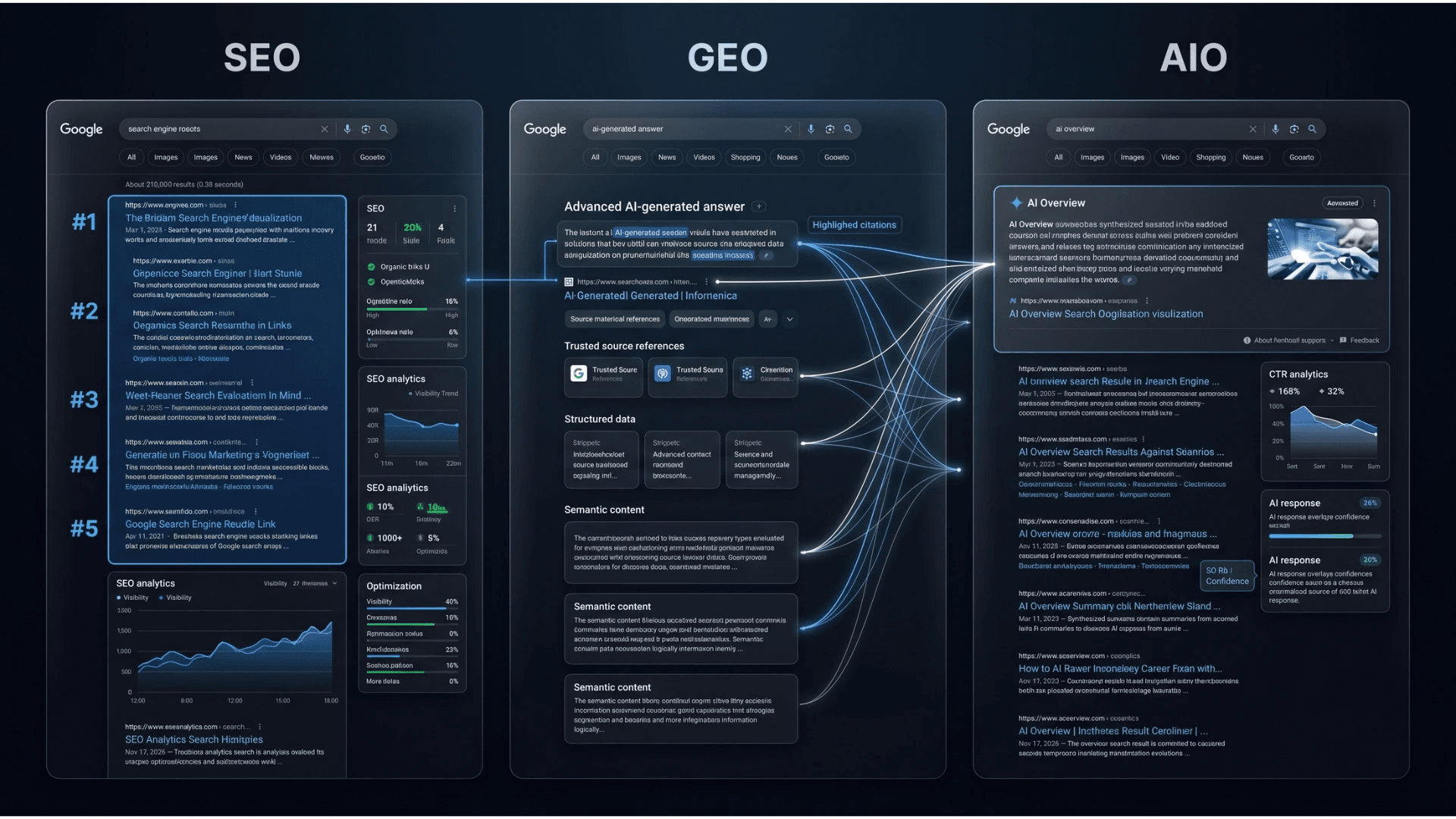
SEO vs GEO vs AIO: The Real Differences, Side by Side
Understanding what is the difference between GEO vs SEO and how AIO fits into that picture is clearest when compared directly across the dimensions that actually affect business decisions.
|
Dimension |
SEO |
GEO |
AIO |
|
Definition |
Optimizing for traditional ranked search results |
Optimizing to be cited in AI-generated answers |
Google's specific AI-generated answer feature in SERPs |
|
Primary goal |
Rank in the top positions of SERPs |
Be referenced inside AI responses |
Appear as a cited source inside Google's AI Overview block |
|
What gets rewarded |
Backlinks, E-E-A-T, technical health, topical depth |
Clarity, cited data, structured answers, trusted sources |
Structured data, heading hierarchy, and helpful content signals |
|
How content is consumed |
User clicks through to your page |
AI extracts and summarizes your content |
AI synthesizes your content above organic results |
|
Click-through behavior |
Direct clicks from the ranked position |
Brand mention with possible indirect traffic |
High visibility, significantly reduced click-through |
|
Key optimization signal |
Domain authority and relevance |
Content trustworthiness and extractability |
Schema markup and content structure |
|
Measurement tool |
Google Search Console, rank trackers |
AI citation monitoring tools |
AI Overview: appearance trackers |
SEO vs GEO vs AIO are not competing strategies. They are overlapping layers of the same visibility system. A business that only optimizes for SEO is leaving GEO and AIO exposure on the table. A business that chases AIO without solid SEO fundamentals has no credible content for the AI to cite. The architecture requires all three. The debate around seo vs aeo vs geo often gets reduced to which one matters most, but that framing misses the point entirely. Each one operates on a different surface and rewards different content signals.
Understanding geo vs seo in 2025 as separate choices was already a mistake. In 2026, treating them as independent strategies is an operational gap with measurable traffic consequences.
How Each One Affects Your Business Traffic
The question every business owner actually has: what does this mean for website visits, leads, and revenue? The answer differs by channel, by query type, and by industry.
Research from SparkToro and Datos confirmed that 58.5% of U.S. Google searches end without a click, with Q1 2026 data showing this figure has climbed to approximately 65%. Zero-click search is the dominant behavior pattern right now, and it is accelerating.
Here is what each channel actually delivers when you break it down by business outcome:
-
SEO delivers direct click-through traffic, long-term compounding visibility, and measurable performance through Google Search Console. It remains the most reliable channel for transactional and navigational queries where users have a clear intent to visit a destination.
-
GEO delivers brand mentions and citations inside AI responses, creating visibility without always generating a click. It builds trust and influences downstream search behavior. AI search traffic, when it converts, does so at significantly higher rates than traditional organic traffic.
-
AIO delivers featured placement at the top of results with high impression volume, but click-through rates on informational queries are substantially lower than traditional organic positions.
The performance gap between channels becomes most visible when broken down by what the user is actually trying to do:
|
Query Type |
SEO Performance |
GEO Performance |
AIO Impact |
|
Transactional (buy, hire, book) |
Strong direct clicks |
Lower relevance |
Limited AIO presence |
|
Navigational (brand searches) |
Dominant |
Lower relevance |
Minimal impact |
|
Informational (how, what, why) |
CTR declining fast |
High citation opportunity |
Strong AIO presence, low CTR |
|
Local service queries |
Strong with local SEO |
Growing relevance |
Increasing AIO presence |
|
Research and comparison |
Moderate, losing ground |
High citation opportunity |
High AIO presence |
For transactional and navigational queries, SEO still dominates and delivers the most direct business value. For informational and research queries, GEO and AIO are taking over fast. AI search visibility is no longer a future concern. It is a present-tense traffic problem that shows up in analytics right now.
What Businesses Should Actually Do: A Practical Optimization Framework
Most businesses cannot run three separate content strategies at full capacity. The practical approach is layered: build a strong SEO foundation, adapt content for GEO, and audit for AIO eligibility as a byproduct of doing both well. A content optimization strategy built only for the 2019-era SEO will miss where search is actually going.
The following content and technical decisions serve all three channels simultaneously; getting them right means every piece of content you produce is already working harder across SEO, GEO, and AIO from the moment it goes live.
-
Write content that directly answers specific questions rather than covering vague topic areas
-
Use structured data, including schema markup, which feeds both Google's algorithm and AI parsers
-
Build genuine E-E-A-T through author bios, cited sources, and first-hand experience signals
-
Create content at multiple depths: overview pages, deep-dive pages, and FAQ clusters
The following adjustments target AI citation eligibility specifically; they are distinct from traditional SEO moves and require a deliberate shift in how content is written and formatted before publishing.
-
Format key answers in clear, citable paragraphs of two to four sentences with no padding
-
Add a quick answer block near the top of long-form content so AI can extract it immediately
-
Cite sources and data inside the content, since AI engines prefer referenced claims over assertions
-
Earn mentions on authoritative third-party sites, because AI systems pull from trusted source clusters
Google has made its AI Overview selection criteria increasingly explicit through its helpful content updates. The following signals reflect what its systems are actively evaluating when deciding which sources to cite.
-
Structured data using FAQ schema, HowTo schema, and Article schema that accurately reflects page content
-
Clear heading hierarchy that breaks content into digestible sections that an AI can parse
-
First-party expertise signals, including author pages, verifiable credentials, and original research
-
Content aligned with Google's helpful content criteria, AI-generated search results now actively deprioritize content that exists to rank rather than to genuinely answer
According to Stackmatix's 2026 research, content with proper schema markup has a 2.5x higher chance of appearing in AI-generated answers, and sites with complete structured data see up to 40% more AI Overview appearances. Schema markup in 2026 is not an advanced SEO tactic. It is a baseline requirement for AI visibility.

Which One Should You Prioritize in 2026?
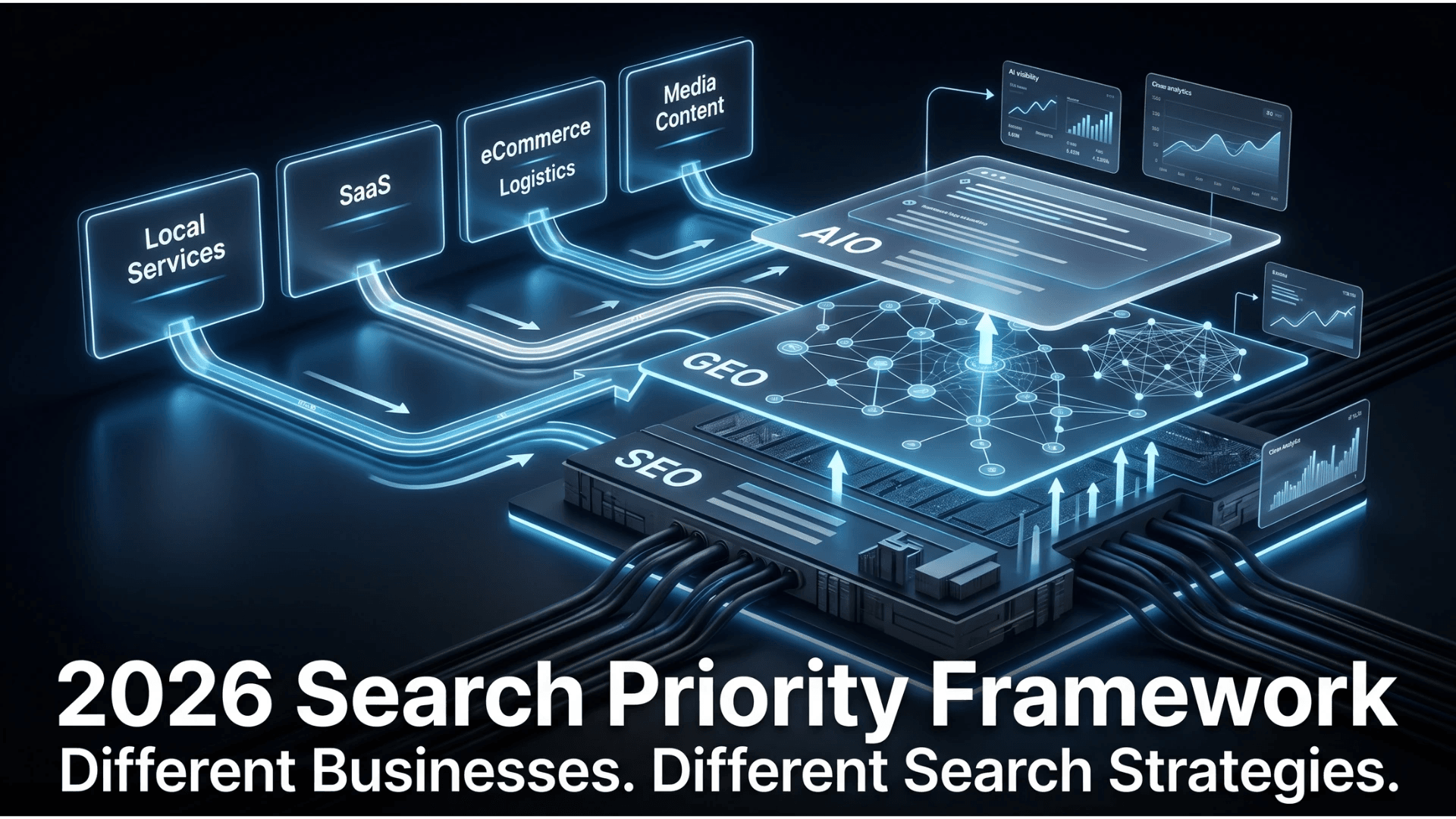
There is no universal answer, but there is a smart default. For most small to mid-sized businesses, the priority order is SEO first, GEO second, and AIO as the natural byproduct of doing both well.
Priority recommendation by business type:
|
Business Type |
Priority Order |
Primary Reason |
|
Local service businesses |
SEO first, GEO second |
Transactional queries still convert through SEO; GEO builds local trust signals |
|
SaaS companies |
GEO first, SEO second |
Research-heavy buyer journeys increasingly resolve in AI answers before a click |
|
eCommerce brands |
SEO first, AIO monitoring |
Transactional queries still drive direct revenue; AIO is expanding into product queries |
|
Logistics and transportation |
SEO first, GEO second |
B2B buyers increasingly use AI search for vendor research and comparison |
|
Content and media businesses |
GEO critical, AIO urgent |
Informational queries are the most heavily impacted by AI Overviews |
GEO is the most underinvested area for most businesses right now, which makes it the highest current opportunity. Most competitors are still writing for 2020-era SEO. Their content is not structured for AI extraction, is not citable, and does not answer questions directly. That gap is real and will not last as awareness of what GEO is in digital marketing vs SEO continues to grow through 2026.
Understanding which is better, GEO vs traditional SEO for local businesses, requires recognizing that the answer depends entirely on query type and customer behavior. The businesses that will lead search in the next three years are the ones treating SEO vs GEO vs AEO not as a debate, but as a layered search engine optimization strategy where each element reinforces the others.
What the Industry Is Still Getting Wrong About Search
The shift toward AI-driven search has created a specific set of blind spots that most businesses are still operating from. The following addresses the most common ones directly, with the context needed to act on them.
What is the difference between SEO, GEO, and AIO?
SEO targets ranked positions in traditional search results. GEO targets citations inside AI-generated answers. AIO is Google's specific implementation of that AI answer layer. They are not interchangeable; each requires a different content architecture. WellsGroup builds visibility systems that account for all three, not just the one that was relevant five years ago.
Does Google's AI Overview replace traditional SEO rankings?
Not entirely, but it significantly reduces the traffic value of those rankings for informational queries. At WellsGroup, we audit both ranking position and AI Overview presence together, because one without the other tells an incomplete story.
How do I optimize my content for AI Overviews?
Structure content to answer questions directly, use schema markup, cite authoritative sources, and build E-E-A-T signals into every page. The businesses appearing in AI Overviews are not doing anything exotic; they are applying systematic content architecture that most competitors have not caught up to yet.
Is GEO the same as SEO, or a completely different strategy?
GEO builds on SEO fundamentals but targets a different output. SEO aims for a ranked link. GEO aims to be the source of AI quotes. Understanding what GEO vs SEO is at an operational level is where most businesses currently have a gap, and where the earliest movers are gaining the most ground.
Will AI search kill organic traffic for small businesses?
Not uniformly. The impact is concentrated on informational queries. Small businesses that identify which query types their traffic depends on and adapt accordingly are the ones holding ground. WellsGroup helps businesses make that distinction before traffic loss makes it obvious.
What type of content gets cited in AI-generated search results?
Content that is structured, specific, well-sourced, and written to answer a defined question. AI systems select sources they can extract cleanly and trust, direct answers, cited data, verifiable authorship, and schema markup. What is SEO vs GEO in practice often comes down to this: SEO content is written to be found; GEO content is written to be quoted.
Search Is Now Three Games Running Simultaneously
Search has changed structurally, not incrementally. It now operates across three overlapping channels with different rules, different signals, and different timelines. SEO is the foundation. GEO is the adaptation. AIO is the outcome of doing both well.
When business owners research geo vs seo vs aeo to decide where to invest first, the answer is almost always the same: fix the SEO foundation, then build GEO citability on top of it, and treat AEO as the byproduct of doing both with structural discipline.
Audit your current content and identify which format it is optimized for. Most business content is written for one channel while ignoring the signals that would make it perform across all three. Pick one gap to close first, starting with structured data and direct-answer formatting, and the compounding effect across SEO, GEO, and AIO will follow.