How to Get Backlinks: 12 Proven Tactics for New Websites
Learn how to get backlinks using ethical strategies, outreach, HARO, guest posting, and content that builds lasting authority and rankings.

Getting backlinks means earning links from other websites that point back to your own, signaling trust and relevance to search engines and AI systems alike. For a new website, the fastest way to learn how to get backlinks is to combine content-driven link-building strategies with manual outreach, structured partnerships, and, in some cases, a dedicated link-building agency. Relevance matters more than volume.
That shift, from chasing volume to earning relevance, defines how backlinks work in 2026. Search engines no longer reward sites that accumulate links indiscriminately. They reward sites that operate like trusted systems, consistently producing content and relationships that other credible sources choose to cite.
This matters more for new websites than for anyone else. A new domain has no history, no existing relationships, and no body of content other sites can reference yet. Every tactic below exists to close that gap faster than waiting it out. Get a Proposal today and see where your site stands today.
Why Do New Websites Struggle to Get Backlinks?
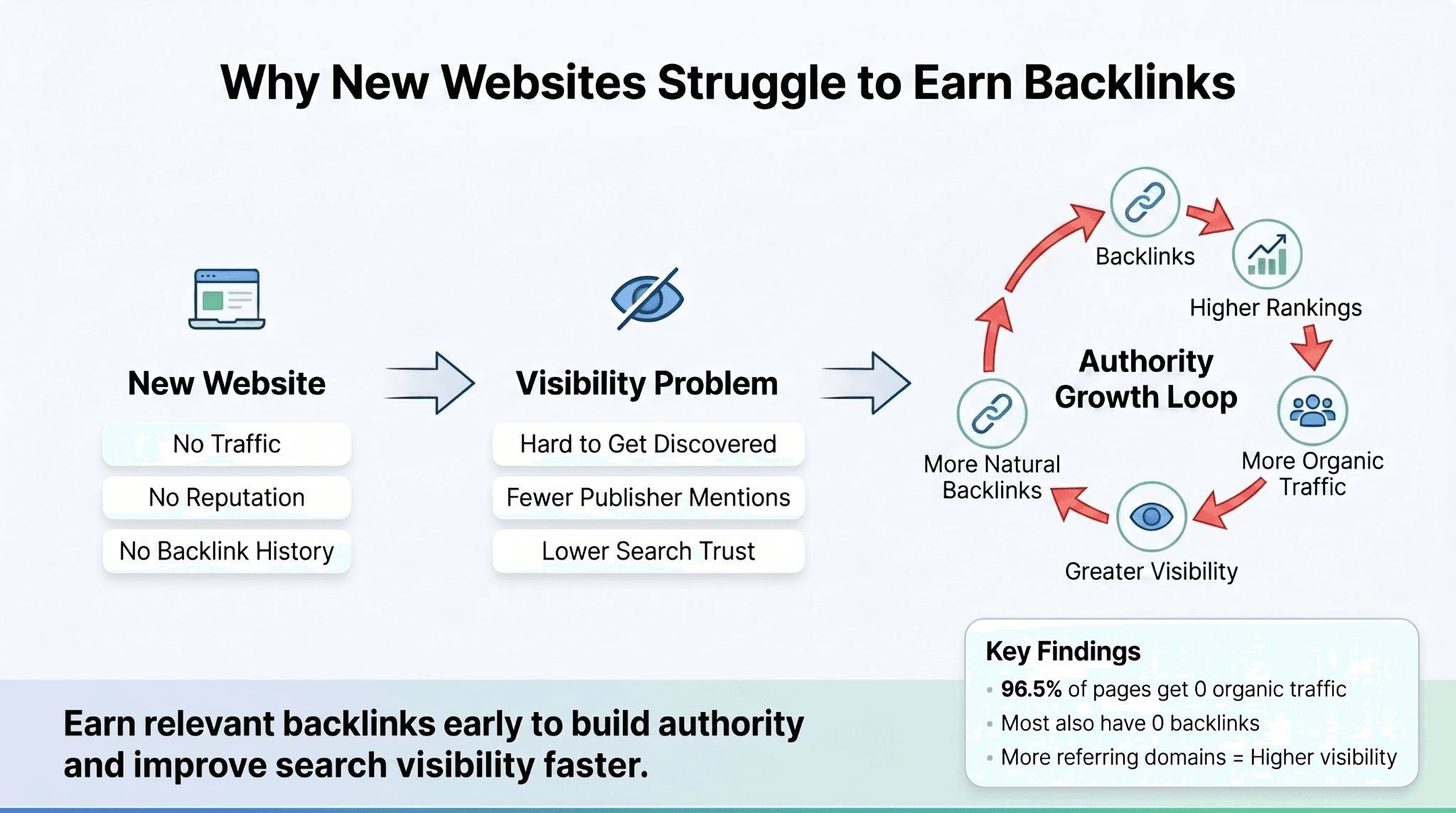
New websites face a structural disadvantage that has nothing to do with content quality. They lack three things that make link acquisition easier over time:
-
Traffic that puts the site in front of other publishers
-
Reputation that signals trustworthiness
-
A track record that search engines can lean on
Established domains attract backlinks somewhat passively because other sites already know they exist. A new site has none of that gravity, and it shows up clearly in the data. This is exactly why understanding how to get backlinks early matters more for a new domain than for one already ranking.
Ahrefs' analysis of 14 billion pages found a pattern that compounds for sites without an existing footprint:
-
Roughly 96.5 percent of pages studied receive no organic Google traffic at all
-
The majority of those zero-traffic pages also carry no backlinks
-
Pages with stronger referring domain profiles consistently correlate with higher organic visibility
The longer a site goes without earning its first set of relevant links, the harder each subsequent one becomes to earn, since search engines weigh existing authority when deciding how much trust to extend. Without a clear plan for how to get backlinks from the start, a new site risks staying invisible long after the content itself is ready to rank.
What Makes a Backlink Valuable?
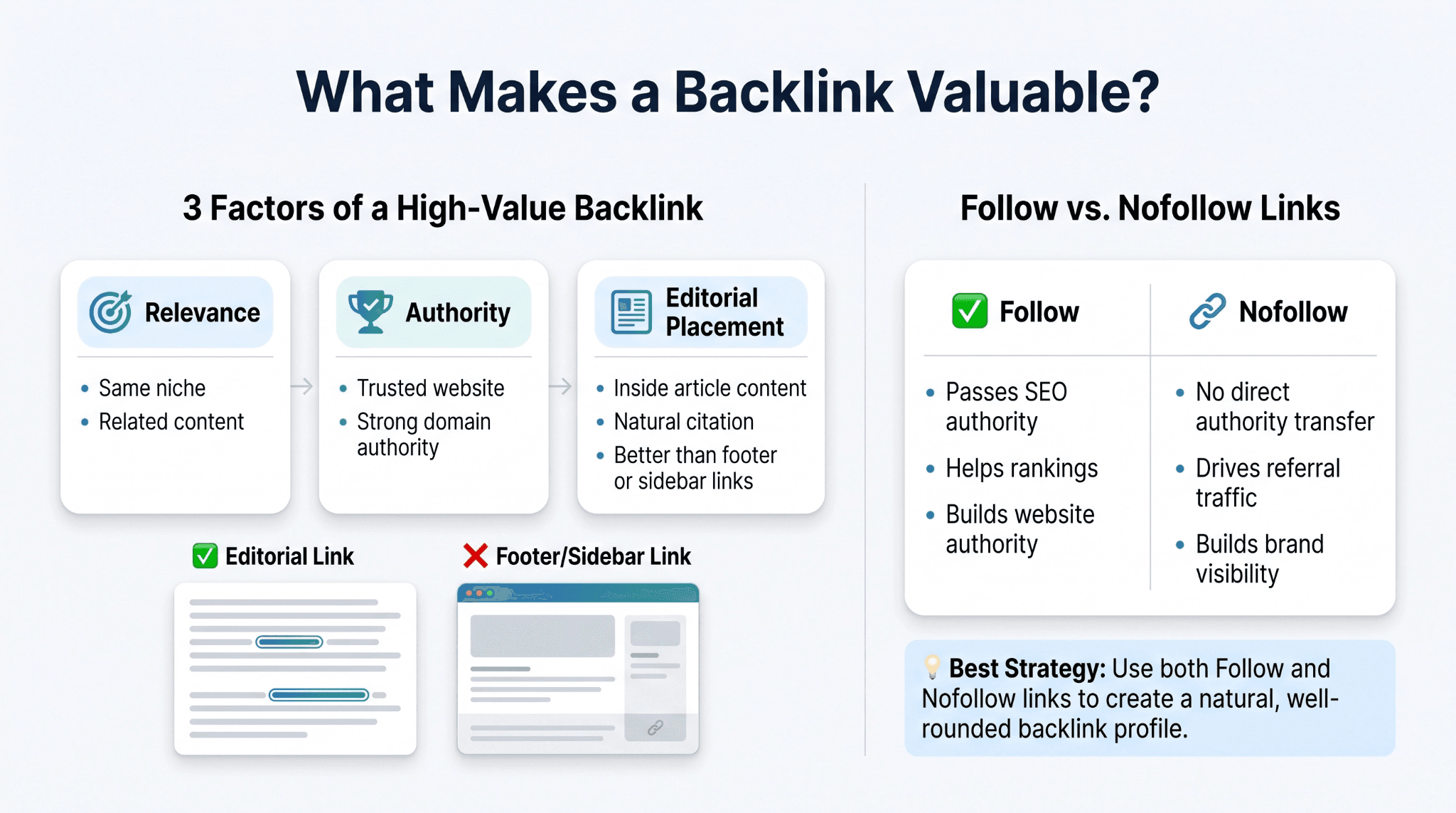
Not every link carries the same weight. Three factors determine a backlink's value:
-
Relevance to your topic or industry
-
The authority of the linking domain
-
Where the link is placed within the content
A link inside a relevant editorial paragraph carries far more weight than the same link buried in a footer or sidebar. Context matters because search engines now interpret links the way a human reader would: a citation inside a thoughtful paragraph reads as an endorsement, while a link dropped into a list of unrelated resources reads as filler.
How Do Follow and Nofollow Links Differ?
A followed link passes authority directly from one site to another. A nofollow link does not pass that signal directly, but it still drives referral traffic, builds brand visibility, and can lead to followed links later, particularly when it comes from a site your target audience already trusts. Both have a place in a complete link-building strategy, and dismissing nofollow links entirely usually means missing real exposure.
How to Get Backlinks Through Content Creation
Content remains the most sustainable foundation for earning links because it removes the need to ask for anything. People link to pages that solve a problem or save them research time.
Backlinko's analysis of content length, based on a study of 912 million blog posts, found that posts exceeding 3,000 words earn roughly 77.2 percent more backlinks than shorter articles, largely because comprehensive pages double as reference material for other writers. The takeaway is not that longer is automatically better, but that depth signals usefulness, and usefulness is what gets cited.
Which Content Formats Attract the Most Links?
Formats that consistently earn links include:
-
Original research or proprietary survey data
-
Free calculators or interactive tools
-
In-depth guides that consolidate scattered information
-
Clear data visualizations and original diagrams
A new site does not need all four at once. Picking one format and doing it well usually outperforms producing several mediocre versions of each.
How to Get Backlinks Through Outreach and Relationship Building
Outreach remains essential for new sites because content alone rarely gets discovered without traffic to surface it. Manual outreach closes that gap, but only when it replaces generic pitching with genuine relevance.
Many businesses also strengthen their authority through HARO link-building services, which connect subject matter experts with journalists seeking credible sources. When combined with personalized outreach, HARO opportunities can earn high-quality editorial backlinks that boost visibility, trust, and long-term search performance.
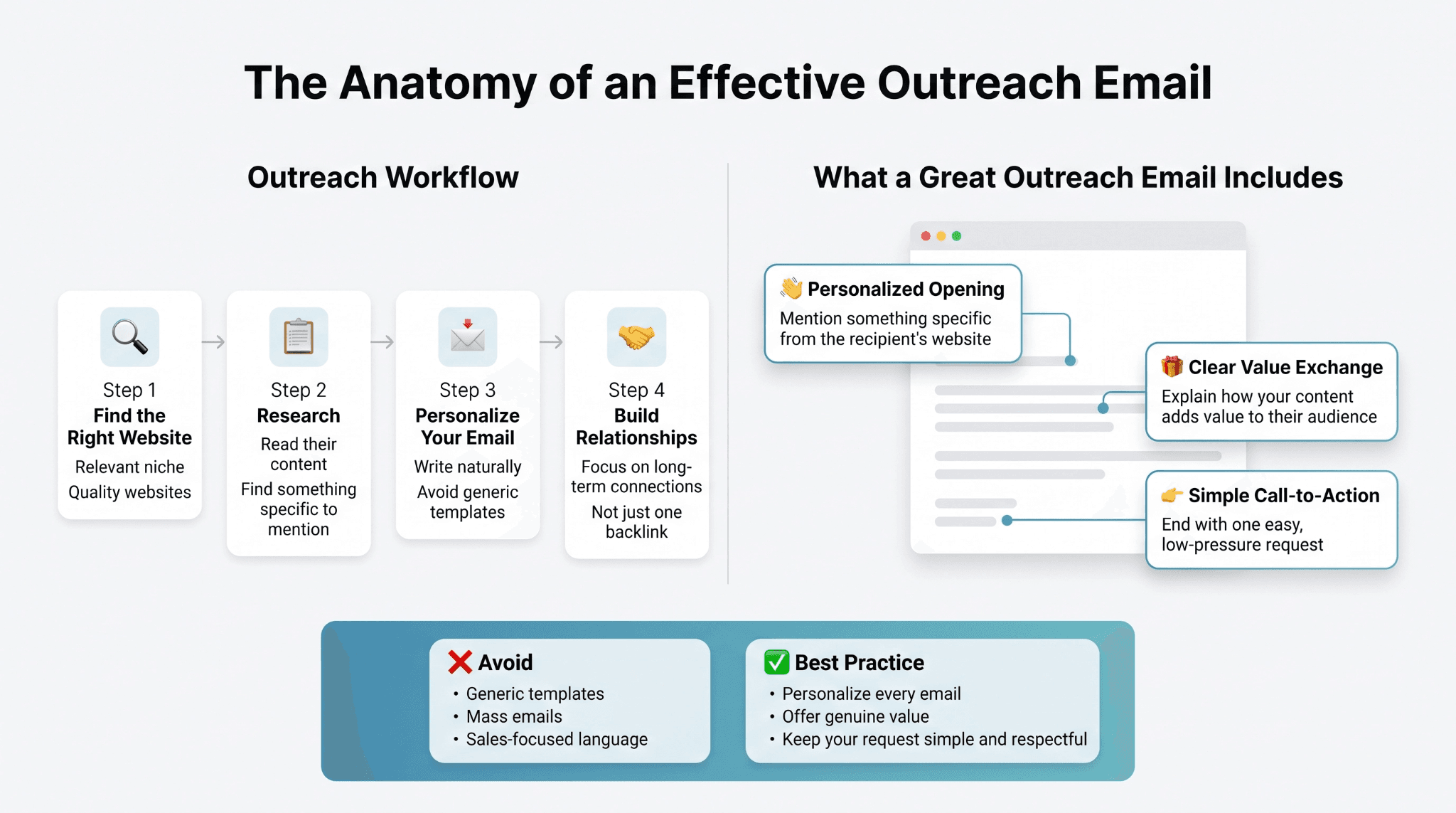
What Does a Good Outreach Email Look Like?
A strong outreach email does three things:
-
References something specific on the recipient's site
-
States a clear value exchange
-
Ends with one simple, low-friction request
Anything that reads as a template gets filtered before it gets read. The most effective outreach treats each email like a one-to-one conversation rather than a mass campaign, even if the underlying research process is repeatable across many prospects.
How to Get Backlinks Through Guest Posting, Broken Links, Digital PR, and Directories
Beyond content and outreach, several other tactics round out a complete link-building strategy. Each works differently, but all reward the same thing: relevance over volume.
Guest Posting Done the Right Way
Guest posting still works in 2026, but the bar has risen. Search engines now distinguish between:
-
Guest contributions on topically relevant, editorially run sites
-
Mass-produced placements on low-quality guest post networks built purely for links
The safest approach is pitching original ideas to sites your actual audience already reads. One relevant, well-placed guest article outperforms a dozen low-quality ones, and it builds a relationship you can return to later for future placements, co-marketing, or referral traffic.
Broken Link Building as a Value Exchange
Broken link building is one of the most reliable, beginner-friendly link building strategies available, because it offers genuine value to the site owner rather than asking for a favor.
The process follows a simple cause-and-effect logic:
-
Find a dead link on a relevant page
-
Create content that replaces what was lost
-
Notify the site owner of your replacement as the fix
Site owners fix broken links because it improves their own page, not because they owe you anything. This tactic also tends to convert at a higher rate than cold outreach, since the request is framed as help rather than a pitch.
Digital PR and Newsworthy Assets
Digital PR earns backlinks from high-authority publications by giving journalists something they need: a story backed by original data or a credible expert voice.
Two tactics drive most results here:
-
Source platforms that connect journalists with expert commentary
-
An original statistic or survey, often called a linkable asset, that gives writers a reason to cite you directly
This approach takes longer to produce results than outreach or guest posting, but the links it earns tend to come from domains a new site could rarely access through direct pitching alone.
Local and Niche Directory Listings
Directory listings will not carry a new site on their own, but they remain a low-effort, low-risk addition to a broader strategy for anyone learning how to get backlinks, especially for businesses with a physical location or a defined regional market.
The principle here is selectivity. A handful of links from relevant, well-maintained industry directories does more for credibility than dozens of links from generic directory sites that exist purely for SEO value. Quality over quantity applies just as much here as it does to outreach and guest posting.
Should You Use a Link Building Agency or Build Backlinks Yourself?
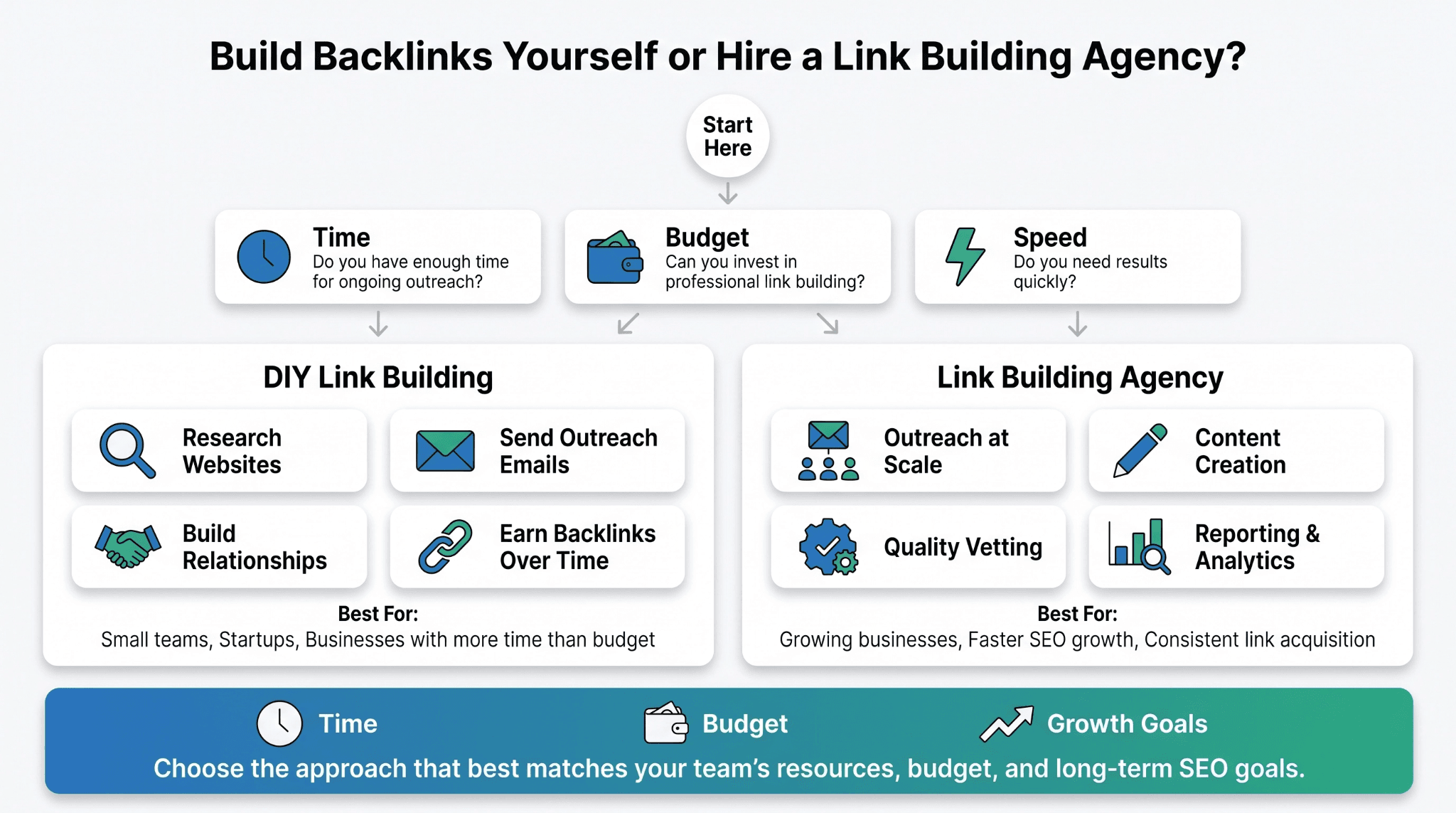
This decision usually comes down to three variables:
-
How much time does your team has
-
How much budget can you allocate
-
How quickly do you need results
Neither path is inherently better. The right choice depends on where the business is in its growth cycle and how much internal capacity exists to sustain a consistent link-building cadence month after month.
What Do Link Building Services Typically Include?
A reputable link-building agency typically handles:
-
Outreach at scale
-
Content creation tied to link acquisition
-
Vetting of placement quality
-
Ongoing reporting on referring domains and link velocity
The value is less about the links themselves and more about the system and relationships built behind them, something that takes most internal teams months or years to develop on their own.
When Is DIY Link Building the Better Option?
DIY link building works well when the team has bandwidth, subject matter expertise, and a longer runway before results are needed. It is slower, but it builds internal knowledge of what works for a specific niche, knowledge that often pays dividends well beyond the initial campaign.
The table below summarizes the trade-off.
|
Factor |
DIY Link Building |
Link Building Agency |
|
Speed |
Slower, depends on internal capacity |
Faster, dedicated resourcing |
|
Cost |
Lower direct cost, higher time cost |
Higher direct cost, lower time cost |
|
Expertise required |
Must be developed internally |
Provided by the agency |
|
Best suited for |
Early-stage teams with time and a limited budget |
Growing teams needing to scale quickly |
What Backlink Tactics Should New Websites Avoid?
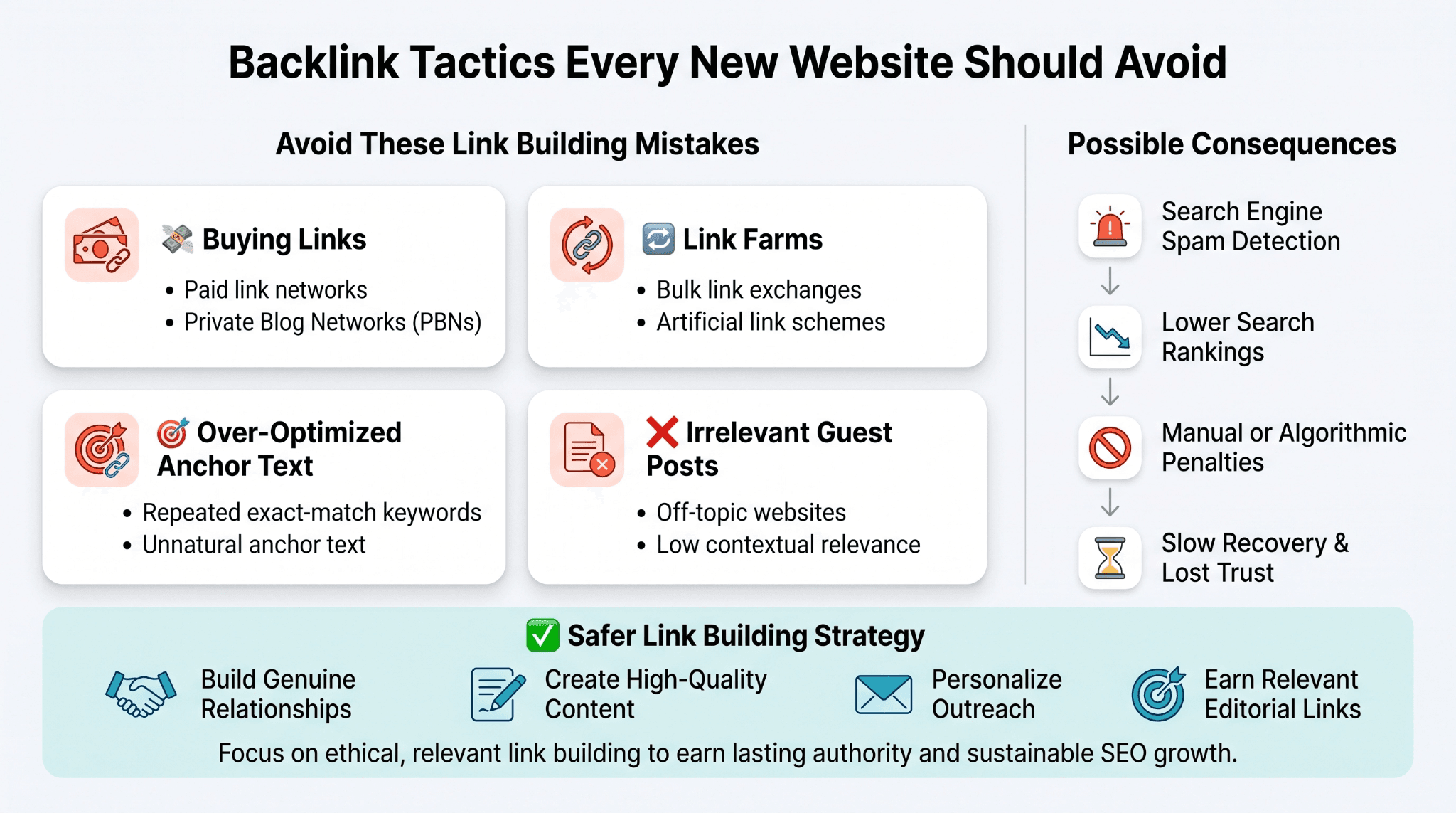
Search engines' spam detection systems have become considerably better at identifying manipulative patterns. Avoid these common mistakes:
-
Buying links from paid link networks or private blog networks
-
Exchanging links in bulk through link farms
-
Over-optimizing anchor text with exact match keywords repeatedly
-
Accepting irrelevant guest post placements purely for the link
Any of these can trigger a manual action or algorithmic penalty that takes far longer to recover from than the time saved by skipping ethical link-building strategies in the first place. New sites are particularly vulnerable here, since they have little established trust to fall back on if a penalty hits.
How Do You Track and Measure Backlink Success?
Three indicators tell most of the story:
-
Number of referring domains
-
Movement in organic traffic to linked pages
-
Changes in keyword rankings tied to those pages
According to a 2026 industry study by WebFX analyzing 1,462 domains across 15 sectors, page one rankings correlate with a median of 907 referring domains, though that figure varies dramatically by industry. The right benchmark is never a generic number pulled from an unrelated niche. It is the median for direct competitors in the same space.
|
Industry |
Median Referring Domains for Page One |
|
Apparel |
76 |
|
General Services |
Varies by competition |
|
Finance & Insurance |
3,027 |
Common Things Readers Want to Know About Backlinks
A few questions come up again and again once the core strategy is in place. Here are five direct answers worth bookmarking before you start building.
How many backlinks does a new website actually need to rank?
There is no fixed number. It depends entirely on your industry's competition level, which is exactly why working with a team that benchmarks against real competitor data, rather than generic advice, makes the difference between guessing and growing on schedule.
How long does it take to see results from link building?
Most sites see measurable movement within three to six months, depending on competition and link quality. A consistent, professionally managed link velocity tends to compress that timeline rather than stretch it.
Do nofollow links still help SEO?
They do not pass direct authority, but they support visibility, referral traffic, and brand mentions that strengthen trust signals over time. A well-rounded strategy treats them as a complement, not a substitute.
Is one high-authority link better than many low-quality links?
Yes. A single relevant, high-authority link consistently outperforms dozens of low-relevance ones, which is why quality vetted outreach delivers better long-term value than mass link building tactics.
Should a new business hire a link-building agency or try it independently first?
It depends on internal bandwidth and how quickly results are needed. Teams without the time to manage outreach, vetting, and reporting often see faster, safer progress by partnering with an experienced agency from the start.
Building Authority One Link at a Time
Backlinks compound. A site that earns a handful of relevant, high-quality links every month will consistently outperform a site that bursts and stalls. Consistency, not speed, is what search engines and AI search systems reward.
Content creation gives outreach something worth sharing. Outreach gives content somewhere to land. Guest posting and digital PR extend that content's reach into rooms a new site could not otherwise enter, while directories and broken link building round out a profile that looks natural rather than manufactured.
A new website that treats link building as an ongoing system, rather than a one-time push, builds the kind of authority that holds up over years, not weeks. The sites that win the next search cycle will be the ones that started building that authority before they felt ready to. Book a Free Consultation and walk away with a backlink plan built for where you are right now.