How Custom Business Systems Improve Daily Operations
Learn how custom business systems streamline operations, eliminate manual work, improve customer experiences, and create scalable growth.

A storage facility owner is juggling three spreadsheets, two phone lines, and a whiteboard to track rentals, payments, and complaints. Across town, a taxi dispatch company is losing repeat customers because nobody has a record of their preferences. Both businesses have the same problem. They outgrew their tools without replacing them.
Salesforce and MuleSoft's 2024 Connectivity Benchmark Report found that 80% of organizations cite data silos as a concern, with less than 30% of their business applications integrated. The result is duplicated work, rising costs, and disconnected customer experiences across every industry and business size.
That is exactly the gap custom business systems are built to close. Not software that almost fits, but tools built around how a specific business actually runs. Let's find out how custom systems improve daily operations across industries, from CRM and quoting tools to phone systems, dispatch platforms, and security setups.
What a Custom Business System Actually Does (And Why Off-the-Shelf Software Falls Short)
Most small businesses start with generic software because it is fast and affordable. The breaking point is rarely one big failure. It is a slow accumulation of workarounds that consume hours, create errors, and erode customer experience over time.
McKinsey research found that employees spend 1.8 hours every day searching and gathering information across disconnected tools. Hubstaff's 2026 Global Benchmarks Report found the average worker now uses 18 apps per day and gets only 2 to 3 hours of uninterrupted focus time. When systems do not talk to each other, that gap is filled with manual work.
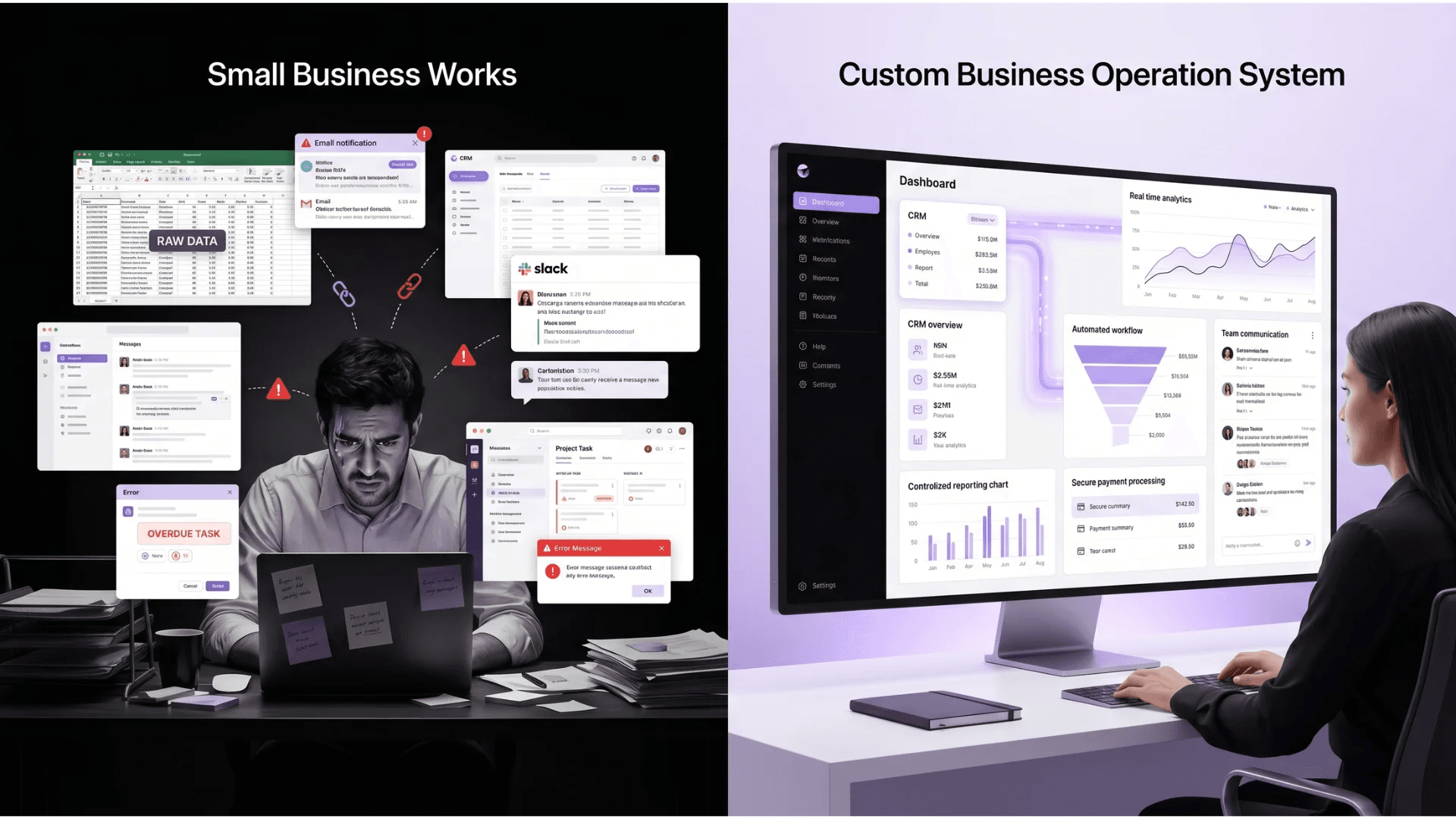
The table below places both approaches side by side across the dimensions that matter most when making a build-or-buy decision:
|
Factor |
Off-the-Shelf |
Custom Business System |
|
Built for |
General market |
Your specific workflows |
|
Cost model |
Monthly subscription, scales with users |
Higher upfront, lower long-term cost |
|
Flexibility |
Limited by the vendor roadmap |
Fully owned and modifiable |
|
Integration |
Dependent on available connectors |
Built to connect with your existing stack |
|
Data ownership |
Vendor-controlled |
Fully owned by your business |
|
Scalability |
Hits ceilings as complexity grows |
Designed to grow with your operation |
The decision to customize business management system infrastructure usually comes after one too many dropped balls. A customized business operating system is not a luxury reserved for enterprises. Mid-sized businesses and small operators are increasingly building them because the cost of not doing so compounds every month.
Custom Business Systems for CRM and Customer Management
A CRM is the most common entry point for custom system investment and the most commonly misused tool in small business operations. The real value of a customer relationship management system for a small business comes when it is shaped around that business's specific customer journey, not a generic sales pipeline template.
CRM Systems for Service-Based and Storage Businesses
Storage businesses have a customer journey that generic CRMs handle poorly. The top-rated management systems for customer service in storage businesses are the ones configured specifically for how storage operators track tenants and units on a daily basis, not the most widely marketed platforms.
A customer management system for small business owners in the storage sector needs to eliminate the phone calls that happen because records are incomplete. The customer relationship management system for small businesses that works best mirrors the operator's actual daily workflow.
The following capabilities are essential for any operator managing recurring service relationships with physical inventory tied to customer accounts:
-
Unit or service availability tracking tied directly to customer records
-
Automated billing reminders and overdue alerts before accounts become delinquent
-
Move-in, move-out, and contract renewal triggers without manual monitoring
-
Complaint and maintenance request logging per customer with resolution status
-
Communication history across phone, email, and SMS in one thread
-
Reporting on occupancy rate, churn, and average customer lifetime value
AI-Assisted CRM and Custom Quoting Systems
One of the most practical developments for small businesses in 2026 is using AI agents to extend CRM functionality, specifically around quoting. This is exactly what an AI agent creates: a custom crm quoting system, small business points to in practice: a specific workflow built into an existing or new CRM that handles the quoting cycle without human intervention at each step.
In 2026, the combination of AI agents and configurable CRM platforms has made the following capabilities accessible for businesses well below the enterprise threshold:
-
Auto-generate quotes based on job type, materials, and labor inputs already stored in the system
-
Pull customer history to apply loyalty pricing or flag high-risk accounts before a quote is sent
-
Send quote follow-ups automatically at set intervals without manual scheduling
-
Log quote acceptance and rejection rates for pricing analysis over time
-
Integrate with invoicing so accepted quotes convert without manual re-entry
Business Phone Systems and Dispatch Platforms: How They Affect Customer Experience Directly
Phone systems and dispatch platforms are two of the most customer-facing operational systems a business runs, and two of the most often treated as commodity purchases. How business phone systems improve customer support is a daily operational reality for any business handling inbound service calls at volume.
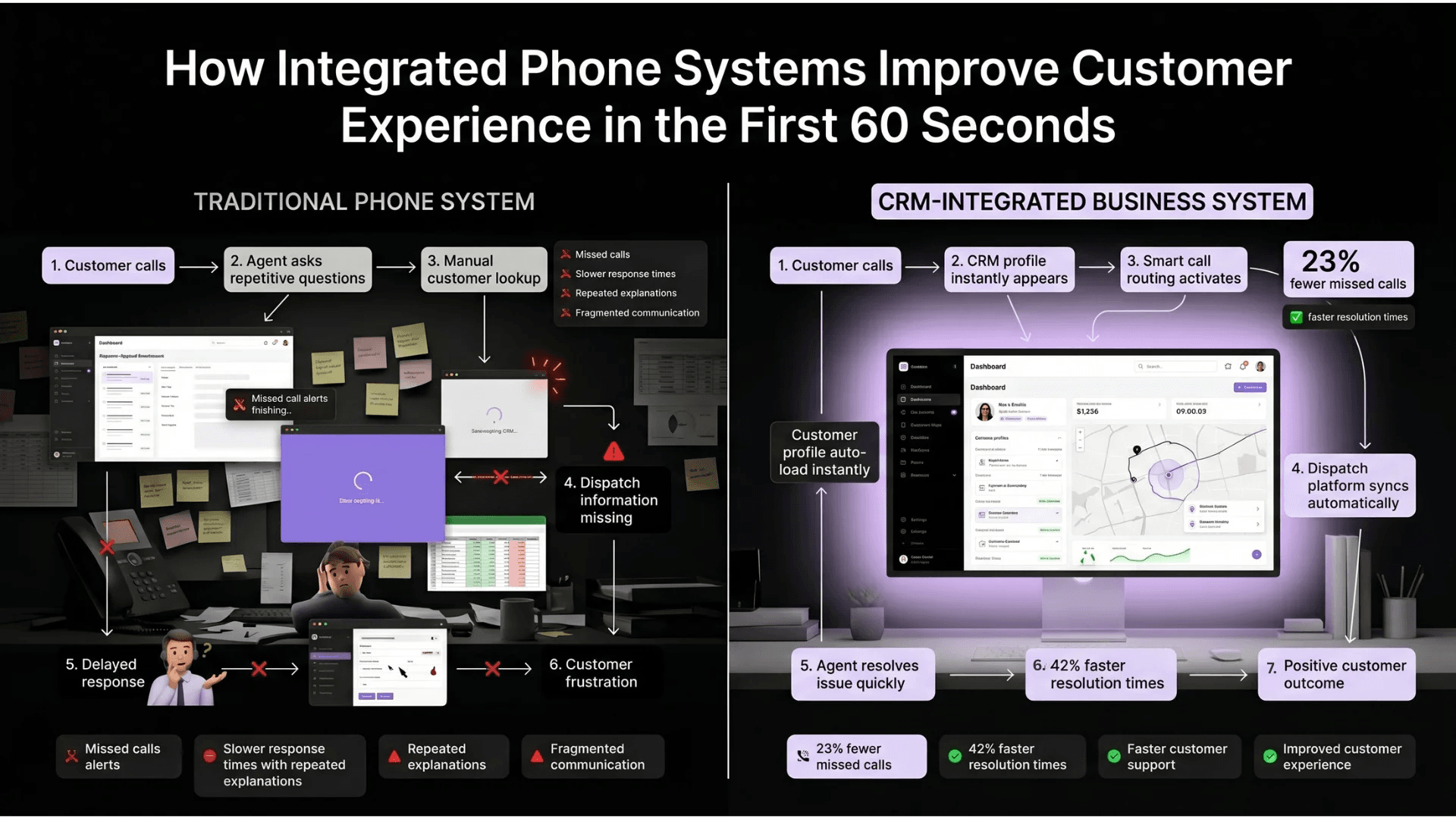
The benefits of business phone systems for customer experience are most visible in the first 60 seconds of a call. When evaluating business phone system brands, customer feedback improvement data, CRM integration, call routing, and response time tracking consistently move the needle most.
INSIDEA's 2026 research on CRM systems found that businesses using CRM-integrated phone systems improved customer retention by up to 27% and increased agent productivity by more than 30%. When the caller's record appears on screen before the agent picks up, the first 30 seconds become productive instead of introductory. CompuVoIP's 2026 data further confirms that businesses deploying AI-assisted phone integrations report up to 95% fewer missed calls after implementation.
The table below maps the features that matter most in a configured business phone system against the direct customer outcome each one produces:
|
Feature |
What It Does |
Customer Impact |
|
CRM integration |
Pulls the caller record on the incoming call |
The agent knows who is calling before speaking |
|
Call routing rules |
Routes by inquiry type, time, or agent skill |
Fewer transfers, faster resolution |
|
Voicemail to email |
Converts voicemail to text and sends it to the inbox |
No missed messages during high-volume periods |
|
Call recording |
Logs all interactions for review |
Quality control and dispute resolution |
|
After-hours response |
Automated reply with callback scheduling |
Customer feels acknowledged outside business hours |
The best customer management system for taxi businesses combines dispatch logic with customer history so every driver and dispatcher knows who they are serving before the call connects. A business taxi dispatch system customer support configuration that does not log ride history, driver performance, and complaint resolution in one place will always produce inconsistent service.
A custom dispatch system for taxi or logistics businesses should cover the following operational requirements at a minimum, regardless of fleet size or geography:
-
Ride or job history tied directly to the customer profile
-
Driver rating and performance tracking per customer
-
Automated booking confirmation via SMS or app notification
-
Complaint logging with resolution status and follow-up trigger
-
Integration with the business's main CRM or phone system
Industry-Specific Custom Systems: Security, Operations, and Travel Management
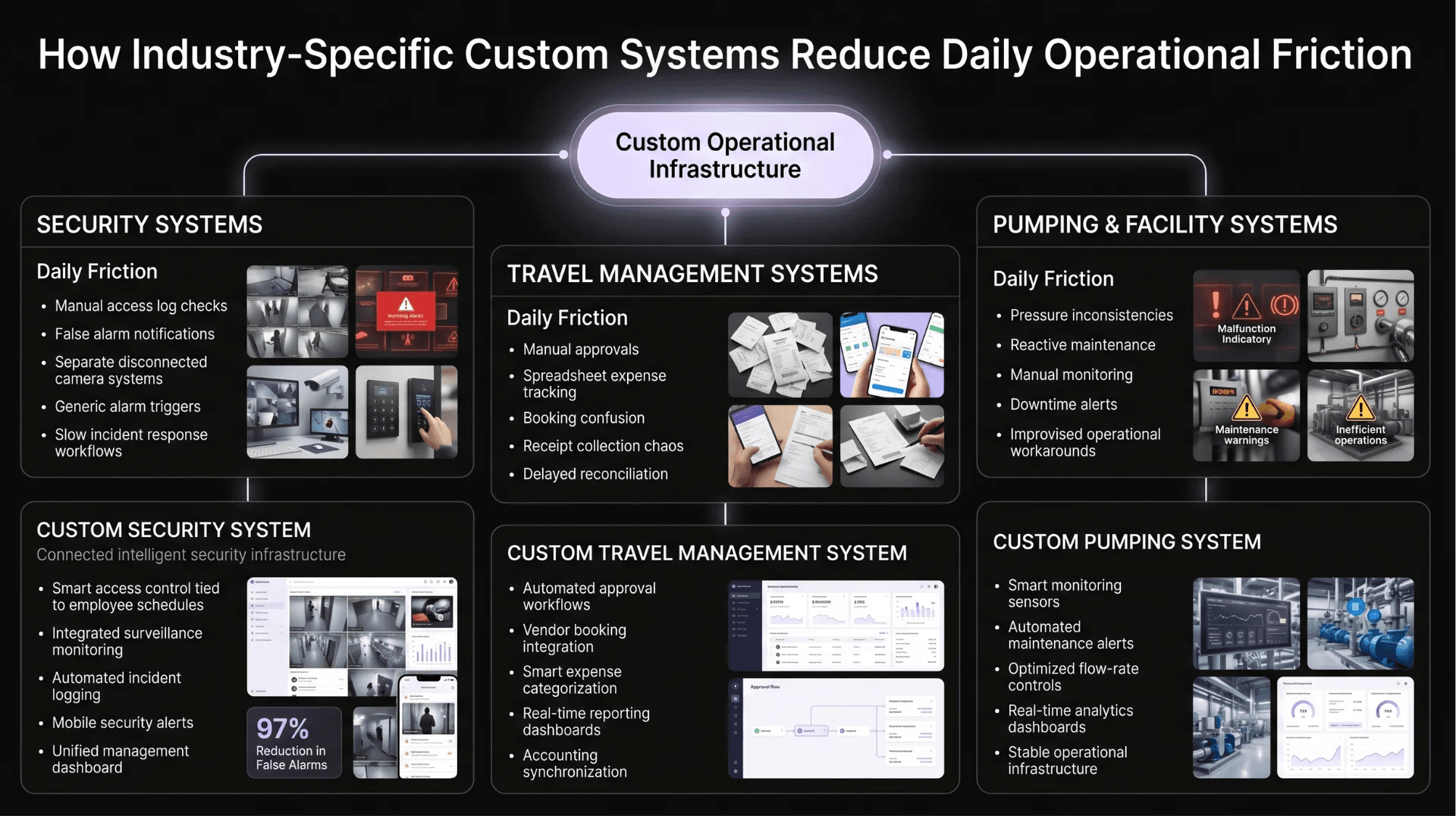
Beyond CRM and communication platforms, some of the most significant daily operational improvements come from physical and operational infrastructure. Security setups, pumping systems, and travel management platforms each solve a category of daily friction that generic tools handle inconsistently. When a system is built around how a specific operation actually runs, the daily overhead of managing it drops measurably.
Custom Security Systems for Business Operations
For facility managers, security is a daily operational responsibility. Checking access logs, reviewing after-hours alerts, and responding to incidents happen every day, and their efficiency depends entirely on how well the security system integrates with the rest of the business.
A professionally configured custom security system for business installation connects access control to employee records, links camera feeds to alarm triggers, and routes alerts to a management dashboard that staff actually use. Interface Systems' 2024 State of Remote Video Monitoring report found that stores using integrated video verification saw a 97% reduction in false alarms, reducing unnecessary dispatches and keeping security staff focused on real events.
The following points reflect where a custom security installation directly reduces daily management overhead:
-
Access control tied to employee schedules and roles, not a single master PIN
-
Camera placement designed around the actual facility's blind spots
-
Alarm triggers connected to specific zones with varying sensitivity thresholds
-
Remote monitoring with mobile alerts for after-hours activity
-
Integration with business management software for automated incident logging
Custom security systems for businesses in Colorado specifically need to account for weather-related hardware durability, remote property monitoring across large distances, and state-specific data retention requirements, all of which affect daily system performance, not just incident response.
Travel Management and Pumping Systems: Operational Custom Builds
A custom business travel management system eliminates the manual expense reporting, booking approvals, and reconciliation that typically consume three to five hours per trip per employee. For field service teams and contractors, the difference between a manual process and a configured one is measured in hours per week.
The following capabilities define what a properly scoped travel management system should handle from approval through reconciliation:
-
Pre-trip approval workflows tied to budget thresholds by department or project
-
Booking integration with preferred vendors and negotiated rate agreements
-
Automated expense categorization and receipt capture without manual submission
-
Reporting by project, department, or employee for accurate cost attribution
-
Integration with accounting software to eliminate double-entry at month-end
For industrial and facilities businesses, the benefits of customized pumping systems for businesses follow the same logic. A pump system configured for the exact flow rate, pressure requirements, and monitoring needs of a specific operation reduces daily maintenance burden and eliminates the workarounds that accumulate when a standard unit is pressed into a non-standard application.
How to Set Up Custom Business Systems That Actually Stick
Most businesses stall on custom business systems, not because they do not see the value, but because they do not know what getting one built actually involves. Every custom business system starts with the same question: what is the manual step costing the most time or causing the most errors right now?
Regardless of whether the system is a CRM, a dispatch platform, a phone system, or a security installation, the decision sequence below applies consistently:
-
Define the specific problem being solved, not the software category wanted
-
Map the current workflow in detail, including every manual step, workaround, and handoff
-
Identify which parts create the most friction or the highest error rate
-
Decide between building from scratch, configuring an existing platform, or extending with integrations
-
Set a realistic timeline: configuration takes weeks, fully custom builds take months
-
Identify who will own the system post-launch, because no system survives without an owner
The table below compares the four most common build approaches by timeline and fit:
|
Approach |
Timeline |
Best For |
|
Platform configuration |
2 to 6 weeks |
Needs that fit within an existing tool's capabilities |
|
Integration layer build |
4 to 10 weeks |
Multiple disconnected tools that need to communicate |
|
Custom development |
3 to 9 months |
Workflows no existing tool can accommodate |
|
Hybrid approach |
6 to 16 weeks |
Most small and mid-sized businesses in practice |
Gartner's SMB software research confirms SMB software spending will grow at 13.3% CAGR through 2028, with two-thirds of SMBs intending to invest in AI-powered software to overcome operational challenges. When mapped correctly, the business operating system customer journey feels invisible to the customer: every touchpoint handled, every follow-up automated, every complaint logged before it escalates. Custom business systems setup rarely goes perfectly on the first build. Treat version one as a starting point and build in a review at 30, 60, and 90 days post-launch.
What Business Owners Ask About Custom Systems
Building or commissioning a custom system raises the same practical questions almost every time. The following addresses them directly, without softening the trade-offs.
What is a custom business system, and how is it different from off-the-shelf software?
A custom business system is built around your specific workflows and operational logic, not the average use case of a thousand other businesses. Off-the-shelf software asks your business to conform to its design. A custom system conforms to your needs. WellsGroup maps how a business actually operates before a single tool is selected or configured.
How do I choose the right customer management system for my small business?
Start by identifying the specific friction point, incomplete records, missed follow-ups, disconnected billing, and work backward from there. The right system removes that friction without creating new complexity. WellsGroup evaluates fit against your actual customer journey before recommending any platform.
Can a small business afford a custom CRM with AI-assisted quoting?
In 2026, yes. Configurable CRM platforms and AI agents have brought this capability well within reach for small businesses. The more relevant question is what manual quoting is currently costing in time and lost conversions. WellsGroup scopes these builds around real workflow requirements so the investment has a defined return.
What features should a taxi dispatch system include for better customer support?
At minimum: ride history tied to the customer profile, driver performance tracking, automated booking confirmation, and complaint logging with follow-up triggers. The best customer management system for taxi businesses connects all of that to a central CRM. WellsGroup builds dispatch configurations that eliminate the gaps generic platforms leave open.
How do custom security systems for businesses differ from standard retail installations?
The hardware may look similar. The architecture is not. A custom security system integrates access control with employee records, connects camera feeds to alarm triggers, and routes alerts to a dashboard your team actually uses. WellsGroup designs security configurations around the specific facility, risk profile, and daily operational requirements of each client.
How long does it take to set up a custom business management system?
A configuration-based system typically takes two to six weeks. A full custom build takes three to nine months. The variable is the quality of the brief going in. WellsGroup invests in the scoping phase upfront so timelines reflect real work, not estimates that shift after the project starts.
Fit Is the Whole Argument
Custom systems do not fix broken businesses. They remove the friction that stops a working business from scaling. Whether that is a CRM built for a storage facility, a dispatch platform for a taxi company, a phone system configured around a support team, or a security installation designed for a specific site, the common thread is fit. A system that fits the actual workflow gets used. One that does not get worked around.
Pick the one operation that costs the most daily friction, missed calls, lost quotes, manual data entry, or inconsistent customer records, and start there. That is where a custom business system pays for itself fastest.