Google Ads vs Meta Ads: Which Is Better for Your Business
Google Ads and Meta Ads serve different goals. Learn which platform delivers better results based on customer intent.

A founder sits with two browser tabs open. One shows Google Ads. The other shows Meta Ads. They have $500 to spend and no clear answer on where it should go.
Google Ads vs Meta Ads is not a question of which platform is better. It is a question of which one matches what your customer is doing at the moment they see your ad. In 2026, the stakes are higher than ever. According to eMarketer's April 2026 forecast, Meta is projected to overtake Google in worldwide digital ad revenue for the first time in history, reaching $243.46 billion versus Google's $239.54 billion. Both paid advertising platforms are evolving fast, and the businesses winning on either are the ones that understand the mechanics before they spend a dollar.
What Each Platform Actually Does (And How They Make Money)
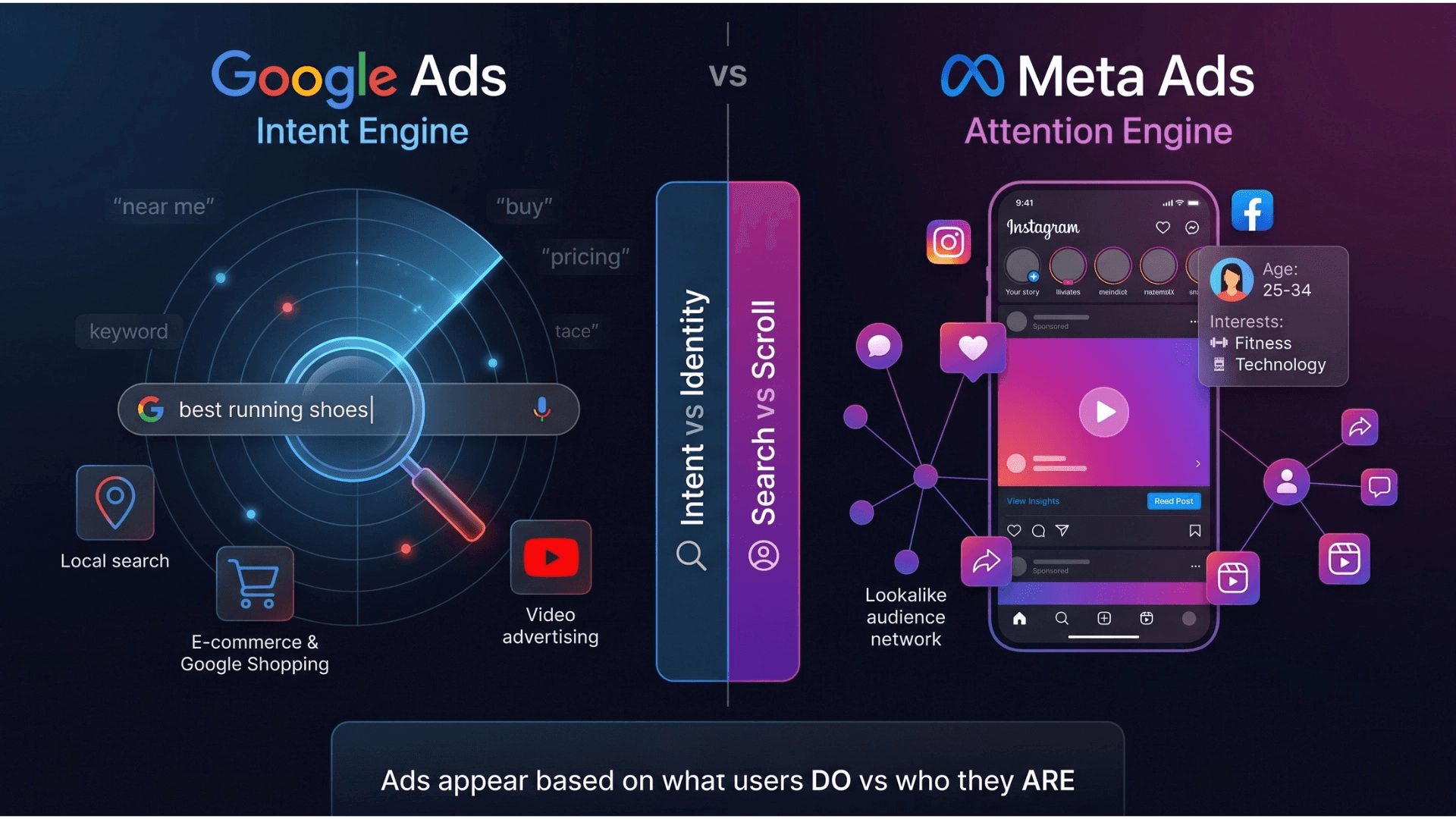
Google Ads vs Meta Ads represent two fundamentally different advertising models.
Google Ads is intent-based. When someone types a query into Google, they are already looking for something. You are bidding to appear at the moment that needs surfaces, through Search, Display, Shopping, or YouTube ads.
Meta Ads is interruption-based. Users on Facebook and Instagram are not searching for anything. You are reaching them based on who they are: demographics, interests, behaviors, and life events. The ad appears in their feed while they scroll. Understanding the Google Ads vs. Meta Ads differences at this structural level, intent-based versus interruption-based, is what separates advertisers who allocate budget strategically from those who choose a platform based on familiarity alone.
The contrast between paid search vs social ads becomes clearest when you look at what triggers the ad to appear:
|
Platform |
Ad Trigger |
Primary Format |
Core Strength |
|
Google Ads |
User search query or browsing context |
Text, Shopping, Display, Video |
Capturing existing demand |
|
Meta Ads |
User demographic and interest profile |
Image, Video, Carousel, Story |
Creating and targeting demand |
The choice between them starts with one question: what is your customer doing when they see your ad?
Audience Targeting: How Each Platform Finds Your Customer
Targeting logic is where the real difference between Meta ads and Google ads becomes operationally significant. Both platforms can reach your customer at very different moments through very different signals.
How Google Targets: Intent Signals and Search Behavior
Google's targeting is built around what users are actively searching for. A keyword typed into the search bar is one of the most powerful buying signals in advertising; the user has declared their need explicitly. For Google Ads for small businesses, local targeting is particularly valuable. "Near me" searches have grown over 500% in recent years, according to Google, as cited by Backlinko's 2026 Local SEO research
Google's main targeting options give advertisers control at every stage of the funnel, from the keyword that triggers the ad to the device it appears on and the audience list it serves.
-
Keyword match types control how closely a search must match
-
Location targeting down to city, zip code, or radius
-
Remarketing lists for users who have already visited the site
-
Customer match uploading first-party email lists
-
In-market audiences reaching users whose behavior signals purchase intent
How Meta Targets: Demographics, Interests, and Lookalikes
Meta Ads targeting is built around who the person is, not what they are searching for. Age, location, interests, purchasing behavior, and life events all inform who sees your ad. Meta's strength is finding people who would buy from you before they know they need you, making it powerful for brand discovery, product launches, and audience development.
Meta's Q4 2025 earnings report confirmed 3.58 billion daily active users across its family of apps. At that scale, the platform's targeting precision matters as much as its reach.
Meta's core targeting tools work best when used in combination, layering behavioral signals on top of demographic filters to narrow from a broad audience to a high-probability buyer.
-
Interest targeting based on content engaged with and pages followed
-
Behavioral targeting based on purchase history and device usage
-
Custom audiences from email lists, website visitors, or video viewers
-
Lookalike audiences find users who resemble existing customers
-
Demographic filters by age, gender, location, and income level
Cost Breakdown: What You Are Actually Paying Per Click and Per Result
No platform is universally cheaper. What matters is cost per result, not cost per click. The table below uses 2026 verified benchmark data; actual costs vary by industry, targeting quality, and creative performance:
|
Metric |
Google Ads (2026) |
Meta Ads (2026) |
Notes |
|
Average CPC |
$4.22 (Search) |
$0.70 (traffic campaigns) |
Google CPC up 12% YoY |
|
Average CPM |
$3.50 to $10 (Display) |
$14.19 |
Meta CPM up 20% YoY |
|
Average CPA |
$48.96 (Search) |
$38.19 (all industries) |
Google CPA is higher, and intent is stronger |
|
Average CTR |
6.11% (Search) |
2.0% (all placements) |
Search CTR reflects active intent |
|
Conversion Rate |
7.04% |
1.5 to 3% |
Google converts at nearly double Meta's rate |
Sources: WordStream/PPCChief 2026, AdAmigo 2026
Google CPCs are higher because competitive keywords carry real intent value. Meta CPMs are lower, but the ad spend ROI calculation requires more creative testing and longer attribution windows before true returns become visible. For businesses under $1,000 per month, mastering one platform produces better outcomes than splitting budgets thin across both PPC advertising platforms.
Which Business Types Get Better Results on Each Platform
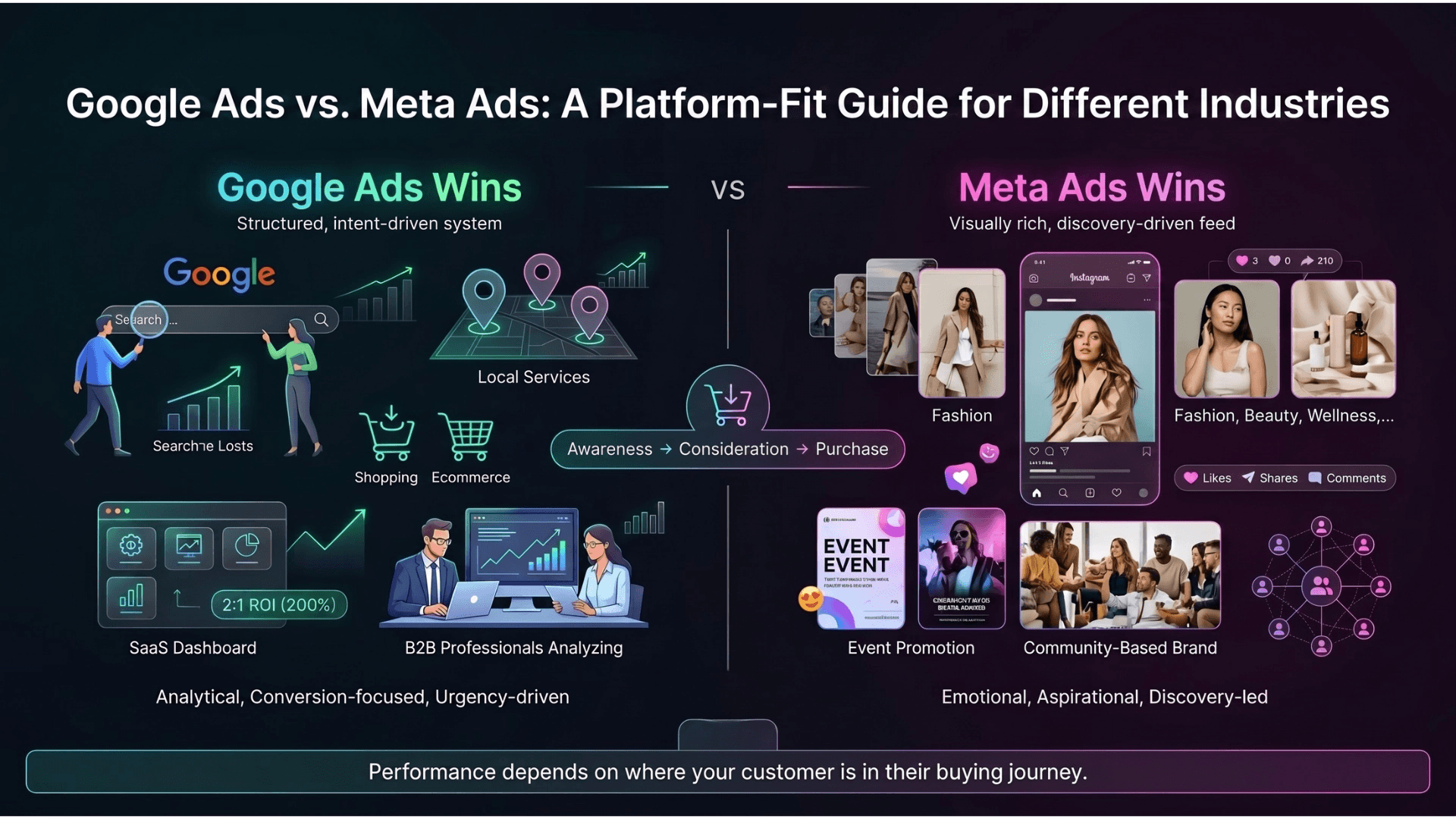
The Google Ads vs. Meta Ads comparison that matters most is not about metrics; it is about business model and customer behavior.
When Google Ads Wins
Google Ads for small businesses works best when customers already know they need something and are actively searching for it. According to Bloom Agency's 2026 analysis, businesses earn an average of $2 for every $1 spent on Google Ads, a 200% return that holds across most industries when campaigns are properly structured.
Business types that consistently outperform on Google:
-
Local service businesses where customers search by location and urgency
-
eCommerce with high-intent products where buyers have already decided what they want
-
SaaS companies targeting decision-makers searching for specific software solutions
-
B2B lead generation where buyers are actively researching vendors
When Meta Ads Wins
Meta performs well when the goal is awareness, product discovery, or selling products people did not know they needed. Instagram generated $83.6 billion in global revenue in 2025, driven by shopping behavior embedded into the content experience, a clear signal of where commerce is heading for visually driven brands. Understanding Meta vs. Google Ads in this context means recognizing that Meta dominates the discovery phase of the customer journey.
Business types that consistently outperform on Meta:
-
e-Commerce with visual or lifestyle appeal, where the product sells itself through imagery
-
Fashion, beauty, and wellness brands where aspiration drives purchase
-
Event promotion where reach matters more than immediate conversion
-
DTC brands building community alongside a customer base
The best platform for paid advertising depends on one variable: where is your customer in their buying journey when they see your ad?
Ad Formats: What Your Creative Actually Looks Like
The creative requirements between paid search and social ads differ significantly, and underestimating that difference is one of the most common reasons campaigns fail.
Google's core format is text. Search ads are headlines and descriptions written to match intent and trigger clicks. The creative barrier is lower, but the quality of copywriting directly determines performance. Google ad formats include Responsive Search Ads, Performance Max, Display banners, Shopping ads, and YouTube video ads.
Meta is visual-first. The image or video does the heavy lifting; weak visuals mean weak results regardless of targeting quality. Creative fatigue is a real operational challenge requiring regular refresh cycles. Meta ad formats include single image ads, Carousel ads, Video and Reels ads, Collection ads, Story ads, and Lead generation forms.
If your team cannot consistently produce strong visual content, starting with Google Search reduces the creative barrier while still generating measurable results.
Tracking, Attribution, and Measuring What Is Working
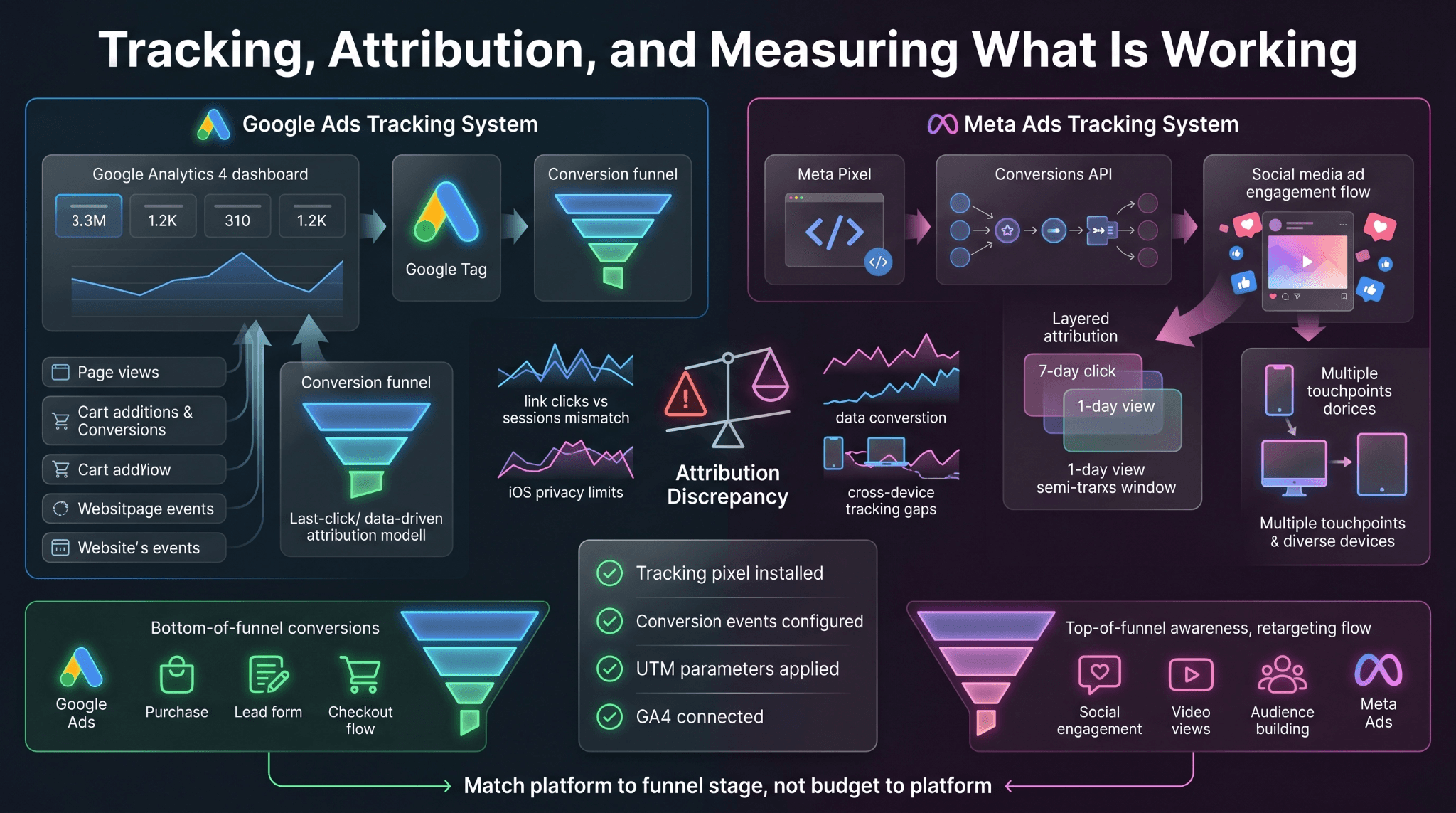
Both platforms have native tracking tools: Google Analytics 4 with the Google Tag and the Meta Pixel with the Conversions API. Neither should be trusted in isolation.
Attribution windows differ meaningfully. Google uses last-click or data-driven models. Meta's default is a 7-day click plus 1-day view-through window, crediting a conversion to a Meta ad even when the user did not click it that day. This is the primary driver of the Meta Ads link clicks vs Google Analytics sessions discrepancy that most advertisers encounter when running both platforms.
The Meta Ads link clicks vs Google Analytics sessions discrepancy reasons include different attribution windows, bot traffic counted by Meta but filtered by GA4, cross-device journeys GA4 cannot stitch, and iOS privacy restrictions limiting Meta's post-click tracking. Understanding these meta ads link clicks vs. Google Analytics sessions discrepancy patterns is essential for accurate budget allocation decisions.
Always use UTM parameters on every ad URL and layer a third-party analytics tool, GA4, Triple Whale, or Northbeam, to get a platform-agnostic view of ad spend ROI. Before running either of these PPC advertising platforms, verify the following:
-
Google Tag or Meta Pixel installed and confirmed firing correctly
-
Conversion events tracking the right actions at the right funnel stages
-
UTM parameters applied to all ad URLs before launch
-
GA4 property linked and receiving data from both platforms
Running Both Platforms Together: When It Makes Sense
Google Ads vs Meta Ads is not always an either/or decision, but running both underfunded is worse than running one well. Splitting $500 per month across two platforms means neither campaign accumulates enough data to optimize. Both platforms need volume to learn.
Signs you are ready to run both effectively:
-
Monthly ad budget above $3,000 with clear per-platform allocation
-
Proven positive ROAS on one platform already
-
Creative capacity for both text-based Google assets and visual Meta assets
-
Clear goal separation so each platform has a defined funnel role
A high-performing multi-platform structure uses Google Search to capture bottom-of-funnel demand and Meta to build top-of-funnel awareness and retarget visitors who showed intent but did not convert. According to Intensify's analysis of over 3,000 Meta ad accounts, the average Meta Ads ROAS was 2.98x per dollar spent, a figure that strengthens when combined with Google's high-intent traffic. When evaluating AdRoll vs. Meta ads vs google display roi, the framework is consistent: match the platform to the funnel stage, not the budget to the platform preference.
What Advertisers Get Wrong Before They Even Launch
These are the decisions that determine whether a campaign succeeds or wastes budget before a single result comes in.
Is Google Ads or Facebook Ads better for small businesses with a limited budget?
For most service-based small businesses, Google Search is the stronger starting point; every click comes from someone actively searching for what you offer. Meta requires more creative testing before it stabilizes. WellsGroup evaluates business type, customer behavior, and budget before recommending either platform, because the wrong starting point on a tight budget is expensive to recover from.
Which platform has a higher ROI, Google Ads or Meta Ads?
Google Ads averages $2 returned for every $1 spent. Meta averages a 2.98x ROAS according to Intensify's analysis of 3,000+ accounts. Neither is universally higher; ROI depends on campaign structure, offer quality, and how well tracking is set up. WellsGroup builds attribution systems that measure true cross-platform ROI rather than trusting either platform's native reporting in isolation.
How much should I spend on Google Ads vs Meta Ads per month?
The minimum viable budget to generate meaningful data is $1,000 to $1,500 per platform per month. Below that, algorithms do not accumulate enough data to optimize. If the total budget is under $3,000 per month, commit fully to one platform first. Splitting a thin budget across both is one of the most common and costly mistakes WellsGroup sees in paid advertising audits.
Can I run Google Ads and Meta Ads at the same time?
Yes, and when structured correctly, running both consistently outperforms either alone. Google captures bottom-of-funnel demand. Meta builds awareness and retargets visitors who showed intent but did not convert. WellsGroup designs multi-platform paid systems with distinct funnel roles, shared attribution tracking, and unified reporting, so no budget is working in the dark.
Why are my Meta Ads not converting even though impressions are deep?
Deep impressions with low conversions almost always point to weak creative, an audience that is too broad, a landing page that does not match the ad, or a tracking gap caused by missing Conversions API setup. WellsGroup audits the full conversion path from ad creative to landing page to tracking configuration, because fixing the wrong variable first wastes both time and budget.
Making the Call That Fits Your Business
The question is not which platform is better. It is which one matches where your customer is and what they need to see before they act?
For service businesses where customers actively search by need and location, Google vs Meta ads almost always resolve in Google's favor as the starting point. For product businesses where discovery and visual appeal drive the decision, Meta is typically where the budget belongs first. For businesses with defined budgets above $3,000 per month and clear funnel goals, both platforms working in coordination consistently outperform either one alone.
The platform matters less than the quality of the targeting, the creative, and the offer. Both sides of the Google Ads vs Meta Ads equation have produced million-dollar businesses and wasted million-dollar budgets. The difference, in almost every case, comes down to how clearly the advertiser understood what their customer needed to see and where.