Digital Marketing Strategy for Business: How Integrated Systems Drive Growth in 2026
Discover how connected marketing systems, AI visibility, and unified attribution are helping businesses turn fragmented tactics into scalable growth.

A founder opens their analytics dashboard and sees three separate reports, one for paid ads, one for organic traffic, and one for email. None of them agrees on which channel brought in the last 40 customers. The SEO agency says it was a search. The ads team credits retargeting. The CRM shows that half of those customers came through a form that nobody was tracking.
This is not a data problem. It is a systems problem. Global digital ad spend reached $835.82 billion in 2026, yet 64.82% of Google searches now end without a click. Businesses are spending more to reach audiences that are increasingly harder to convert. The ones gaining ground are not the ones with the biggest budgets. They are the ones with connected systems, and that is exactly what a digital marketing strategy for business in 2026 must be built around.
What Is a Digital Marketing Strategy for Business?
A digital marketing strategy for a business is not a content calendar or a media plan. It is an integrated system that connects every channel, every touchpoint, and every data point into a single, accountable growth engine. Most businesses are not running a strategy; they are running a collection of tactics with no architecture connecting them.
Strategy vs Individual Marketing Tactics
A strategy has a defined goal, a customer journey mapped from first touch to closed deal, and a system that tracks every step. Random posting, isolated ad campaigns, and disconnected lead generation are not a strategy. They are active. Without that architecture, marketing spend becomes a cost center instead of a growth engine.
Why Businesses Need Connected Marketing Systems
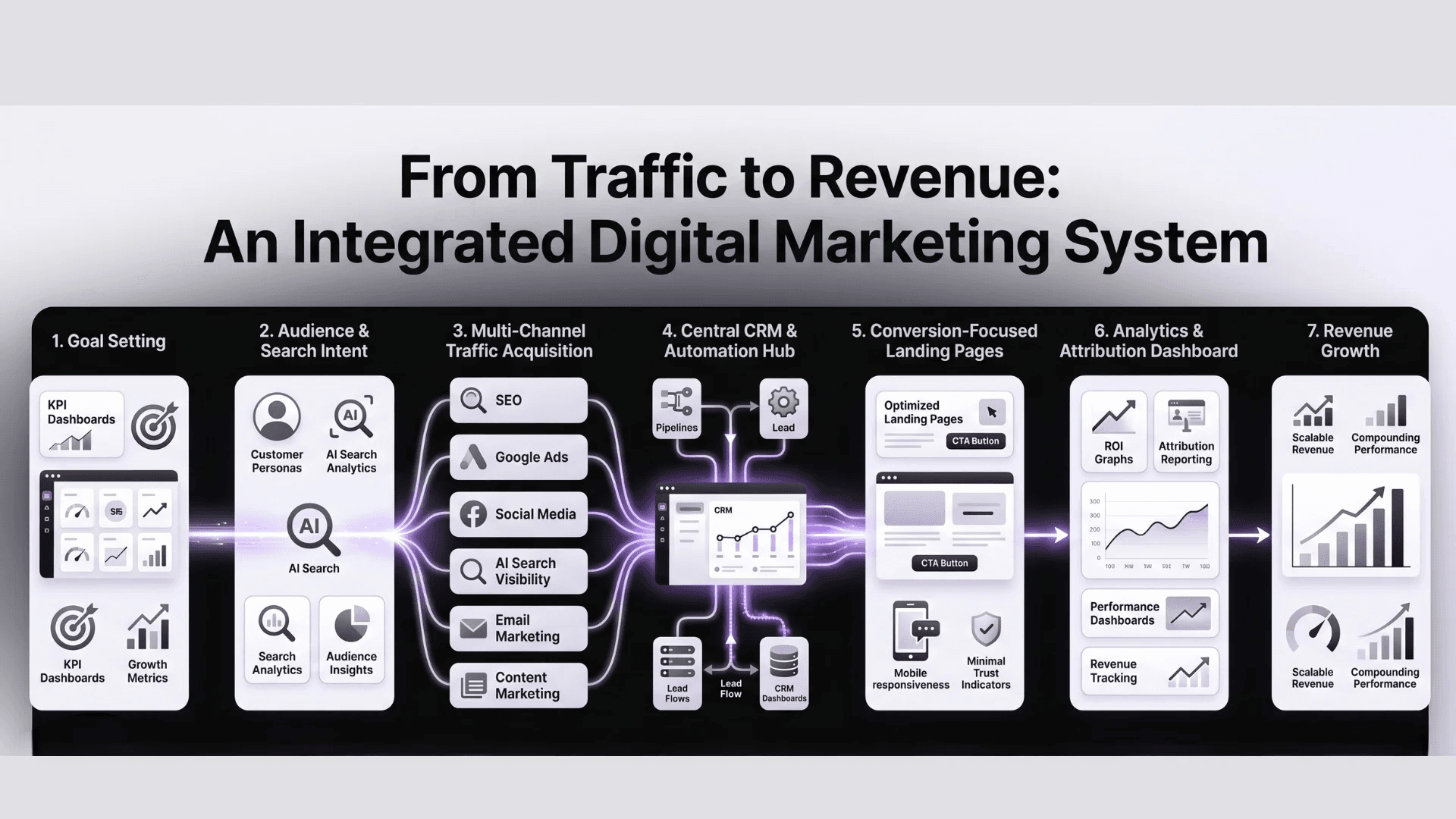
When marketing channels operate separately, their data stays siloed. When they are connected, every channel informs every other, and the system compounds over time. An integrated digital marketing strategy for business growth connects SEO, paid advertising, email automation, CRM, analytics, and conversion optimization into one accountable architecture. The output is not just more traffic. It is attributable revenue.
The following components form the building blocks of that integrated architecture, each one dependent on the others to produce compounding results:
-
Search engine optimization covering traditional rankings and AI search visibility
-
Paid advertising across Google, Meta, and relevant industry platforms
-
Marketing automation and lead nurture sequences tied to CRM pipeline stages
-
Content strategy built around topical authority and AI citation eligibility
-
Conversion rate optimization on landing pages, forms, and checkout flows
-
Unified analytics with multi-touch attribution across all channels
The Core Components of an Integrated Digital Marketing Strategy
Each pillar below is only as strong as its connection to the others. Building one without the others produces diminishing returns. Building all four as a connected system produces compounding ones.
Search Engine Optimization and AI Visibility
SEO in 2026 is not just about ranking on page one. Visibility inside AI-generated answers, Google AI Overviews, ChatGPT Search, Perplexity, and Gemini is now a parallel priority. Content needs direct answers, cited sources, schema markup, and clear topical authority signals. Businesses that optimized only for traditional search in 2024 and 2025 are now losing discovery share to competitors whose content AI systems actively cite.
Paid Advertising and Traffic Acquisition
Paid channels remain the fastest way to generate qualified traffic, but their efficiency depends entirely on what happens after the click. The paid channel only performs when the destination converts and the lead data flows directly into the CRM. Without that connection, paid advertising reports its own metrics in isolation, and the real cost per acquisition stays invisible.
Content Marketing and Brand Authority
Topical authority is the mechanism behind sustainable organic visibility. Businesses publishing consistent, expert-level content across a defined topic cluster signal to both search engines and AI systems that they are credible sources worth citing. The businesses that invested in topical depth through 2025 are seeing compounding returns in AI citation frequency entering 2026.
CRM and Marketing Automation
Lead nurturing and email automation are where most businesses leave the most money on the table. Email marketing returns an average of $36 to $42 for every dollar spent, making it the highest-returning digital channel available. A lead without a structured follow-up sequence within 24 hours is statistically far less likely to convert. CRM and automation ensure every lead receives the right message at the right stage, without manual intervention.
How to Build a Digital Marketing Strategy for Business Growth
The following sequence moves from goal-setting to implementation in the order that actually works.
Define Clear Growth Goals
Before selecting any channel or tool, define what success looks like in measurable terms. Without these anchors, budget allocation drifts toward whoever argues most convincingly rather than what the numbers support.
Define and agree on the following before any channel investment is made:
-
Monthly qualified lead target by channel
-
Target customer acquisition cost per channel
-
Conversion rate benchmarks from lead to opportunity and close
-
Revenue attribution by channel at 30, 60, and 90 days
Understand Your Audience and Search Behavior
Buyer intent varies significantly by channel and query type. Digital marketing strategies for small businesses that treat research-phase and purchase-phase audiences identically waste budget on the wrong message at the wrong moment. Understanding the difference between awareness-stage and purchase-stage intent is what allows a strategy to match message to moment.
Build a Multi-Channel Marketing System
No single channel is sufficient on its own in 2026. The integration point is the CRM, which should receive lead data from every channel and feed it back into targeting and attribution across all of them. Digital marketing strategies for small businesses built on this connected model consistently outperform single-channel approaches.
The goal is not to be on every platform. A well-scoped digital marketing strategy for a small business focuses on the two or three channels where the target audience is most active and builds the integration layer between them before expanding further.
Create Conversion-Focused Landing Pages
Traffic without conversion architecture is a waste. Every landing page needs to earn its role in the system before traffic is sent to it:
-
A single clear call to action aligned with visitor intent at that stage
-
Trust signals relevant to the specific audience arriving on that page
-
Fast mobile load time, pages above three seconds lose visitors before they read a word
-
Form fields scoped to only what the business needs at that funnel stage
Track Performance and Optimize Continuously
A unified analytics setup connects ad platform data, organic data, CRM pipeline data, and revenue data into a single reporting layer. Without it, decisions get made on last-click attribution, which consistently overcredits the final touch. The businesses with the clearest performance picture are the ones that invested in attribution architecture before scaling ad spend.
Best Digital Marketing Strategies for Small Businesses in 2026
Best digital marketing strategies for small businesses in 2026 require prioritization over volume. A small team cannot execute every channel at full capacity. The following reflects where returns are most concentrated.
Local SEO for Business Visibility
Digital marketing strategy for local business starts with Google Business Profile optimization, consistent NAP data across directories, and review generation systems that feed local ranking signals. Digital marketing strategies for local businesses that integrate local SEO with a CRM-connected follow-up system consistently outperform competitors running local ads without the organic foundation beneath them.
AI Search Optimization
Best digital marketing strategies for small businesses 2025 is a framing that no longer applies. The AI search transition accelerated faster than most predictions. A digital marketing strategy for a travel agency business, for example, needs destination-level content that answers specific traveler questions in a format AI can extract and cite, not generic promotional copy that AI systems routinely ignore.
Email and SMS Automation
Owned channels are the most cost-efficient form of retention. Segmented email campaigns drive a 760% increase in revenue compared to non-segmented sends, yet most small businesses still send the same message to their entire list. An automated sequence tied to purchase behavior or service milestones reduces churn and generates referrals without incremental ad spend.
Video and Short-Form Content Marketing
Short-form video across YouTube Shorts, Instagram Reels, and TikTok drives brand awareness at scale with low production cost. For businesses where trust is the primary conversion barrier, video accelerates the credibility-building that longer written content cycles would otherwise require over months.

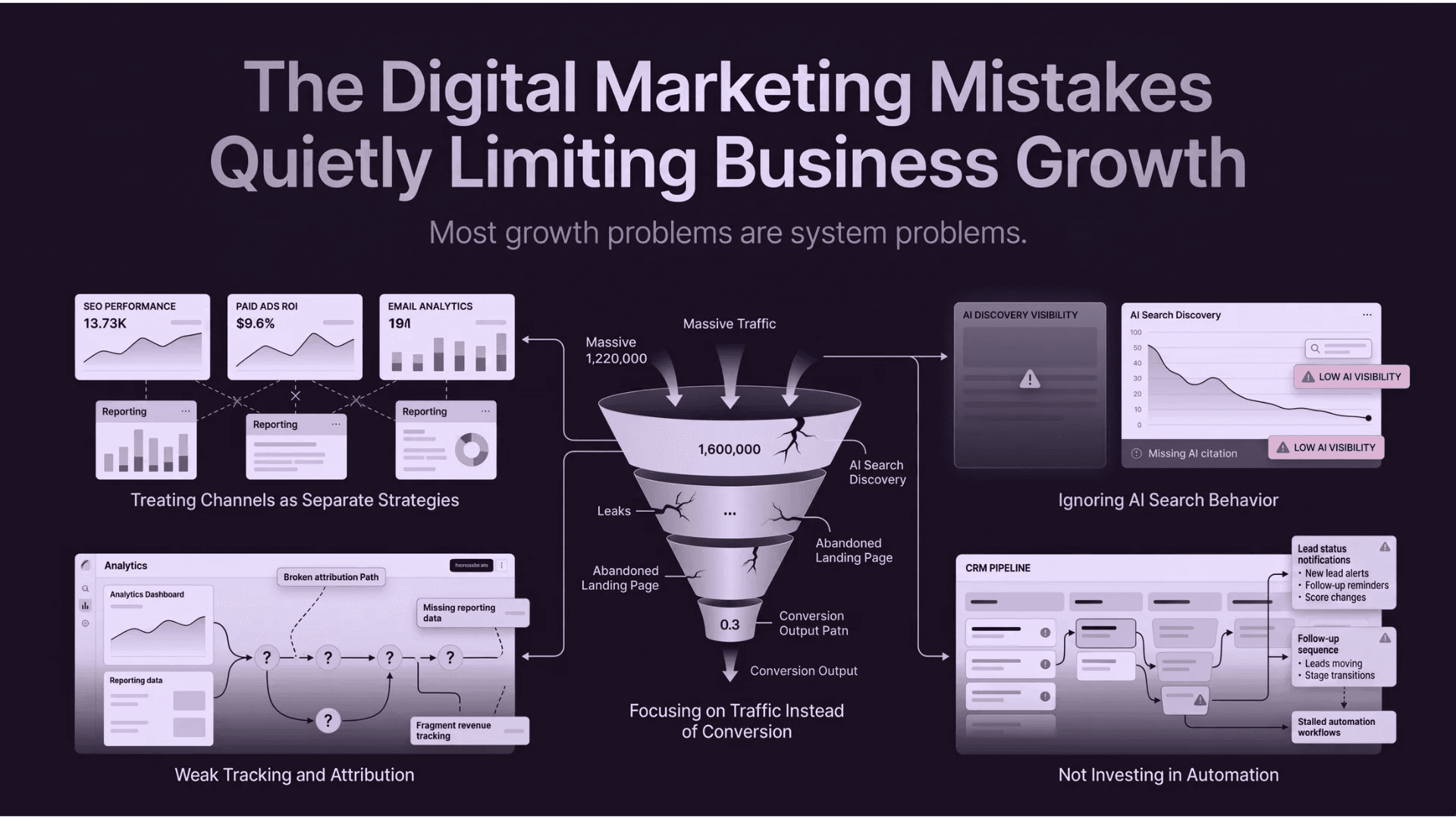
Common Digital Marketing Mistakes That Hurt Business Growth
Each of these mistakes is entirely preventable with the right systems architecture in place before the budget is committed.
Mistake 1: Treating channels as separate strategies.
Nobody is accountable for the combined result, and the combined result is the only one that maps to revenue. When SEO, paid ads, and email each report independently, the business optimizes three separate systems instead of one growth engine.
Mistake 2: Ignoring AI search behavior.
The rules shifted decisively through 2025 and into 2026. Businesses still optimizing for 2022-era SEO are losing ground. Content that is not structured for AI extraction is invisible to the systems that now influence the majority of high-intent research queries.
Mistake 3: Focusing on traffic instead of conversion.
More visitors to a page that does not convert is a more expensive failure at higher volume. The channel is rarely the problem; the destination and the follow-up architecture almost always are.
Mistake 4: Weak tracking and attribution.
Last-click attribution consistently underfunds the channels doing the most work. Without a unified reporting layer, budget decisions are made on incomplete data, and the channels building early-stage intent never get the credit or the investment they deserve.
Mistake 5: Not investing in automation.
Manual follow-up at scale is not a growth strategy. It is a ceiling. Every lead that enters the system without an automated sequence is a conversion opportunity that depends entirely on someone remembering to follow up.
Why AI and Integrated Systems Are Reshaping Digital Marketing
The shift toward AI-driven discovery and connected marketing infrastructure is not a future consideration. It is the present operating condition for any business that depends on search visibility or inbound lead generation.
AI Search Is Changing Customer Discovery
Buyers researching vendors, comparing options, or evaluating service providers are increasingly doing that research inside ChatGPT, Perplexity, or Google AI Mode. The businesses appearing in those answers are the ones whose content was structured to be cited, not just indexed.
Integrated Systems Create Sustainable Growth
The businesses outperforming their markets in 2026 are running connected systems where marketing feeds CRM, CRM feeds automation, automation feeds retention, and every layer reports into unified analytics. Digital marketing strategies for local businesses in 2025 that relied on standalone tactics are being replaced by integrated architectures that treat every channel as a component of a single compounding system.
What Growing Businesses Get Wrong About Digital Marketing
The following addresses the questions business owners and marketing decision-makers are asking most consistently right now, with the context needed to act on them.
How long does it take to see results from a digital marketing strategy?
It depends on the channel. Paid advertising generates traffic within days. SEO takes three to six months. Email automation produces results as soon as sequences are live. The mistake most businesses make is expecting every channel to perform on the same timeline. WellsGroup sequences channel investments to generate early wins while longer-term channels compound in the background.
Should we be worried about AI taking our search traffic?
AI is not killing search traffic; it is redistributing it toward businesses whose content is structured to be cited in AI-generated answers. Businesses optimizing for AI citation alongside traditional SEO are gaining visibility, not losing it. WellsGroup builds content architecture that performs across both environments simultaneously.
Do we need to optimize separately for ChatGPT and Perplexity vs Google?
The principles overlap significantly: direct answers, cited sources, schema markup, and topical authority. A single content architecture built around extractability and trust signals performs across Google AI Overviews, ChatGPT Search, Perplexity, and Gemini without requiring entirely separate strategies for each.
How do we actually measure ROI across multiple marketing channels?
This requires a unified attribution setup connecting ad platform data, CRM pipeline data, and revenue into one reporting layer. Last-click attribution consistently overcredits the final touchpoint and underfunds the channels doing the most early-stage work. WellsGroup implements multi-touch attribution so every channel gets accurate credit and budget decisions reflect actual revenue contribution.
What is the right digital marketing budget for a small business?
The more useful question is what the business can afford to test, learn from, and scale. A small budget deployed across a connected system consistently outperforms a larger budget scattered across disconnected tactics. WellsGroup scopes every engagement around documented goals before a dollar is committed.
How do we know which channels to prioritize first?
Start where your buyers are in their research process. For service-based businesses, local SEO and email automation deliver the highest early returns. For SaaS and B2B, content marketing and LinkedIn paid advertising tend to move fastest. WellsGroup maps buyer intent and channel behavior before making any channel recommendation.
Build Systems, Not Just Campaigns
A campaign ends. A system is composed. An integrated digital marketing strategy for business growth connects every channel, automates every repetitive process, and attributes every conversion to the right source.
The businesses dominating their categories in 2026 built the underlying architecture first, the CRM that captures every lead, the attribution layer that explains every conversion, and the automation that follows up without human intervention.
Most businesses are one or two systems away from that operating model. The gap is rarely budget. It is architecture. Start with the system, define what each channel is accountable for, and let the campaigns follow from that foundation. That is how a digital marketing strategy for business becomes a permanent growth engine.