Digital Marketing Channels for Business: What Every Company Should Consider
Most businesses choose channels based on habit. Learn how SEO, email, social, and paid media work together to drive growth.
A business owner spent six months on Instagram ads and got inconsistent results. When they dug into analytics, they found most of their best customers had come through Google Search and email referrals the whole time. Instagram did not fail; they picked a channel before understanding their customers' actual path.
This is the most common channel strategy mistake in 2026. Most businesses do not have a channel strategy; they have a channel habit. According to Omnisend's analysis, businesses using three or more digital marketing channels see a 287% higher purchase rate than those using a single channel. The gap is not incremental. It is structural. This article covers all digital marketing channels for business in practical terms, how they are categorized, what each delivers, how to build a mix that matches your goals, and what the data shows across industries.
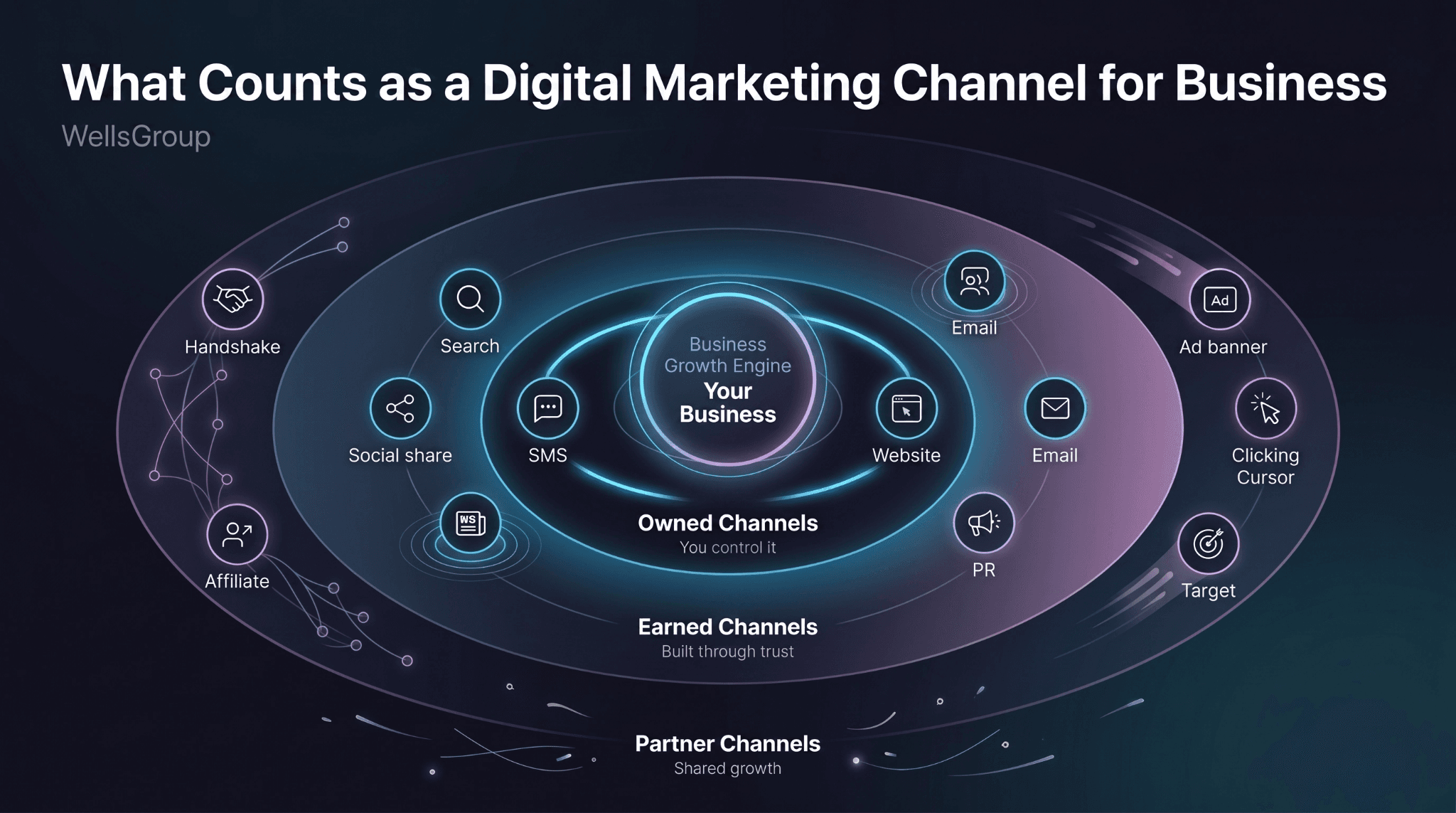
What Counts as a Digital Marketing Channel for Business
A digital marketing channel is any medium through which a business reaches its audience online. Before choosing one, understanding the four structural categories matters because each operates differently in cost, timeline, and control.
The table below maps the major channel categories against the variables that actually affect budget and planning decisions, the first step in any serious digital marketing channels for business strategy.
|
Channel Category |
Examples |
Cost Model |
Time to Results |
Control Level |
|
Owned |
Website, email, SMS |
Fixed platform cost |
Medium to long |
Full |
|
Earned |
SEO, organic social, PR |
Time and labor |
Long, compounding |
Indirect |
|
Paid |
PPC, display, paid social |
Per click or impression |
Immediate |
High |
|
Partner |
Affiliate, influencer, co-marketing |
Revenue share or flat fee |
Variable |
Medium |
Most articles list all digital marketing channels as a flat inventory, as if a paid search ad and an email newsletter require the same skills and timelines. They do not. Treating them as interchangeable is what leads to wasted spend. The right starting point is understanding which digital marketing channels for business category fits the current goal, awareness needs different channels than lead generation, which needs different channels than retention.
The Core Digital Marketing Channels and What Each One Actually Does
Each channel below serves a different function in the customer journey and performs differently depending on the goal, audience, and stage of the funnel. Understanding what each one actually delivers prevents the common mistake of treating all channels as interchangeable options rather than distinct tools with distinct roles.
Search, SEO, and Paid Search
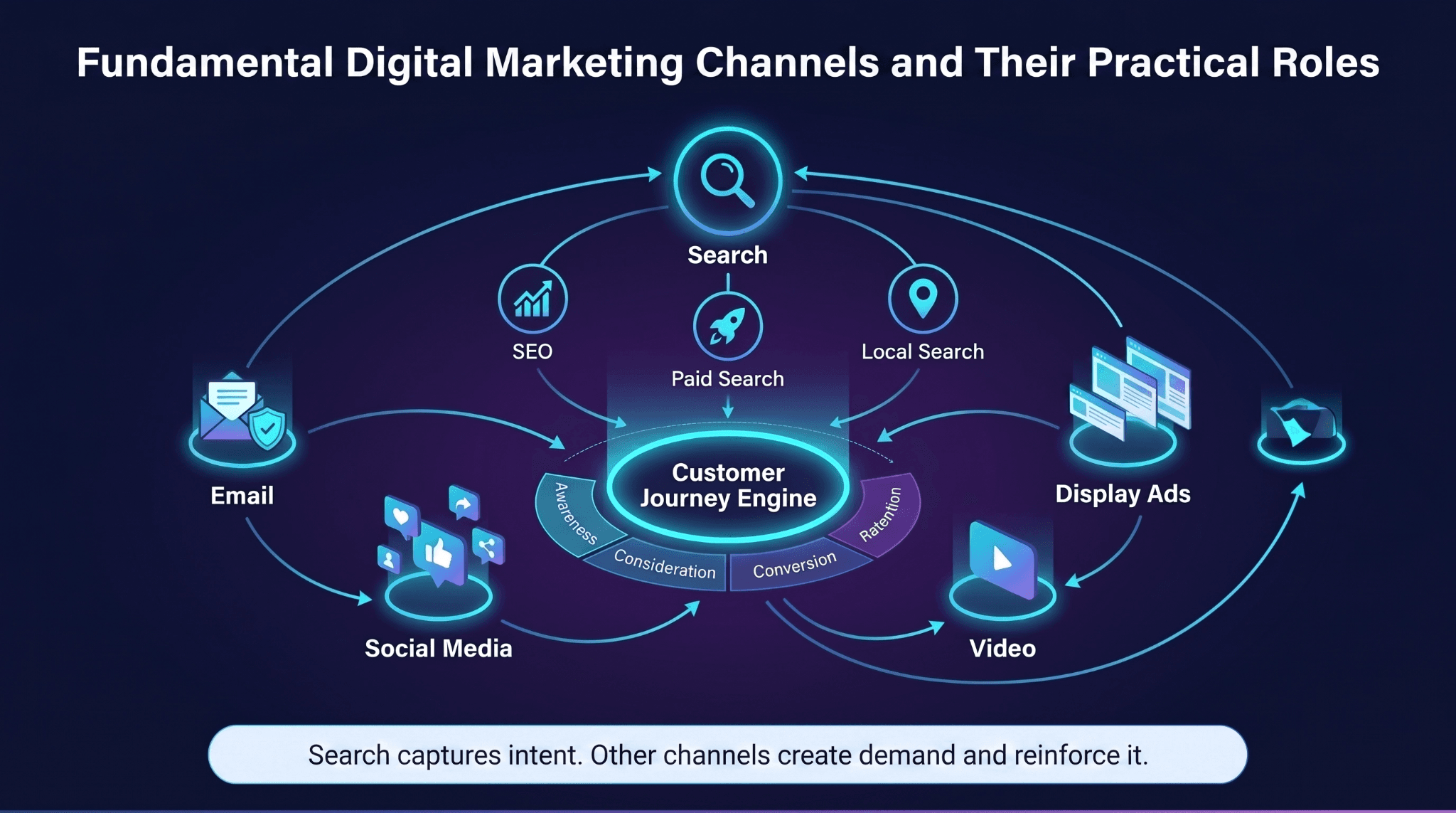
Search is where commercial intent lives. When someone types "best CRM for logistics companies" into Google, they are already looking for a solution. SEO captures that traffic over time. Paid search captures it immediately. Both compete for the same real estate and belong in the same planning conversation.
Google processes approximately 8.5 billion searches per day, making search the highest-intent digital channel available. Search is also the hub that digital marketing channels that amplify your SEO feed into, content builds authority, PR earns backlinks, and social signals drive branded search volume. Every other channel, when executed consistently, feeds back into search performance.
What search channels deliver:
-
Bottom-of-funnel traffic with purchase or inquiry intent
-
Long-term compounding returns from SEO investment
-
Immediate visibility from paid search with full budget control
-
Local discovery through Google Business Profile and Maps
-
AI-powered visibility across Google AI Overviews, ChatGPT, and Perplexity
Email, Social Media, and Display
Email is a retention and conversion tool; you are talking to people who already know you. Social media is a discovery tool; you are building familiarity with people who may not. Display follows audiences across the web to maintain brand presence.
Email marketing delivers an average ROI of $36 for every $1 spent, making it the highest-returning channel in most digital marketing channel mix calculations, according to Litmus. The table below maps each channel against the stage where it performs best:
|
Channel |
Primary Stage |
Best Content Format |
Audience Relationship |
|
Email marketing |
Retention and conversion |
Sequences, offers, newsletters |
Warm, opted-in |
|
Organic social |
Discovery and community |
Short-form, video, stories |
Cold to warm |
|
Paid social (Meta, LinkedIn) |
Prospecting and retargeting |
Video, carousel, static image |
Cold |
|
Display/programmatic |
Awareness and retargeting |
Banner, native, video |
Cold |
|
Video (YouTube, Reels) |
Consideration |
Long-form, short-form |
Cold to warm |
When each channel type performs best:
-
Email: post-purchase sequences, loyalty programs, reactivation campaigns
-
Organic social: community building, brand voice, product discovery
-
Paid social: prospecting, retargeting, product launches
-
Display: retargeting and brand recall rarely convert as a standalone channel
-
Video: product demos, testimonials, brand storytelling at scale
How to Build a Channel Mix That Matches Your Business Goals
There is no universal digital marketing channel mix. The right combination depends on where your customer spends time, which funnel stage you are targeting, and what budget and team capacity you actually have.
For businesses trying to understand how to choose digital marketing channels without wasting months on trial and error, the clearest shortcut is customer research. Where do your best current customers say they found you? That answer is worth more than any benchmark.
CoSchedule's research confirms that marketers who document their strategy are 414% more likely to report success, yet fewer than 17% have their entire strategy documented. One underrated input in channel selection is the ROI model. A wholesale business ROI model marketing attribution digital offline channels approach, tracking both digital touchpoints and offline conversions, frequently reveals that digital channels are influencing sales that get credited to the field sales team.
Cross-Channel Strategy: Why Channels Work Better Together
Running channels in isolation is one of the most consistently documented reasons marketing budgets underperform. The data on multi-channel performance is unambiguous: each additional coordinated channel does not just add value linearly; it multiplies the effectiveness of every other channel in the mix.
How Cross-Channel Marketing Actually Works
Cross-channel digital marketing is the practice of delivering a connected experience across multiple channels, where a customer sees a paid social ad, receives a follow-up email, then converts through a retargeted search ad. Each touchpoint builds on the last. Running channels in isolation with different messages creates a fragmented experience that breaks trust before it builds it.
Customers who engage across multiple channels have a 30% higher lifetime value than single-channel customers, according to Omnisend's 2026 omnichannel data.
What a functional cross-channel strategy looks like in practice:
-
Consistent messaging and creative across all active channels
-
Audience data shared between paid and owned channels, email list used to build lookalike audiences
-
Content repurposed across formats: blog to email to social clip to video
-
Retargeting sequences that adjust based on which channel a user came from
-
A unified customer profile that captures behavior across all touchpoints
Multi-Channel Attribution: Knowing Which Channel Deserves Credit
Multi-channel attribution in digital marketing is the process of assigning credit to every channel that contributed to a conversion, not just the last one clicked. Most businesses default to last-click attribution, which systematically undercredits the channels that built awareness early.
|
Attribution Model |
How Credit Is Assigned |
Best For |
Key Limitation |
|
Last-click |
100% to final channel |
Simple conversion tracking |
Ignores the full journey |
|
First-click |
100% to first channel |
Awareness measurement |
Ignores conversion channels |
|
Linear |
Equal credit to all channels |
Balanced view |
Oversimplifies channel weight |
|
Time-decay |
More credit to recent channels |
Short sales cycles |
Undercredits early channels |
|
Data-driven (AI-based) |
Based on actual conversion impact |
Complex multi-touch journeys |
Requires sufficient data volume |
CleverTap digital marketing channels reporting and GA4's data-driven model give a more complete view of the actual conversion path, so budget shifts toward what is genuinely driving revenue, not just what appears last in the funnel.
Channel Strategy by Industry
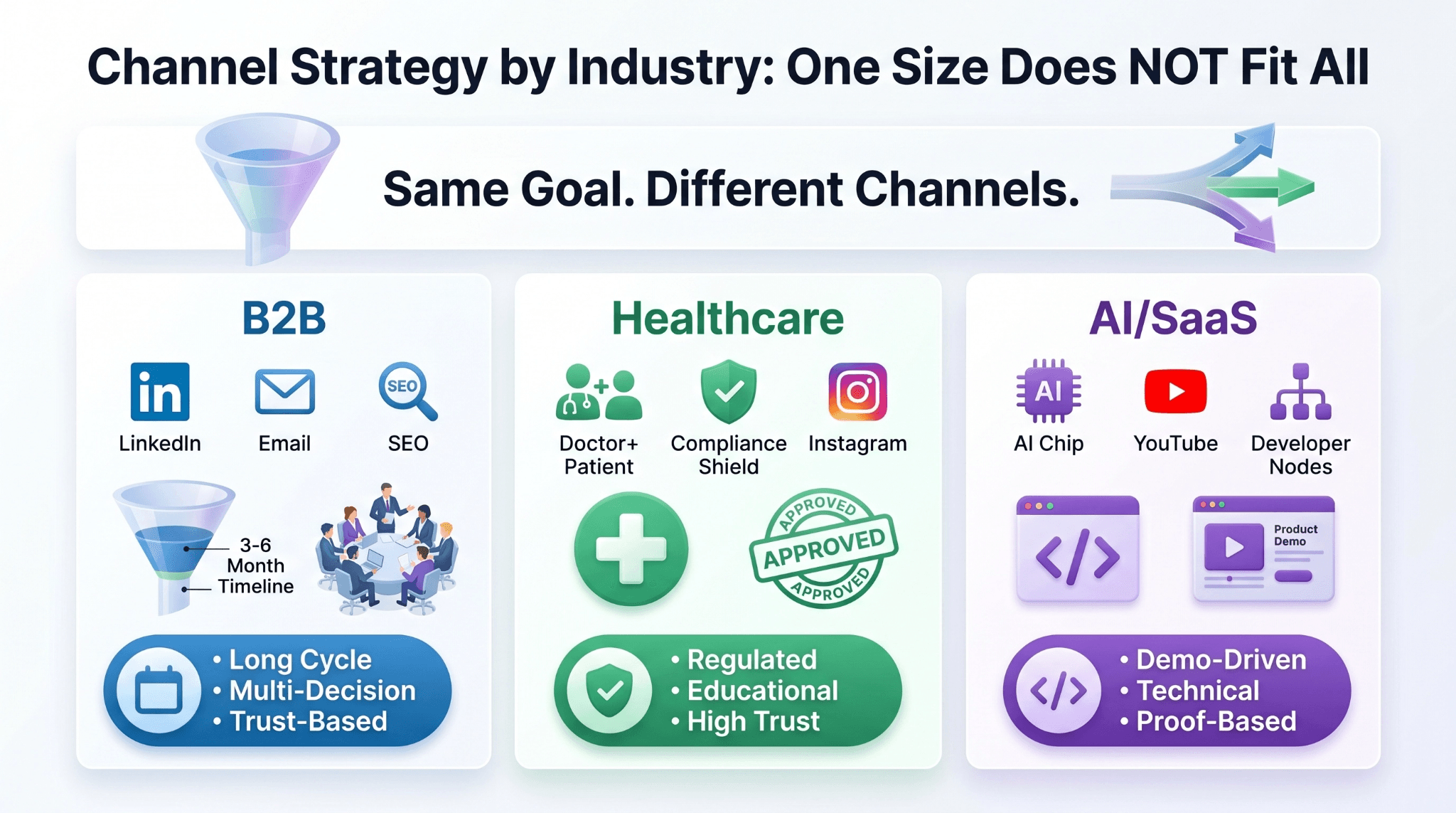
Different industries face fundamentally different buyer behaviors, regulatory environments, and sales cycle lengths. The channel mix that works for a SaaS company will not work for a dermatology practice, and the one that works for a B2B logistics operator will not work for a DTC eCommerce brand. The following covers the most distinct cases with specific, actionable guidance for each.
B2B Digital Marketing Channels and Lead Generation
B2B buying cycles are longer, involve multiple decision-makers, and rarely convert on first contact. The best digital marketing channels for B2B lead generation in 2025 have shifted as we enter 2026. LinkedIn has maintained dominance, but content-driven SEO and AI-visible thought leadership are now equally critical for staying present through a 3 to 6-month consideration window.
LinkedIn generates 80% of all B2B leads from social media, making it the dominant platform in any B2B digital marketing channel mix. For AI product companies, top digital ad channels AI product marketing 2025 data points toward LinkedIn sponsored content, developer-community platforms, and YouTube tutorials as the strongest combination for reaching technical buyers in 2026.
Top-performing channels for B2B:
-
LinkedIn organic thought leadership plus paid Lead Gen Forms
-
Email nurture sequences tied to content downloads
-
SEO-driven long-form content targeting decision-maker queries
-
Webinars and virtual events for mid-funnel engagement
-
Retargeting via display and paid social to maintain visibility
Life Sciences, Healthcare, and Dermatology
For life sciences digital marketing channels, reaching HCPs, patients, and payers requires channels that meet regulatory requirements. Peer-reviewed content, HIPAA-aligned email, search ads with approved claim language, and LinkedIn for HCP engagement are the consistently effective options.
The effective digital marketing channels for dermatology businesses in 2025 entering 2026 point to Instagram and YouTube as primary discovery channels; before-and-after content, procedure explainers, and patient testimonials drive significant organic reach when posted consistently within regulatory guidelines.
Tools, Data, and What the Channel Comparison Actually Shows
Choosing the right channels is only half the equation. Managing them without a central platform leads to fragmented data, duplicate audiences, and campaigns that cannot be meaningfully compared against each other.
Managing Multi-Channel Campaigns Without Losing Control
The right digital marketing agency tools multi-channel campaign optimization stack connects channels into a single reporting view so decisions are based on unified performance data, not isolated dashboards. Iterable customer engagement software digital marketing channels module orchestrates email, push, SMS, and in-app messaging from a single workflow, sending the right message based on what a user actually did, not a fixed schedule.
What to evaluate in any multi-channel tool:
-
Native integrations with channels already running
-
Behavioral trigger capability, action-based sends versus fixed schedules
-
Cross-channel reporting in one dashboard
-
Audience segmentation that syncs across channels
Businesses without in-house expertise often work with the best digital marketing agencies for multi-channel campaign optimization, specialists who connect platforms, read attribution data, and continuously test channel mix across the full funnel.

What the Channel Data Actually Shows in 2026
Any digital marketing channels comparison should be read in context. Global digital ad spend reached $835.82 billion in 2026, making up 68.7% of all advertising worldwide, with search capturing approximately 40% of that spend and social capturing around 32%, according to PPCChief's 2026 analysis.
Key performance patterns from 2026 benchmark data:
-
Email continues to outperform all channels on pure ROI
-
LinkedIn CPL is high, but B2B conversion quality consistently justifies it
-
Video on YouTube and Reels is the fastest-growing format by engagement
-
SEO timelines are longer, but provide compounding returns unavailable in paid channels
-
Display alone rarely converts, but works best as a retargeting layer
What Most Businesses Get Wrong About Channel Strategy
These are the decisions that consistently separate businesses with predictable revenue from those chasing the next platform.
What are the most effective digital marketing channels for small businesses in 2026?
For most small businesses, the highest-return starting point is owned channels, SEO, and email, before any paid spend. Both compounds over time without an ongoing budget. Once those foundations are in place, adding one paid channel based on where your customer actually spends time produces far better returns than spreading thin across multiple platforms. WellsGroup identifies that starting point before recommending any channel investment.
How do I choose the right digital marketing channel mix for my industry?
Start with your customer's behavior, not your competitor's budget. The right mix depends on where your buyer is in their journey, how long their consideration cycle is, and what content format they engage with. WellsGroup maps customer journeys before recommending any channel combination, because the wrong mix at the right budget still produces the wrong result.
What is multi-channel attribution and why does it matter for marketing ROI?
Multi-channel attribution assigns credit to every channel that contributed to a conversion, not just the last click. Without it, most businesses underfund the channels doing the most early-stage work. WellsGroup builds attribution systems that give every channel accurate credit so budget decisions reflect actual revenue contribution rather than platform-reported assumptions.
Which digital marketing channels work best for B2B lead generation?
LinkedIn, SEO-driven long-form content, and email nurture sequences consistently outperform other channels in B2B environments. LinkedIn alone generates 80% of all B2B leads from social media. WellsGroup builds this structure, LinkedIn for awareness, content for credibility, and email for conversion, across B2B clients in most industries.
How do I know which channels are actually driving my sales?
If you are relying on platform-native reporting, you are seeing a distorted picture. Every platform overcredits itself. The reliable answer comes from a unified attribution layer, GA4's data-driven model, a tool like Triple Whale or Northbeam, and UTM parameters on every URL. WellsGroup implements that attribution infrastructure before any channel scaling begins.
Where Your Channel Investment Should Go Next
Stop thinking about which digital marketing channels are best in general. Start asking which channel your specific customer uses at the stage they are currently in.
If you are a new business with a limited budget, build owned channels first, SEO and email before paid. If you are in B2B with a long sales cycle, LinkedIn plus content plus email nurture is the most reliable combination. If you are in eCommerce with a visual product, Meta or Instagram combined with Google Shopping covers both discovery and intent. If you are in a regulated industry, search and compliant email is where returns concentrate.
For businesses that need to prove channel ROI internally before adding spend, fix multi-channel attribution in digital marketing first, because the data you have right now is probably undercrediting two or three channels doing real work. The digital marketing channel mix that produces consistent results in 2026 is not the one with the most channels. It is the one where each channel has a defined role, shared data, and a review cadence that matches how fast these environments move.