6 Steps to Estimate Your YouTube Advertising Cost in 2026
Estimate YouTube advertising cost in 2026 with six practical budgeting steps, CPM and CPV insights, targeting strategies, and proven optimization tips.

Estimating your YouTube advertising cost in 2026 comes down to six steps: define your campaign goal, choose an ad format, understand CPM and CPV pricing, set a realistic budget, factor in audience targeting, then test before scaling. Most businesses pay between $0.10 and $0.30 per view, or $4 to $18 per 1,000 impressions, depending on format.
Most businesses approach YouTube advertising with a single question in mind, which is simply how much it will cost. The honest answer is that there is no fixed price, only a set of variables that shift the number up or down depending on your goal, your industry, and how the campaign is structured. This guide breaks that process into six practical steps, so you can walk away with a realistic budget range instead of a rough guess. If you would rather skip the estimating and get exact numbers for your business, get a proposal from WellsGroup's paid media team.
What Determines YouTube Advertising Cost?
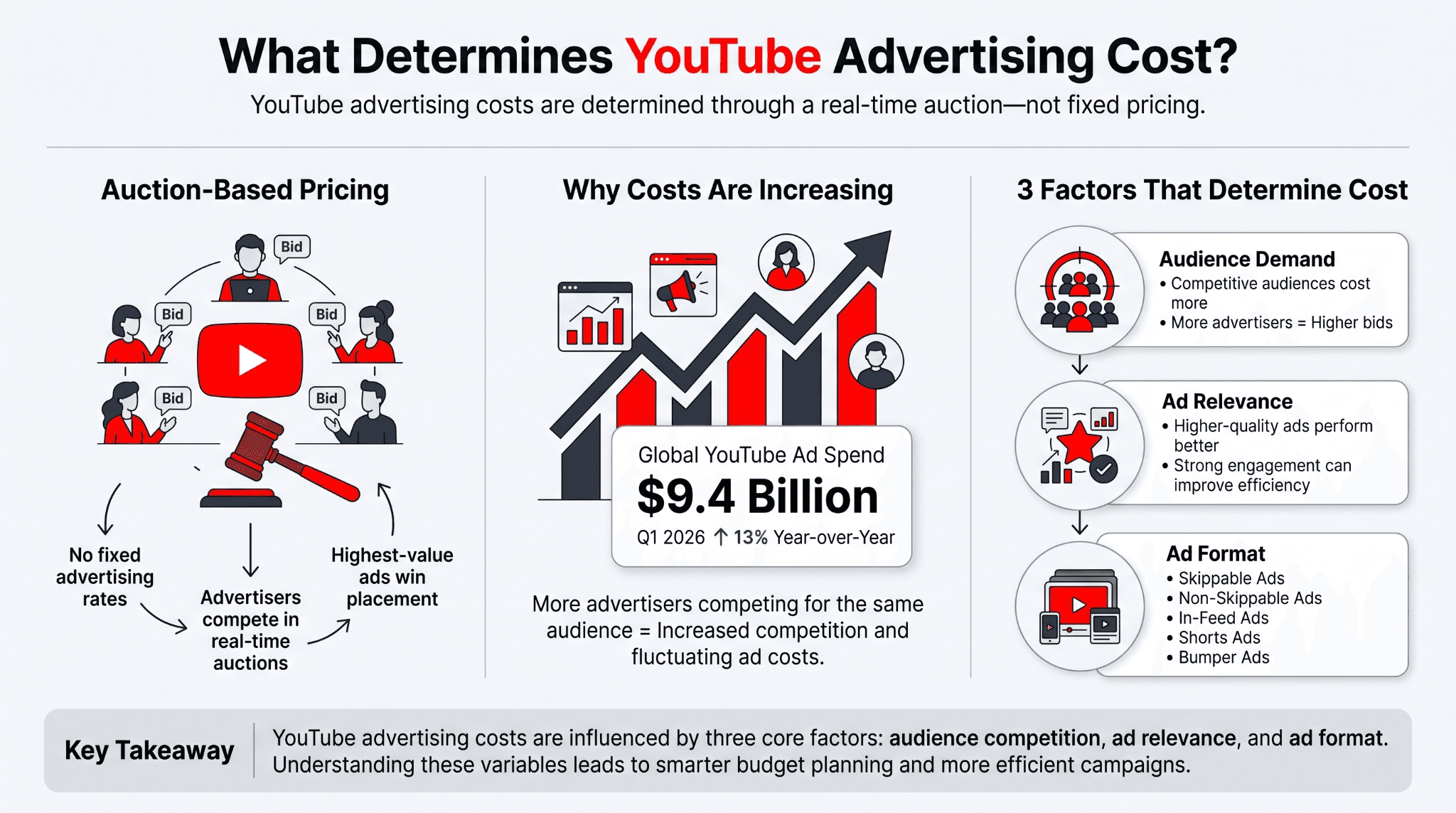
YouTube runs on an auction system, similar to Google Search ads. Advertisers do not pay a fixed rate. Instead, they bid for placement against every other business targeting the same viewer.
Global YouTube ad spend reached $9.4 billion in Q1 2026 alone, up 13 percent year over year, according to Google Ads cross-network reporting compiled by DigitalApplied. That growth means more advertisers competing for the same inventory, which is one reason YouTube advertising costs have become harder to predict using outdated benchmarks.
Three variables control the outcome of every auction:
-
Advertiser demand for the specific audience being targeted
-
Ad relevance and expected viewer engagement
-
The ad format selected, since each format uses a different billing model
Understanding this auction logic is the foundation for every step that follows. Without it, budget planning becomes guesswork rather than a repeatable process.
Step 1: Define Your Campaign Goal Before Setting a Budget
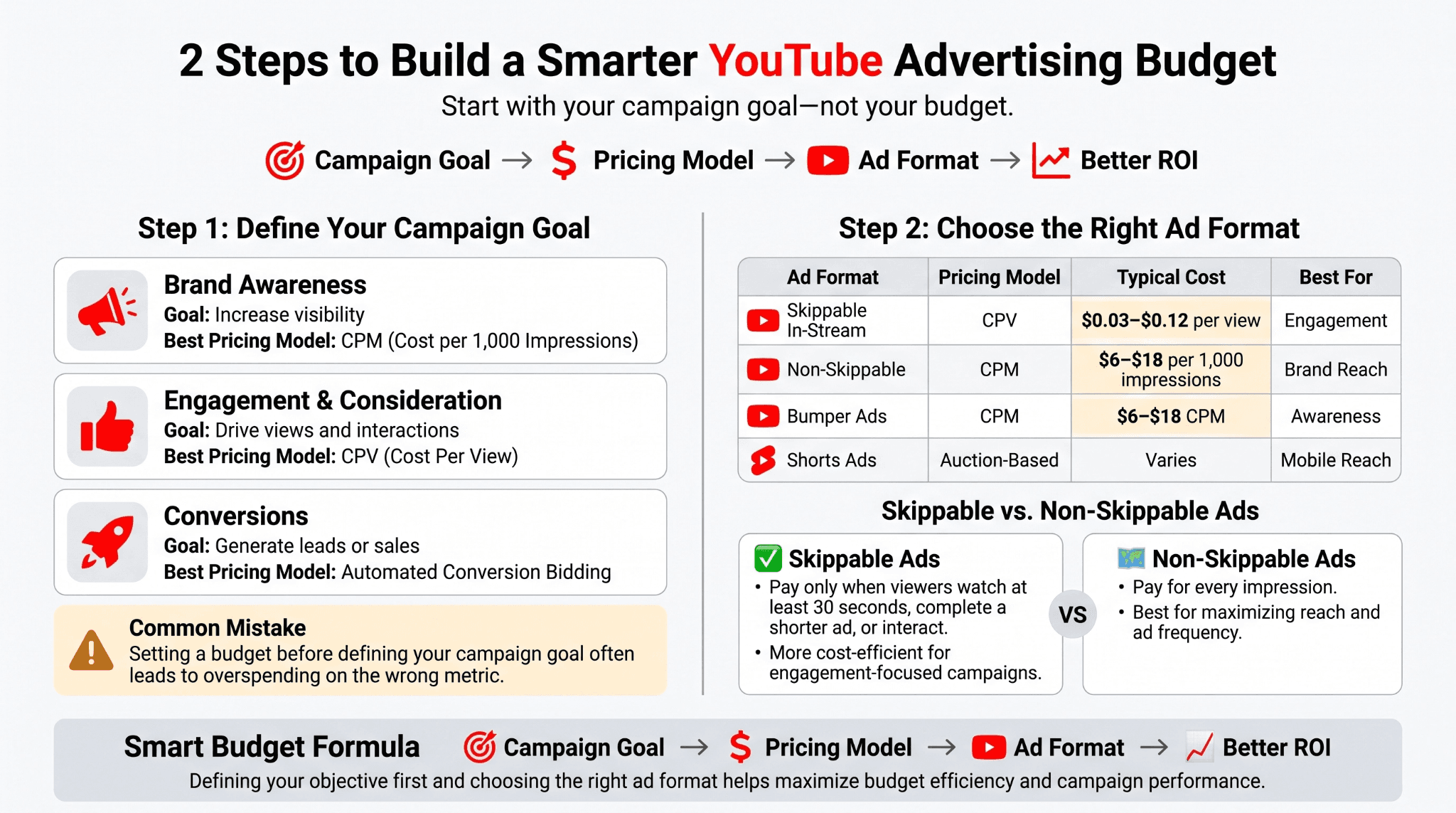
Every YouTube advertising decision should start with a defined outcome, not a dollar figure. Brand awareness, website traffic, and lead generation each pull on different pricing models within the platform.
Matching goal to pricing model looks like this:
-
Brand awareness and reach goals are typically billed on a cost per thousand impressions basis
-
Engagement and consideration goals typically bill on a cost-per-view basis
-
Conversion goals often shift toward automated bidding once enough conversion history exists
A SaaS company running a product awareness campaign will likely optimize around CPM and view completion. A logistics company promoting a limited-time freight offer will lean toward CPV or conversion-focused bidding, since the objective is action, not just exposure.
Businesses that set a budget before defining a goal tend to overspend on the wrong metric, then misread the results.
Step 2: Choose the Right YouTube Ad Format for Your Budget
YouTube offers several ad formats, and each one carries a different pricing structure. Skippable in-stream ads, non-skippable ads, bumper ads, and Shorts ads all draw from the same auction but behave differently once you look at YouTube ad pricing by format.
Skippable in-stream ads typically run between $0.03 and $0.12 per view for standard placements. Non-skippable and bumper formats shift to a CPM model instead, generally ranging from $6 to $18 per 1,000 impressions.
Before comparing skippable and non-skippable pricing directly, it helps to understand why the billing structures differ in the first place.
How Do Skippable and Non-Skippable Ads Differ in Cost?
Skippable ads are billed only when a viewer watches at least 30 seconds, watches the full ad if it is shorter, or interacts with it. This makes them naturally more cost-efficient for engagement-focused campaigns.
Non-skippable ads use a flat CPM model, meaning you pay for the impression regardless of whether the viewer engages. This format suits reach and frequency goals, but it removes the built-in cost efficiency that skippable formats provide.
Step 3: Understand How YouTube CPM Works
YouTube CPM stands for cost per mille, or cost per 1,000 impressions. If a campaign has a $10 CPM, an advertiser pays $10 every time the ad is shown 1,000 times, regardless of whether anyone watches past the first few seconds.
The calculation is straightforward. A $10 CPM with a $1,000 budget delivers approximately 100,000 impressions. This basic math is what turns an abstract YouTube cpm figure into a usable planning number.
CPM is not static across the platform, and the industry has a significant effect on where it lands.
What Is a Good YouTube CPM in 2026?
CPM spreads meaningfully by industry. Lower-competition categories tend to sit toward the bottom of the range, while regulated or high-intent industries like legal and financial services push toward the top, since those advertisers are competing for a smaller pool of high-value viewers.
A reasonable benchmark for most general consumer categories in 2026 sits between $5 and $12. B2B software, insurance, and legal advertisers should expect to land at the higher end of that range.
Two lines of context before the comparison below: pricing models are not interchangeable, and choosing the wrong one for your goal is a common source of wasted spend.
|
Pricing Model |
Typical 2026 Range |
Best Suited For |
|
CPV (skippable in-stream) |
$0.03 to $0.30 per view |
Engagement, consideration, direct response |
|
CPM (non-skippable, bumper) |
$6 to $18 per 1,000 impressions |
Brand awareness, reach, frequency |
|
Shorts CPM |
$2 to $5 per 1,000 impressions |
Low-cost top-of-funnel reach |
Step 4: Set a Realistic Daily or Campaign Budget
Once you know your target CPM or CPV, budgeting becomes a matter of simple math rather than guesswork. Multiply your expected cost per view by your desired view count, or divide your total budget by your target CPM and multiply by 1,000.
For most small and mid-sized businesses, a daily budget between $10 and $50 is typical for an active YouTube advertising campaign, with roughly $2,000 needed to reach around 100,000 views at average rates, based on benchmark data from LocaliQ. Businesses running a structured test rather than a live campaign should plan differently:
-
A monthly minimum of $1,500 to $3,000 generally produces enough data to draw reliable conclusions
-
Daily budgets under $10 rarely exit the platform's learning phase fast enough to produce usable insights
Starting conservatively and scaling based on performance data consistently outperforms committing a large budget before the auction dynamics for your specific audience are understood.
Step 5: Factor In Audience Targeting and Competition
Targeting precision has a direct, measurable effect on YouTube ad costs. A broad audience with minimal demographic or interest filters will generally produce a lower CPM, simply because fewer advertisers are competing for that exact combination of viewers.
Narrow targeting, such as a specific job title, income bracket, or purchase intent signal, increases competition and therefore price. This is not a flaw in the system. It reflects genuine advertiser demand for a smaller, higher-value pool of viewers.
Three targeting factors consistently move the cost the most:
-
Geographic location, since Tier 1 markets like the United States and Australia carry higher CPMs than emerging markets
-
Audience specificity, since narrow interest or in-market segments cost more than broad demographic targeting
-
Seasonal timing, since Q4 and holiday periods reliably push CPM higher due to increased advertiser demand
Businesses operating in competitive verticals should budget for these swings in advance rather than reacting to them mid-campaign.
Step 6: Test With a Small Budget Before Scaling Up
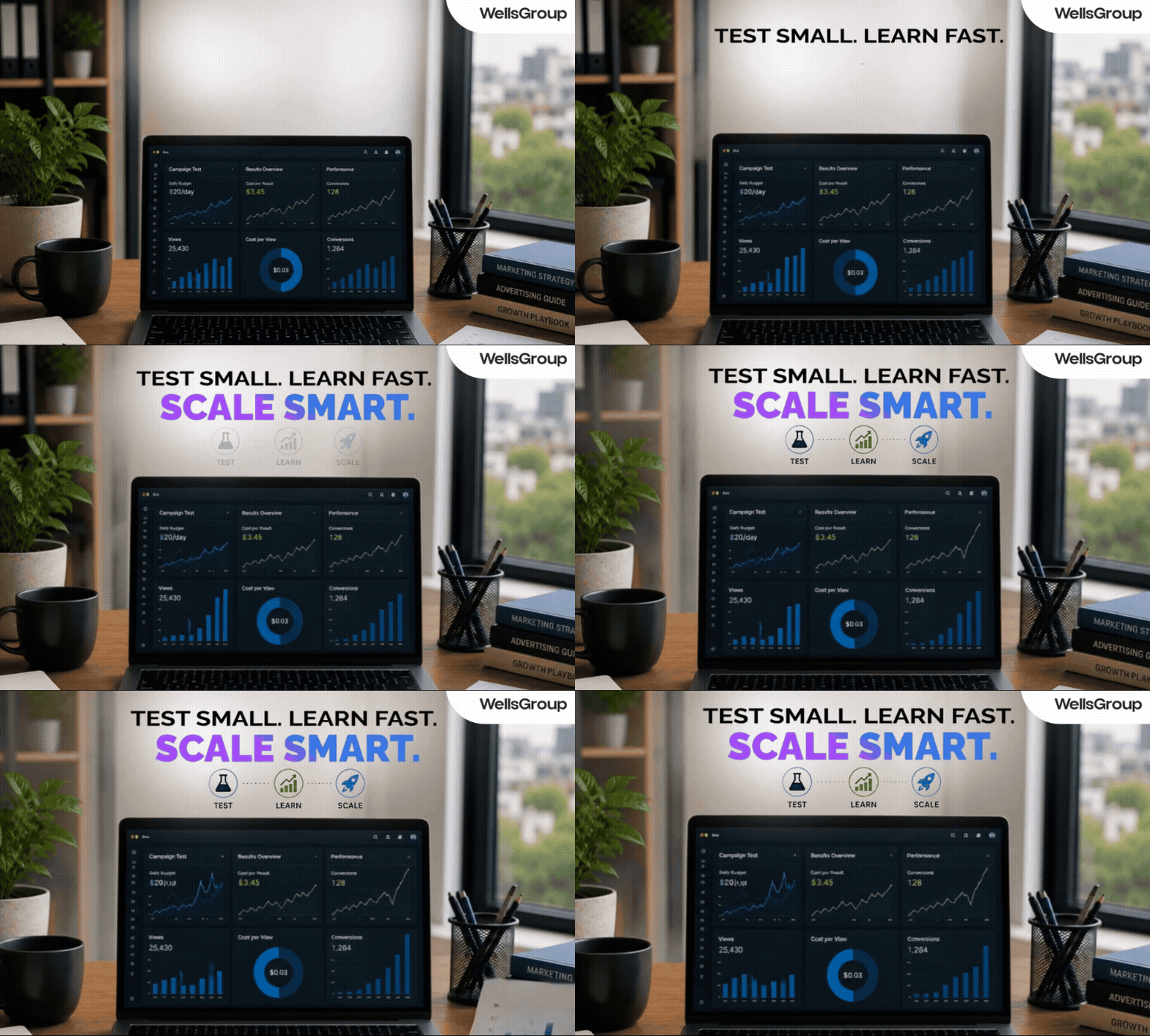
No benchmark, including the ones in this article, can substitute for your own account data. YouTube advertising performance varies by industry, creative quality, and audience overlap in ways that generic averages cannot capture.
Running a smaller test campaign first, typically two to four weeks at a modest daily spend, validates whether your assumed CPM or CPV holds up in practice. It also surfaces creative or targeting issues before they scale into a larger budget.
This step protects against the most expensive mistake in paid media: scaling a campaign before confirming that the underlying assumptions are correct.
How Can Businesses Keep YouTube Advertising Costs Under Control?
Once a campaign is live, YouTube advertising cost is not something you set once and leave alone. It requires consistent monitoring and adjustment to stay efficient.
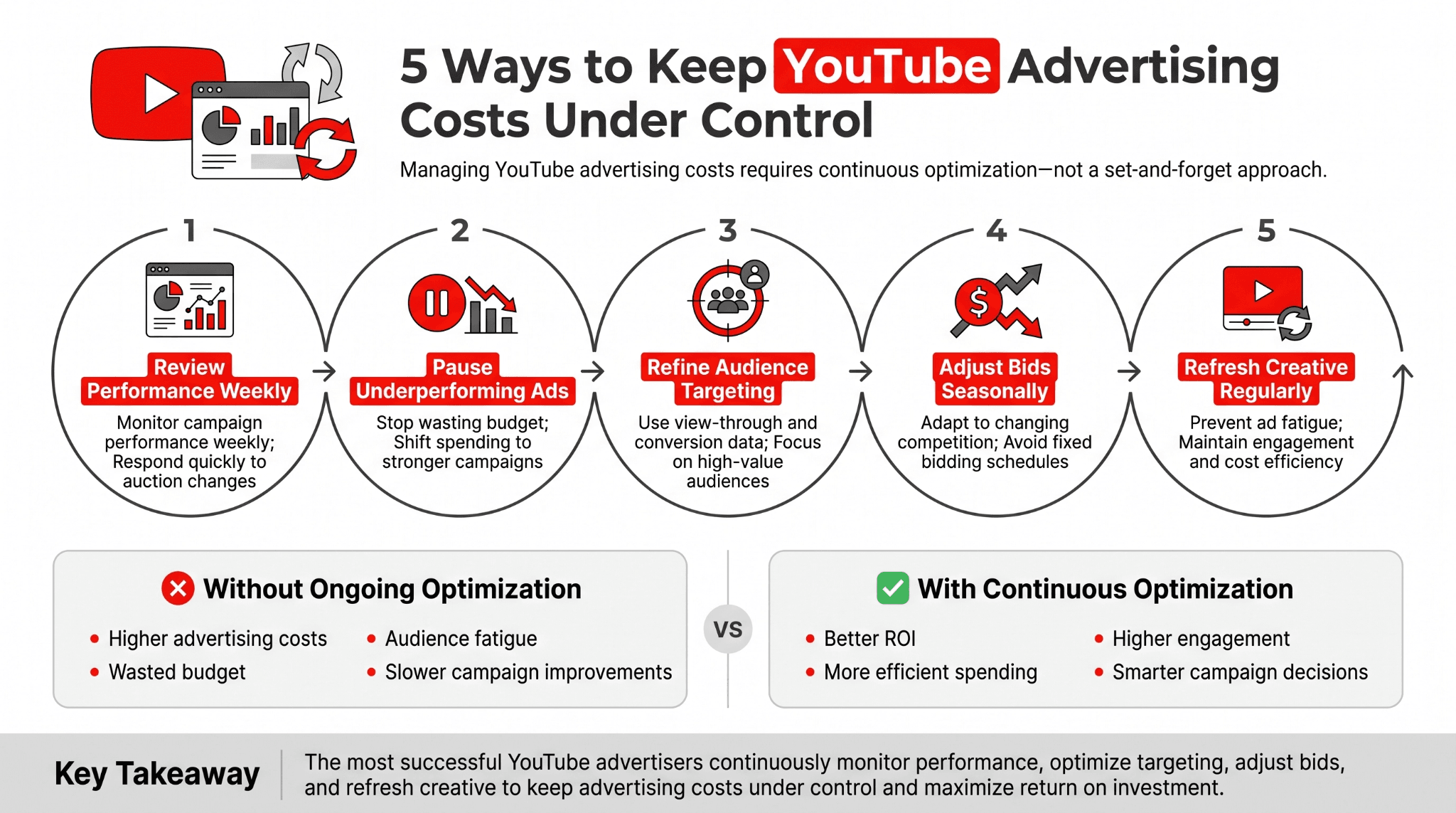
The businesses that manage cost most effectively treat their YouTube account as an operating system, not a set-and-forget campaign:
-
Review performance weekly rather than monthly, since auction dynamics shift quickly
-
Pause underperforming ad groups instead of letting them absorb budget
-
Refine audience targeting based on actual view-through and conversion data
-
Adjust bids in response to seasonal competition rather than fixed schedules
-
Rotate creative regularly, since ad fatigue quietly raises effective cost over time
This is where many businesses without a dedicated operations layer struggle. Managing YouTube spend alongside CRM data, analytics, and broader marketing systems requires infrastructure, not just a login to Google Ads.
What Should You Know Before Your Next YouTube Ad Campaign?
A few practical questions come up consistently when businesses plan a serious YouTube advertising investment.
How much should a small business expect to spend on YouTube ads in 2026?
Most small businesses can start meaningfully with $500 to $1,500 per month and scale from there once performance data is available. A structured system that tracks cost against actual conversions, rather than views alone, tends to get more out of that starting budget than manual campaign management does.
Is YouTube advertising still worth it in 2026?
With ad spend and CTV viewing both continuing to grow on the platform, YouTube remains one of the most measurable video advertising channels available. It works best when the campaign is built on a clear goal and connected to real attribution data, which is exactly where a lot of self-managed accounts fall short.
Does a higher YouTube CPM always mean a worse deal?
Not necessarily. A higher CPM in a high-intent category like legal or financial services often reflects stronger buyer value, not inefficiency. The more useful question is not whether your CPM is high, but whether it is translating into pipeline, and that requires tracking beyond what the YouTube dashboard shows on its own.
How long does it take to see results from YouTube advertising?
Most accounts need two to four weeks of consistent spend to exit the platform's learning phase and produce reliable data. Businesses that pair this testing window with proper conversion tracking and CRM integration typically reach a confident read on performance faster than those relying on view counts alone.
Should YouTube advertising be managed in-house or by a specialized partner?
It depends on whether the business has the internal bandwidth to monitor bids, creative performance, and attribution weekly. Many growing companies find that partnering with a technology operator like WellsGroup, one that manages the media buying alongside the CRM and analytics stack it feeds into, produces more consistent results than running YouTube in isolation.
Making Every Advertising Dollar Work Harder
YouTube advertising cost is not a single number to memorize. It is the output of a system: goal definition, format selection, pricing model, budget structure, targeting precision, and ongoing testing, all working together.
Businesses that treat these six steps as isolated tactics tend to overspend and underperform. Businesses that treat them as a connected operational framework, one that feeds into CRM data, attribution reporting, and broader revenue tracking, consistently get more from the same budget.
That is the distinction between running ads and operating a paid media system. If you are ready to move from estimating YouTube advertising costs to actually managing them as part of a unified growth infrastructure, Book a Free Consultation with WellsGroup's team.